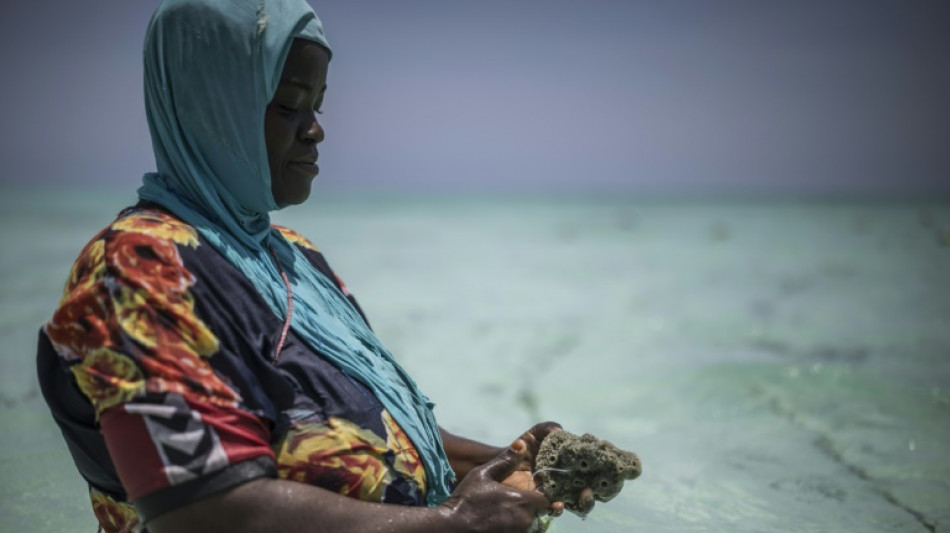
Zanzibar women turn to sponge farming as oceans heat up / Photo: MARCO LONGARI - AFP

 Netanyahu orders West Bank closure as attack wounds Israelis before election

 Asian stocks mixed ahead of weekend as tech recovers early losses

 How five Boeing 777s linked Madagascar's power elite to Iran

 South Korea proposes holding border talks with North

 Ukraine's young figure skaters twizzle on despite Russian threat

 Asian football endorses Infantino re-election as FIFA president

 Complete Kane hopes for 'special night' as Ballon d'Or rumours swirl

 Rooney calls United squad 'selfish babies' after Fernandes criticism

 Teddy Wilson, son of World Cup-winner David, gets Wallabies call-up

 New Zealand military chief resigns over 'inappropriate relationship'

 Man Utd's Carrick on borrowed time, free-scoring Brighton face Liverpool
 Asian stocks head into weekend on a low as tech extends losses

 'Generational rage': Young Europeans fight to be heard

 Lula, Bolsonaro to clash once more before Brazil vote

 Dressed to kill: Haircuts cap menacing look of Japan's yakuza

 Napa Valley's wineries feel Trump's tariff squeeze

 Venezuela protests demand return of Nobel winning leader Machado

 Marquez tops incident-packed opening practice for Australian MotoGP

 New York votes to ban Central Park horse carriages after decades of debate

 What Does a Race-Ready Bike Actually Cost?

 Eylsia Nicolas Hits #1 in the United States as Her Multi‑Category Chart Sweep Extends Across Global All‑Genres and International Markets

 Australia face selection headaches after 'shambolic' South Africa defeat

 Around 150,000 rally in Belgrade as Serbia heads to pivotal poll

 Hamilton sets sights on racing in African grand prix

 Bournemouth hammer 10-man Milan, Juventus denied at the death

Around 10 in the morning each day, women in hijabs and loose long dresses wade through Zanzibar's turquoise shallow tides to tend their sponge farms -- a new lifeline after climate change upended their former work.
Rising ocean temperatures, overfishing, and pollution have steadily degraded marine ecosystems around the island, undermining a key source of income for locals in Jambiani village who long depended on farming seaweed.
Instead, they have turned to sponge cultivation under a project set up by Swiss NGO Marine Cultures.
Hot temperatures have killed seaweed, and declining fish stocks have driven many fishermen to quit, said project manager Ali Mahmudi.
But sponges -- which provide shelter and food for sea creatures -- tend to thrive in warmer waters.
They are also lucrative as an organic personal care product, used for skin exfoliation. Depending on size, they can fetch up to $30 each and a single farm can have as many as 1,500 sponges.
From the shore, black sticks can be seen jutting out of the water, holding lines of sponges.
"I was shocked to learn that sponges exist in the ocean," Nasiri Hassan Haji, 53, told AFP, recalling when she first learned about the practice more than a decade ago.
The mother-of-four once farmed seaweed, describing the work as labour-intensive with meagre returns.
In 2009, Marine Cultures launched a pilot farm with widowed women in Jambiani to test their potential in the archipelago, where more than a quarter of the 1.9 million population live below the poverty line.
With demand for eco-friendly products on the rise, the market has grown steadily, with the US National Oceanic and Atmospheric Administration estimating the value of the natural sponge market at $20 million in 2020.
"It has changed my life, I have been able to build my own house," said 53-year-old Shemsa Abbasi Suleiman, smiling with pride.
Many other women have now joined a cooperative to expand the project, but it was not always smooth sailing.
"At first I was afraid of getting into it because I did not know how to swim. Many discouraged me saying the water is too much and I will die," said Haji.
Thanks to an NGO programme, she learned to swim at the age of 39.
- Sponges restore coral reefs -
As well as making money for locals, sponges are beneficial to the marine environment.
Studies show that a sponge's skeletal structure aids carbon recycling within coral reef ecosystems, while its porous body naturally filters and purifies seawater.
An estimated 60 percent of the world's marine ecosystems have been degraded or are being used unsustainably, according to the United Nations, which warns that the "ocean is in deep crisis".
Sponges are also known to help restore coral reefs, which support 25 percent of marine life and are currently under threat.
"What attracted me to this is the fact that we are not destroying the environment," said Haji.
G.P.Martin--AT