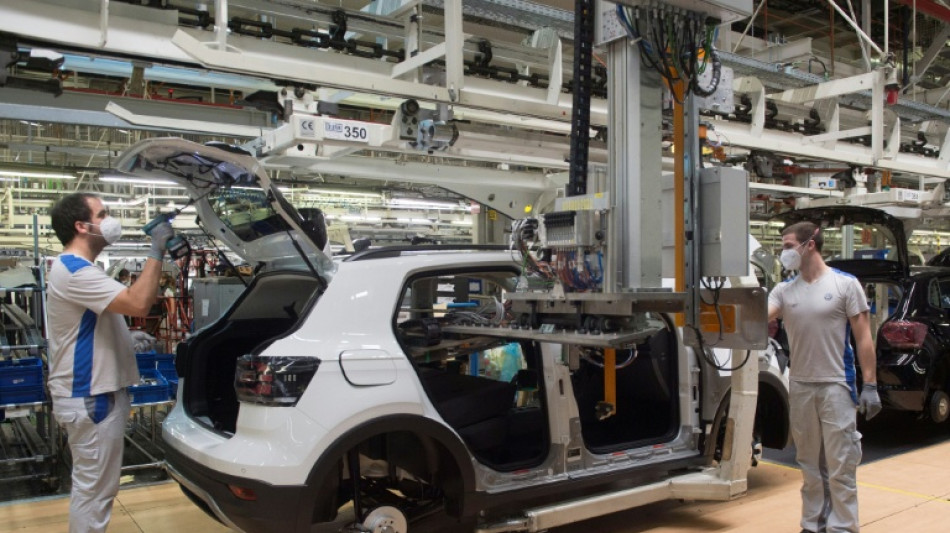
Nexperia, the new crisis looming for Europe's carmakers / Photo: ANDER GILLENEA - AFP

 Oil tops $116 with stocks mixed on earnings, AI

 Trump orders lawsuit to block Alaska Senate result if Republicans lose

 Ebola patient in Nigeria is Swiss, had not visited DR Congo: Bern

 Messi receives top Spanish award from heir to throne

 Macron condemns 'racist terrorist attack' after deadly shooting near Paris

 Shiffrin sidesteps slalom in 'exploration' season

 Bayern Munich coach Kompany in hospital after collapsing: club

 Alonso sees Courtois similarities in Chelsea's Penders

 Melania Trump announces truce in Ukrainian city 'on brink of disaster'

 Saka to be carefully managed after latest injury setback, says Arteta

 Goodell says NFL's France debut 'just the beginning'

 Singapore widens haze probe to local firms linked to Indonesian fires

 Hundreds of Syrians protest repeated Israeli incursions

 El Salvador sends troops to Haiti to find 4 missing soldiers

 Liverpool must go 'full gas' despite injury issues, says Iraola

 Oil hits $115 with stocks mixed on earnings, AI

 Casualties feared as multi-storey building collapses in Nairobi

 Man Utd defeat to Como 'unacceptable', says Carrick

 Hurzeler 'focused' on Brighton job despite Man Utd links

 Hammer blow for Kenya as world marathon champ Jepchirchir suspended for doping

 Latin America's right-wing swing looms large over nature summit

 European, Mideast foreign ministers hold talks in Istanbul
 World marathon champion Peres Jepchirchir suspended for doping: AIU

 Romania blames Russia for new deadly attack on ship
 Waze rejects Malaysia's data security claims after civil servant ban
European automakers already buffeted by US tariffs and a rocky shift toward electric vehicles now face a new threat: a shortage of key semiconductors supplied by Chinese-owned Nexperia.
Beijing is locked in a standoff with Dutch officials who invoked a Cold War-era law in September to effectively take over the company, whose factories are in Europe.
Carmakers as well as parts suppliers have already warned of shortages that would force stoppages at production lines across the Continent.
Who is Nexperia?
The company produces relatively simple technologies such as diodes, voltage regulators and transistors that are nonetheless crucial, as vehicles increasingly rely on electronics.
The chips are mainly found in cars but also in a wide range of industrial components as well as consumer and mobile electronics like refrigerators.
It makes them in Europe before sending them to China for finishing, and are then re-exported back to European clients.
Based in the Netherlands and once part of electronics giant Philips, it was bought by Wingtech Technology of China in 2018.
But in September, the Dutch government took the unusual step of taking over the company, citing its "Goods Availability Law" of 1952 to ensure essential items.
In response, China banned any re-exports of Nexperia chips to Europe, igniting fresh geopolitical tensions.
Why is the automotive sector vulnerable?
Nexperia supplies 49 percent of the electronic components used in the European automotive industry, according to German financial daily Handelsblatt.
The European auto lobby ACEA warned this month that production would be seriously hit.
"Without these chips, European automotive suppliers cannot build the parts and components needed to supply vehicle manufacturers and this therefore threatens production stoppages," the group said.
For Germany alone, analysts at Deutsche Bank forecast a production drop of 10 percent while warning of a 30-percent cut in a "worst-case scenario".
How are automakers responding?
German auto giant Volkswagen has warned that it cannot not rule out "short term" production stoppages, while emphasising that it is searching for alternative suppliers.
Nexperia does not supply it directly but some of its parts suppliers use its chips.
Bosch, for example, says it has not yet reduced employee shifts at its German sites "but we are preparing to do so at our Salzgitter site", a spokesman told AFP.
But French parts maker Valeo said it had "visibility for the coming weeks" with regards to "all its components".
It said it had found alternatives for "95 percent of the volumes" bought each year from Nexperia, but "they haven't yet been approved by our clients".
Other suppliers?
According to OPmobility, another French parts maker, Nexperia's chips, while widely used, are not "unique" in terms of technology and therefore "easily substitutable".
But suppliers have to get the new products approved by automakers, which cannot be done quickly.
"They're looking frantically for other suppliers but these firms cannot build production capacity overnight," said Ferdinand Dudenhoeffer, director of Germany's Center Automotive Research institute.
"In the worst case this situation could go on for 12 to 18 months," he told AFP.
He added however since the disruptions cause by global lockdowns during the Covid-19 pandemic, "we've learned to pay more attention, both among general management and purchasing teams".
In any case, Dudenhoeffer said, "100 percent protection against supply disruptions is impossible -- or in any case prohibitively expensive".
Ch.Campbell--AT