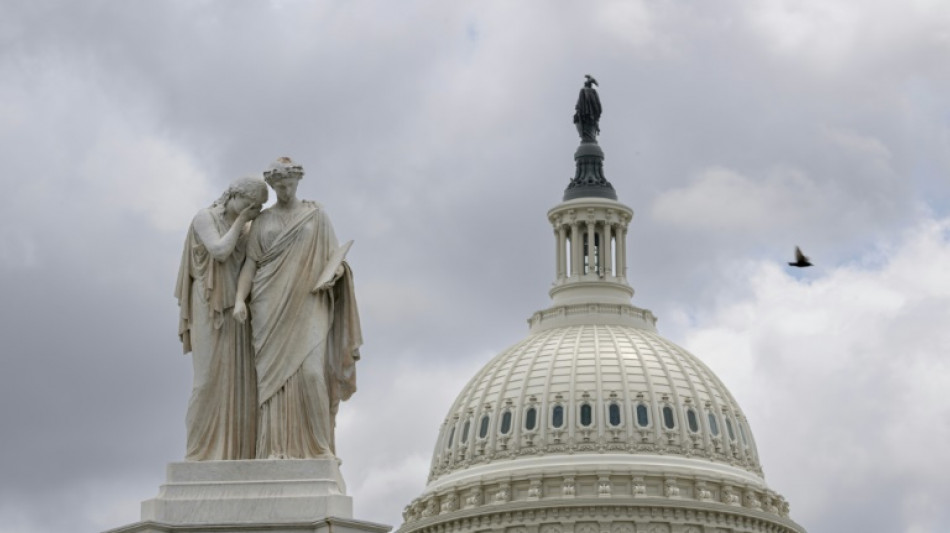
What do some researchers call disinformation? Anything but disinformation / Photo: Mandel NGAN - AFP/File

 Thousands rally for Lula and Bolsonaro on eve of tight Brazil vote

 Red-hot Fuellkrug bags Bremen brace, Leipzig win

 Thousands gather at new Albanian anti-government rally
 French police fire tear gas during fresh protests

 Suspect detained after fire wrecks Hitler's mountain retreat
 Alexander Skarsgard and his viral 'Wicker' transformation
 Thousands protest in Turkey over journalists' arrests, media shutdowns
 Man City beaten by Aston Villa to end perfect Premier League start

 Luis Enrique says PSG unbothered by Lyon match switch
 US gymnast Richard wins floor exercise gold at worlds
 Moltzan upstages Shiffrin to win season-opening World Cup giant slalom
 Infantino says backed by 'vast majority' in bid for re-election

 Police fire tear gas as new French protests kick off

 Police fire tear gas as new French demonstrations kick off

 Tropical Storm Champi nears China after battering Taiwan, Japan

 'Weeks, not days' in Kompany recovery, say Bayern

 Unfair to compare us to Barca: Real Madrid's Mourinho

 North Korea's Kim makes unannounced visit to Chinese border city

 Fire breaks out at Hitler's mountain retreat, suspect arrested
 Marc Marquez wins Australian sprint as Martin crashes out
 North Korea's Kim calls for training world's 'strongest' military

 Brewers edge Rays to capture World Series opener

 France to deploy 70,000 police for fresh weekend protests

 Tatum delivers as Celtics down winless Knicks
 Romantasy fans ready for sleepless night as 'Court of Thorns and Roses' returns

"Disinformation" is fast becoming a dirty word in the United States -- a label so contentious in a hyperpolarized political climate that some researchers who study the harmful effects of falsehoods are abandoning it altogether.
In an era of online deception and information manipulation, the study of disinformation seems more critical than ever, but researchers are battling federal funding cuts, a surge of abuse, and even death threats -- fueled in part by accusations from conservative advocates of a liberal bias.
Some researchers are now opting for more neutral language -- words, and at times, technical jargon that are less likely to inflame or derail vital public discourse about falsehoods flooding the internet.
Earlier this year, the watchdog NewsGuard announced it was retiring the labels "misinformation" and "disinformation" -– terms it said were "politicized beyond recognition and turned into partisan weapons by actors on the right and the left, and among anti-democratic foreign actors."
It renamed its so-called "Misinformation Fingerprints" database to "False Claim Fingerprints," opting for language that it said was "more precise" and "harder to hijack."
"A simple phrase like 'false claim' is more powerful and precise than 'misinformation' and 'disinformation,'" said NewsGuard's McKenzie Sadeghi.
"It names the problem plainly and directs attention to the content itself -- without triggering partisan reflexes or rhetorical spin."
- 'Fractured information ecosystem' -
Terms such as "fake news", "misinformation" and "disinformation" pre-date the internet age, but they have never been more heavily weaponized by governments and vested interests to silence critics and thwart legitimate debate.
Peter Cunliffe-Jones, author of the book "Fake News -- What's the harm," has advocated for using more specific alternatives ranging from false or unproven to mislabelled or fabricated.
Such labels "do not simply declare information false but explain the way in which information is untrue or misleading," he said.
"That way, we hopefully create less room for cynical disputes and more for better understanding."
Authoritarian states including Russia routinely dismiss credible Western media reports as disinformation.
Some governments have even co-opted fact-checking itself -- launching state-sponsored "fact checks" to legitimize their own propaganda and spin.
"In today's fractured information ecosystem, one person's 'misinformation' or 'disinformation' is another's truth," said Sadeghi.
"And in that ambiguity, bad actors win."
- 'Provocative, dangerous' -
The debate comes as major tech platforms pull back key anti-misinformation guardrails -- including scaling down content moderation and reducing their reliance on human fact-checkers, who reject accusations of liberal bias.
However, Emerson Brooking, from the Atlantic Council's Digital Forensic Research Lab (DFRLab), said the problem with abandoning the term disinformation was the lack of a clear replacement to describe the intention to deceive.
"This idea of intentionality is very important," he told AFP.
"If we see thousands of fake accounts posting a false claim in unison, we can reasonably describe it as a disinformation campaign."
The label, however, has become so heavily politicized that officials in US President Donald Trump's administration have equated disinformation research with censorship.
Following Trump's executive order on "ending federal censorship," the National Science Foundation recently cancelled hundreds of grants, including projects that supported disinformation research.
In April, Secretary of State Marco Rubio shut down the State Department's Counter Foreign Information Manipulation and Interference (R/FIMI) hub -- formerly known as the Global Engagement Center (GEC) -- which was responsible for tracking and countering disinformation from foreign actors.
Rubio justified its closure, saying that it was the government's responsibility to "preserve and protect the freedom for Americans to exercise their free speech."
"It's true that the term (disinformation) has been politicized, and that using it can feel provocative -- even dangerous," Brooking said.
"But so long as it has descriptive value, it should still be used. My organization fights authoritarian information manipulation around the world -- if we start censoring our own language, we aren't doing a good job."
T.Perez--AT