Survivors of Bosnia 'rape camps' come forward 30 years on / Photo: ELVIS BARUKCIC - AFP

 Kuwait exhibition presents Ukraine’s Islamic heritage and cultural ties

 Tech firms track Wall St rally on mixed day for Asian markets

 Jay-Z to perform at Super Bowl LXI halftime show: NFL

 Climate-threatened Fijian utopia rejects calls to relocate

 Israel to give verdict on Netanyahu in pivotal election

 $1m bounties, dawn arrests: Trump presses voter fraud campaign

 Gasping for air: Borneo residents struggle as island burns

 Doha exhibition charts a millennium of Chinese maritime ceramics trade
 New Zealand ex-PM Ardern to teach leadership in Sydney

 Ballon d'Or 'beyond wildest dreams' but Kane has plenty more to prove
 No envy, no secrets: How Spain's Gipuzkoa became football coaching hotbed

 South Korea economy grows three times faster than expected in Q3

 Al-Thawadi urges technology to deepen human connection through shared experiences

 Ballon d'Or: Harry Kane's crowning moment

 Harry Kane wins men's Ballon d'Or

 Lula win rattles Brazil markets over spending spree fears

 De la Fuente wins men's Ballon d'Or coach of year

 Trump slams 'rigged' Brazil election after ally loses to leftist Lula

 Nadal returns for Vegas hardcourt event

 Fainga'anuku named as loose forward for All Blacks northern tour

 Anthropic points to AI dangers, soaring sales in IPO filing

 Sinner to play rescheduled Saudi Six Kings in December
 Brazilian lawmaker Andre Janones, Lula's social media 'general'

 Swiss Ebola patient repatriated from Nigeria

 Nations far from a deal as UN nature talks enter final stretch
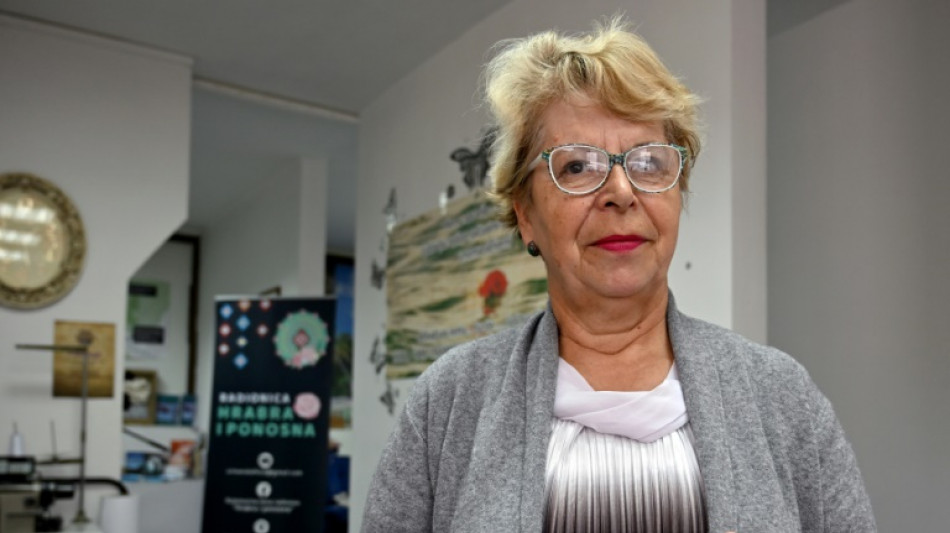
It took years for Zehra Murguz to be able to testify about what happened to her and other Muslim women in the "rape camps" run by Serb forces during the war in Bosnia.
One of the awful memories that drove her to give evidence was of seeing a girl of 12 "with a doll in her arms" dragged into one of them.
Murguz felt she was also speaking "in the name of all the others, of that girl of 12 who will never talk... who was never found".
The horror began for her in the summer of 1992 when Serb forces took the mountain town of Foca and Murguz was taken to the Partizan gym, one of several notorious rape camps the Serbs ran.
For months dozens of Muslim women and girls were gang raped and forced into sexual slavery there. Others were sold or killed.
At least 20,000 people suffered sexual violence across Bosnia as Yugoslavia collapsed into the worst war Europe had then seen since 1945.
Most victims were Bosnian Muslims, but Serbs and Croat women also suffered.
In 2001 the International Criminal Tribunal for the former Yugoslavia became the first court in Europe to recognise rape as a crime against humanity in an historic verdict against three Bosnian Serb army officers from Foca.
While a handful of survivors driven by a thirst for justice continue to collect thousands of testimonies, many remain locked in silence more than three decades on.
- Triple murder and rape -
Murguz, 61, began her judicial journey when she returned to Bosnia in 2011 -- after years living in exile in Montenegro, Serbia and Croatia -- to bring her neighbour to book for raping her during the war.
"If I don't speak, it will be as if the crime never happened," she told herself. He was still living in Foca and "wasn't hiding", she said.
He was arrested and tried in the local court in 2012.
Going there was "like going back to 1992", to the "agony" of that time, Murguz recalled. "I came face to face with him, we looked each other in the eye, and justice won out," she said.
The man was jailed for 14 years, a "light sentence", said Murguz "for the murder of three people and a rape".
But the conviction at last "stamped him with his true identity -- war criminal", she told AFP from a sewing workshop in Sarajevo run by the Victims of the War Foca 1992-1995 group.
Around her other survivors wove fabric together, a form of collective therapy.
"To this day, only 18 verdicts have been delivered for crimes of sexual violence committed in Foca," said the group's president, Midheta Kaloper, 52.
"Three trials are ongoing. A lot of time has passed, and witnesses are exhausted."
She herself was a victim of "an unspeakable, inexplicable crime" in Gorazde, the "worst torture a girl can endure", she said.
She still hopes the suspect will be tried in Bosnia, not in Serbia where he now lives.
But Kaloper warned that things have "stagnated" over the last five years, with 258 cases involving 2,046 suspects still needing to be judged, according to figures from the High Council of Magistrates.
Bosnian judges had tried 773 war crime cases by the end of last year -- over a quarter involving sexual violence -- according to the OSCE monitoring mission.
It said there had been "significant delays" in hundreds of others where the suspects have yet to be identified.
"What kills us most is the excessive length of these proceedings," said Kaloper.
- 'Timebomb' -
"We have been fighting for 30 years, and our only real success has been obtaining the law on civilian war victims," under which survivors can be given a pension worth about $400 a month, she said.
However, the law only covers the Muslim-Croat half of Bosnia and those living there, and not those living in the self-governing Serb Republika Srpska (RS) and the small mixed Brcko District in the northeast, which have different judicial systems.
Around 1,000 survivors have obtained war victim status in the Muslim-Croat federation and some 100 more in the RS and Brcko, said Ajna Mahmic, of the Swiss legal NGO Trial International.
Rape, she said, still carries a particular stigma. "Unfortunately, as a society we still put the blame and shame on the victims rather than the perpetrators.
"Many of the survivors do not feel secure," Mahmic told AFP. "Some of the perpetrators are still living freely and some are working in public institutions," some in positions of authority.
Not to mention the continued glorification "of war criminals (in the Balkans) and the minimisation of the suffering we have endured", Kaloper added.
Nearly half of ongoing cases are held up because the accused are abroad, an OSCE report said in January.
Another "worrying trend is the widespread failure of courts to grant victims compensation" in criminal cases, the OSCE added.
While witnesses could testify anonymously in The Hague, there is nothing to protect their identity in civil compensation proceedings in Bosnia.
"Even today it is very difficult for victims to speak," said Bakira Hasecic, 71, head of the Women Victims of War group, and they keep the "weight of this tragedy in their hearts".
Many follow what their former torturers are up to on social networks.
It is an emotional "timebomb that can explode at any moment and drives some to call us", she said.
Though over 30 years have passed, 15 more victims stepped forward needing to talk in the last few months alone, Hasecic said.
P.Smith--AT