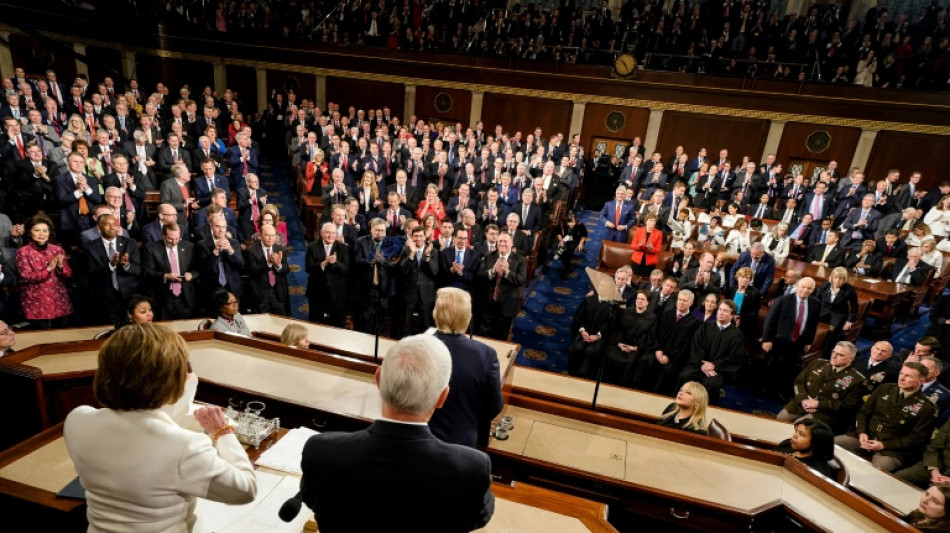
Trump's next 100 days: Now comes the hard part / Photo: Doug Mills - POOL/AFP/File

 Mona Lisa scrubbed from Syrian textbooks as critics slam conservative drift
 Bolsonaro flees Brazil for US after election defeat: AFP
 Brazil's Bolsonaros: between power, prison, and exile

 Israel president urges against new vote despite inconclusive result

 Eala recovers to move into Tokyo quarter-finals

 COPs 'bunch of baloney' says Panama as it vies to host nature summit

 Denmark mulls banning turbo chickens

 Nintendo producer 'all nervous' as Zelda classic remake hits shelves

 Israeli Arab parties hold key as Netanyahu falls short of majority

 UK comedian Brand tells rape trial 'consent is fundamental'

 Shadman guides Bangladesh to 213-3 in West Indies Test

 Tech optimism lifts stocks ahead of Fed update on rates
 No penalty practice for Fleetwood hero Haughey before he downs Arsenal
 Billionaire Ambani's Jio soars in market debut after India's biggest IPO

 Cross-border abductions threaten Kenya's status as dissident refuge

 'Eat the rich': Indonesians protest against graft, wildfires

 Netanyahu bloc leads as Israeli votes counted, but no majority

 Cyclone eases after lashing India coast, no deaths reported
 AI chip giant SK hynix posts seven-fold surge in quarterly operating profit

 Two hundred 'Cruise for life' passengers stranded in Cambodia

 Pierce Brosnan and Helen Mirren on the joys of filming 'MobLand'

 S.African activists push back on data centre rush

 Judges set to rule on Australian mushroom killer's appeal

 Syria reopens Jordan border crossing after mending ties
 Cyclone Arnab lashes India coast, no deaths reported
President Donald Trump spent his first 100 days issuing a blitz of executive orders to deliver rapidly on campaign pledges, drastically downsize the government and reshape America's role on the global stage.
But the job gets trickier now for the self-styled dealmaker-in-chief, who must corral fractious Republicans on Capitol Hill to anchor his domestic policies in legislation that can cement a lasting legacy.
"Trump's first 100 days were remarkable for their pace and impact. Now comes the hard part," Stephen Dover, chief market strategist and head of the Franklin Templeton Institute, said in a memo to investors.
"The next 100 days will shift the focus to the challenges of passing legislation while simultaneously addressing deficit reduction. Congress must act, which requires building legislative coalitions."
In a dizzying first three months, Trump wielded executive power like no other modern president, signing more than 140 orders on immigration, culture war issues and slashing the federal bureaucracy.
But the unilateral authority of the Oval Office has its limits and much of the reform Trump wants to enact -- particularly anything involving spending public money -- requires laws to be passed by Congress.
Trump's political capital will be put to the test as he aims to shepherd his sprawling agenda on tax, border security and energy production through the House and Senate.
Complicating Trump's task is his receding popularity, with the polls flashing warning signs amid economic uncertainty and misgivings over his handling of immigration and international trade.
- Brinkmanship -
Executive orders signed without the involvement of Congress can be undone by any president.
They are also vulnerable to legal and constitutional challenges, as Trump has discovered in dozens of rulings that blocked his policies early in his presidency.
A more lasting impact, say analysts, will require the kind of political brinkmanship and consensus-building that haven't been necessary so far.
The author of "The Art of the Deal" doesn't have a great record of getting contentious legislation through his divided party.
In his 2017-21 term, he passed the Abraham Accords, fostering peace between Israel and several of its neighbors, and celebrated a trade deal with Canada that has since been obliterated by his tariffs.
But he failed to repeal the Affordable Care Act, or Obamacare -- a key priority -- and, despite much fanfare over summits in Singapore and Hanoi, was unable to ink any kind of deal with North Korea's Kim Jong Un.
When it comes to uniting around a common cause, his lawmakers in Congress haven't fared much better, getting just five bills into law in Trump's first 100 days, the lowest number in generations.
Republicans set a deadline of July 4 to pass the president's agenda -- led by an extension of his 2017 tax cuts and fulfilling a campaign pledge to eliminate levies on tips, overtime and Social Security payments.
- 'A lot trickier' -
The slim Republican majorities in both chambers will require almost perfect unity.
But conservatives won't back the tax cuts -- which have an estimated price tag of around $5 trillion over 10 years -- without deep reductions in spending.
Moderates with tough reelection fights in next year's midterms say they won't support the likely evisceration of the Medicaid health insurance program for low-income families that this would entail.
Political consultant and former Senate aide Andrew Koneschusky, a key player in negotiations over the 2017 tax cuts, expects Trump's next 100 days to be "a lot trickier."
"When it comes to tax bills, the ultimate adult in the room is math. You can't break the laws of mathematics, no matter how much politicians might want to," he told AFP.
"It's going to be extremely tricky for the numbers to add up in a way that satisfies everyone in the Republican caucus."
Meanwhile Trump is up against the clock.
The battle for the House majority in 2026 will likely come down to a few swing districts and the president could easily see his ability to shepherd legislation through Congress curtailed.
Trump is relying on an arcane Senate procedure called "reconciliation" that means, given certain conditions are satisfied, he won't need Democratic support to pass his priorities -- which is just as well.
House Minority Leader Hakeem Jeffries has called Trump's agenda "unconscionable" and "un-American," vowing to do everything Democrats can to "bury it in the ground, never to rise again."
T.Sanchez--AT