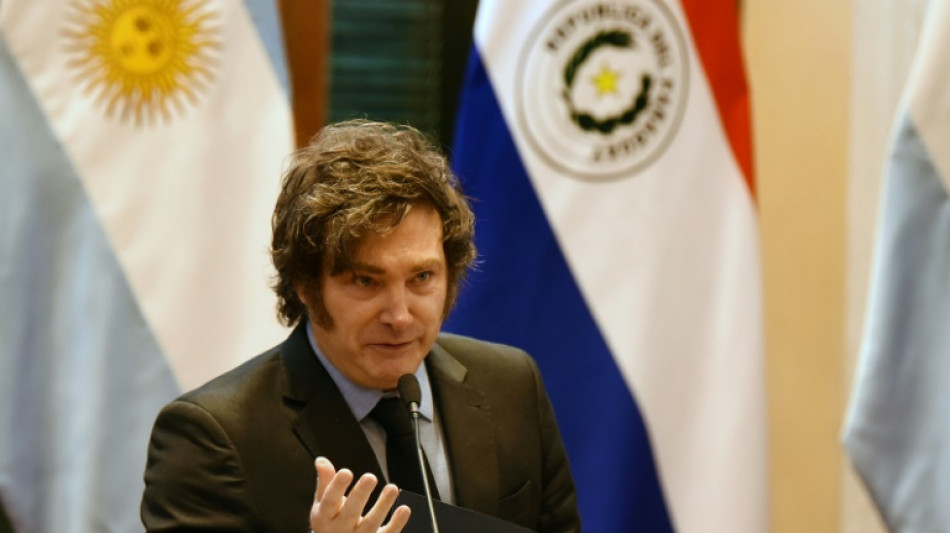
Argentina receives $42 bn from international financial institutions / Photo: DANIEL DUARTE - AFP/File

 Injured Australian swim star O'Callaghan pulls out of PanPacs
 California lifeguards wiped out from extreme weather
 FIFA scraps private investment plan after backlash: Infantino
 South Africa's WAFCON hopes hang in the balance after dramatic draw

 Hunter Bell cruises to Commonwealth gold, Pathirage stuns javelin stars

 Amazon surges as US stocks shrug off bond yield worries

 Google rolls back new satellite image AI tool after backlash

 Ryu leads in bid for third straight major at women's British Open

 Fire-hit France region 'coming up for air' as main blaze calms
 Wembanyama to get signature shoe in Nike contract extension: reports
 Oil giants report blowout profits on war, warn high gas prices could persist
 Google launches new satellite image AI tool, alarming researchers

 Eddie Howe resigns as Newcastle boss to 'recharge'
 High winds hamper firefighting efforts in western Turkey

 Howe resigns as Newcastle boss

 Full-scale tour will benefit All Blacks, says coach Rennie

 US Fed dissenters call for rate hikes over sustained inflation
 Trump and far-right seize on Spanish migration crisis

 Hamas agrees to disarm under Trump plan
 French, Italian winegrowers face earliest ever harvest

 Alarm over climate-linked low level of German waterways

 UK court rejects challenge against new Chinese embassy in London

 New York sues online prediction markets giant Kalshi

 Commerzbank agrees to talks with UniCredit after two-year standoff
 A rumour, a rush: chaos at Morocco border with Spain's Ceuta
Three international financial institutions announced $42 billion in fresh support for financially troubled Argentina on Friday, as its president said his country's economy will grow "like never before."
The IMF approved a new four-year $20 billion bailout for the South American nation as the World Bank said it would pump $12 billion into the economy and the Inter-American Development Bank (IDB) announced plans for a $10 billion deal.
Some of the cash is expected to flow as soon as next week to help skint Argentina defend its wobbling peso currency, in a political boon for libertarian President Javier Milei's aggressive efforts to revive the nation's fortunes.
"Argentina will be the country with the strongest economic growth for the coming 30 years," the self-styled "anarcho-capitalist" leader said in a TV address, adding that the economy will grow "like never before."
Finance Minister Luis Caputo had earlier said that "within 60 days" Buenos Aires expects to receive $19 billion from the IMF, World Bank and other sources including the IDB.
That figure will include an "immediate" first tranche of $12 billion from the IMF, the institution's board said in a statement.
The program is "a vote of confidence in the Government's determination to advance reforms, foster growth & deliver higher standards of living for the Argentine people," IMF boss Kristalina Georgieva posted on X, hailing Milei's "impressive progress in stabilizing the economy."
For its part, the World Bank said $1.5 billion would be released to Argentina immediately.
- Under-pressure peso -
It is the 23rd time the IMF has bailed out Argentina since it became a member of the Washington-based institution in 1956.
Caputo had earlier said that the IMF money would allow the "recapitalization of the Central Bank... and continue the disinflation process."
It would also, starting Monday, "allow us to end the exchange controls that have done so much harm" to Argentines, and "affected the normal functioning of the economy," said the minister.
In place of exchange controls in place since 2019, the peso will be allowed to float within a band of between 1,000 and 1,400 pesos to the dollar, the Central Bank added in a statement.
On Friday, the peso traded at 1,097 to the dollar at the official rate, and at 1,375 at the unofficial "blue" rate.
The Central Bank said the $200-per-month limit on Argentine citizens accessing greenbacks will also be lifted.
Under the deal, the differential exchange rate for exporters will be eliminated, while "the distribution of profits to foreign shareholders is allowed starting from the financial years beginning in 2025, and the deadlines for the payment of foreign trade operations are relaxed," it added.
- Inflation down -
"Milei needs this deal like he needs air," said Belen Amadeo, a political scientist at the University of Buenos Aires.
"He needs it to back up his economic offer, give himself more room to maneuver, because if instability sets in and inflation rises, insecurity will reach the population and they will flee immediately to the dollar."
Argentina, Latin America's third-biggest economy with a record of economic crises, hyperinflation and defaults, already owes the IMF $44 billion under a 2018 loan agreement -- the lender's biggest ever -- on which it has since renegotiated the repayment terms.
Milei, the country's budget-slashing president in office since December 2023, has sought a new loan to cancel Treasury debt to the Central Bank, wipe out stubborn inflation, boost growth and replenish foreign reserves.
The prospect of another IMF loan has caused a run on the peso, prompted by fears -- which Milei has rebuffed -- that a new deal could entail a currency devaluation.
The IMF has expressed approval of Milei's attempts to curb inflation, which came in higher at 3.7 percent for the month of March compared to 2.4 percent in February.
Annual inflation came in at 55.9 percent in March -- down from 211 percent at the end of 2023, but still one of the highest rates in the world.
Milei has fired tens of thousands of public sector workers, halved the number of government ministries and vetoed inflation-aligned pension increases to curb public spending.
Last year, Argentina recorded its first budget surplus in a decade, but the collateral damage has been a loss of purchasing power, jobs and consumer spending.
US Treasury Secretary Scott Bessent is due next week to visit Argentina and "affirm the United States' full support for Argentina's bold economic reforms," a statement from his office said.
burs-tgb/bfm
O.Brown--AT