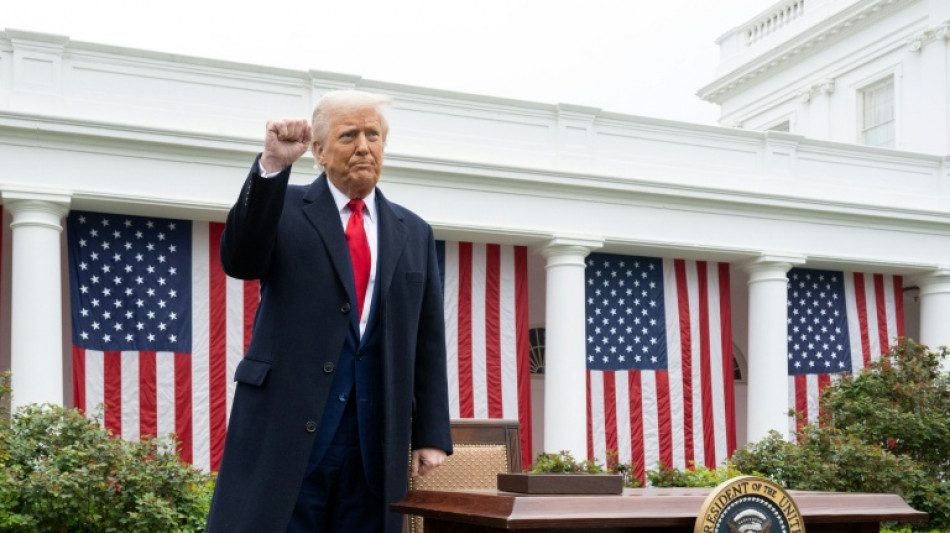
America's passion for tariffs rarely pays off, economists warn / Photo: SAUL LOEB - AFP

 FIFA scraps private investment plan after backlash: Infantino

 South Africa's WAFCON hopes hang in the balance after dramatic draw

 Hunter Bell cruises to Commonwealth gold, Pathirage stuns javelin stars

 Amazon surges as US stocks shrug off bond yield worries

 Google rolls back new satellite image AI tool after backlash

 Ryu leads in bid for third straight major at women's British Open

 Fire-hit France region 'coming up for air' as main blaze calms

 Wembanyama to get signature shoe in Nike contract extension: reports
 Oil giants report blowout profits on war, warn high gas prices could persist

 Google launches new satellite image AI tool, alarming researchers

 Eddie Howe resigns as Newcastle boss to 'recharge'

 High winds hamper firefighting efforts in western Turkey

 Howe resigns as Newcastle boss

 Full-scale tour will benefit All Blacks, says coach Rennie

 US Fed dissenters call for rate hikes over sustained inflation

 Trump and far-right seize on Spanish migration crisis

 Hamas agrees to disarm under Trump plan

 French, Italian winegrowers face earliest ever harvest

 Alarm over climate-linked low level of German waterways

 UK court rejects challenge against new Chinese embassy in London

 New York sues online prediction markets giant Kalshi

 Commerzbank agrees to talks with UniCredit after two-year standoff

 A rumour, a rush: chaos at Morocco border with Spain's Ceuta

 Fornaro Legal Releases Guidance to Help Businesses Maintain Clear Ownership Records During Growth

 Hamas agrees to disarm: what are the challenges ahead?
Long before Donald Trump's "Liberation Day" announcement, the United States had toyed with imposing high tariffs throughout its history, with inconclusive -- and sometimes catastrophic -- results.
"We have a 20th century president in a 21st century economy who wants to take us back to the 19th century," Dartmouth College economics professor Douglas Irwin posted on X.
The 19th century marked the golden age of tariffs in the United States, with an average rate regularly flirting with 50 percent.
The century extended a doctrine adopted since the country's founding, which advocated for the protection of the American economy as it underwent a period of industrialization.
"Careful studies of that period suggest that the tariffs did help protect domestic development of industry to some degree," said Keith Maskus, a professor at the University of Colorado.
"But the two more important factors were access to international labor, and capital... which was flowing in the United States during that period," he added.
Christopher Meissner, a professor at the University of California, Davis, told AFP that in addition to these factors, "the reason we had a thriving industrial sector in the United States was we had great access to natural resources."
These resources included coal, oil, iron ore, copper and timber -- all of which were crucial to industry.
"The industrial sector wouldn't have been much smaller if we had much lower tariffs," Meissner added.
Shortly after taking office in January, Trump said: "We were at our richest from 1870 to 1913."
The 78-year-old Republican often references former US president William McKinley, who was behind one of the country's most restrictive tariff laws, which passed in 1890.
These tariffs did not prevent imports from continuing to grow in the years that followed, although once customs duties were lowered in 1894, the amount of goods the US purchased abroad remained below previous peaks.
- Great Depression -
In 1929, Harvard professor George Roorbach wrote: "Since the end of the Civil War (1865), during which the United States has been under a protective system almost, if not quite, without interruption, our import trade has enormously expanded."
"Fluctuations that have occurred seem to be related chiefly to factors other than the ups and downs of tariff rates," he added.
A year later, the young nation tightened the screws with tariffs again, this time under Republican president Herbert Hoover.
The Smoot-Hawley Tariff Act of 1930 is best remembered "for triggering a global trade war and deepening the Great Depression," according to the Center for Strategic and International Studies.
"What generated the depression... was a lot of complicated factors, but the tariff increase is one of them," said Maskus from the University of Colorado.
The end of the Second World War marked the start of a new era in trade, defined by the ratification in 1947 by 23 countries -- including the United States -- of the GATT free trade agreement.
The agreement created the conditions for the development of international trade by imposing more moderate customs duties.
The momentum was maintained by the North American Free Trade Agreement (NAFTA) between the United States, Mexico and Canada, which took effect in 1994.
Alongside NAFTA, free trade in the United States was further expanded by the creation of the World Trade Organization in 1995, and a 2004 free trade agreement between the United States and several Central American countries.
During his first term in office, Donald Trump reopened the tariff ledger and decided on new measures against China, many of which were maintained under his successor, Joe Biden.
But despite these levies, the US trade deficit with China continued to grow until 2022, when China was hit by a brutal economic slowdown unrelated to the tariffs.
For Keith Maskus, the tariffs on Beijing did not do much to prevent the growth of imports from China.
E.Flores--AT