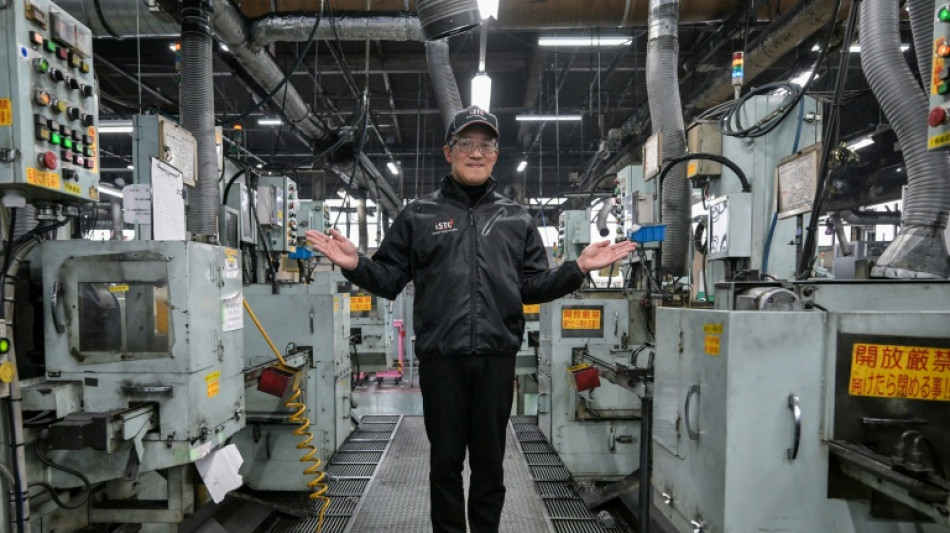
'Give me a break': Trump tariffs threaten Japan auto sector / Photo: Richard A. Brooks - AFP

 Hunter Bell cruises to Commonwealth gold, Pathirage stuns javelin stars

 Amazon surges as US stocks shrug off bond yield worries

 Google rolls back new satellite image AI tool after backlash

 Ryu leads in bid for third straight major at women's British Open

 Fire-hit France region 'coming up for air' as main blaze calms
 Wembanyama to get signature shoe in Nike contract extension: reports
 Oil giants report blowout profits on war, warn high gas prices could persist
 Google launches new satellite image AI tool, alarming researchers

 Eddie Howe resigns as Newcastle boss to 'recharge'
 High winds hamper firefighting efforts in western Turkey

 Howe resigns as Newcastle boss

 Full-scale tour will benefit All Blacks, says coach Rennie

 US Fed dissenters call for rate hikes over sustained inflation

 Trump and far-right seize on Spanish migration crisis

 Hamas agrees to disarm under Trump plan

 French, Italian winegrowers face earliest ever harvest

 Alarm over climate-linked low level of German waterways

 UK court rejects challenge against new Chinese embassy in London

 New York sues online prediction markets giant Kalshi

 Commerzbank agrees to talks with UniCredit after two-year standoff

 A rumour, a rush: chaos at Morocco border with Spain's Ceuta
 Fornaro Legal Releases Guidance to Help Businesses Maintain Clear Ownership Records During Growth

 Hamas agrees to disarm: what are the challenges ahead?
 Turkey fights to last major blaze inland from Bodrum
 Japan probe made closest-ever asteroid flyby: space agency

Business was already tough for auto parts maker Asahi Tekko, but with US car tariffs due to bite this week its president has a simple message for Donald Trump: "Give me a break."
The 425 workers at the company are some of the 5.6 million Japanese people employed directly or indirectly in the auto sector who are now fearful about their future.
"There is no point in learning about this only two or three months in advance," company president Tetsuya Kimura said at Asahi Tekko's factory in Hekinan in central Japan.
"Frankly speaking, I want to say: ‘Give me a break’," Kimura, a former engineer at Toyota, his current firm's main customer, told AFP.
At the plant, where the noise of clanging metal fills the air, robotic arms and machine tools busily produce precision brake, engine and transmission components.
The factory is in the Aichi region, Japan's industrial heartland where Toyota, the world's biggest automaker by sales, has its global headquarters.
Autos have for decades been one of Japan's biggest success stories.
Last year vehicles accounted for around 28 percent of the country's 21.3 trillion yen ($142 billion) of US-bound exports, and roughly eight percent of all Japanese jobs are tied to the sector.
- Ripple effect -
But rising costs, tougher emission rules, a global shift toward electric vehicles and a shrinking and ageing Japanese population have pressured the industry for years.
Honda and Nissan recently abandoned efforts to merge.
The US president last week announced he would impose 25 percent duties on imports of all vehicles into the country from April 3 -- hours after he is due to unveil sweeping measures against trading partners for what he says are years of being "ripped off".
For Japan, this is despite talks in February between Trump and Prime Minister Shigeru Ishiba that saw a joint statement hailing a "new golden age for US-Japan relations".
Japanese companies are also the biggest investors into the United States. Trump's policies, Ishiba said last week, are "difficult to understand".
To compensate for the tariffs, firms such as Toyota, Honda and Nissan will likely hike prices for US consumers, potentially hitting demand for their vehicles -- and by extension for parts.
That may come on top of a possible global slowdown, triggered by unpredictable US policies.
The tariff "will hit auto production hard, undermine confidence, and reduce orders", Moody's Analytics said in a report about Japan's business sentiment.
"Given the long and complex supply chains in car manufacturing, the impact will ripple through the economy," it said.
And Natixis economist Kohei Iwahara told AFP: "Some of the bigger companies could actually transfer their production overseas, and that would have consequences on the smaller auto part companies."
- Added uncertainty -
The rapid global shift toward electric vehicles has already been forcing some Japanese parts makers to explore opportunities outside of the sector, said Takeshi Sasaki, president of Hokuriku Light Metal Industry.
Hokuriku, based in the Saitama region near Tokyo, makes specialised parts for vehicles under research and development for brands including Honda and Suzuki.
But it is now looking to develop parts for industrial robots in order to ensure its future, he told AFP.
"EVs require fewer parts than internal combustion engine vehicles," Sasaki said.
"Now we have this tariff. This adds uncertainty on top of the uncertainty that we already had. Forex is a risk. The US economic outlook is at risk." he said.
Kimura's firm is also trying to grow a new business that offers tools and know-how to improve efficiency while reducing emissions.
"I am afraid there will be many suppliers that will suffer and go into the red if vehicle production volumes were to fall.
"So I think each of the suppliers will have to work very hard to survive," Kimura said.
"I never expected (Trump) to go this far.
"Now that this is happening, we just have to move forward and work as we must."
Y.Baker--AT