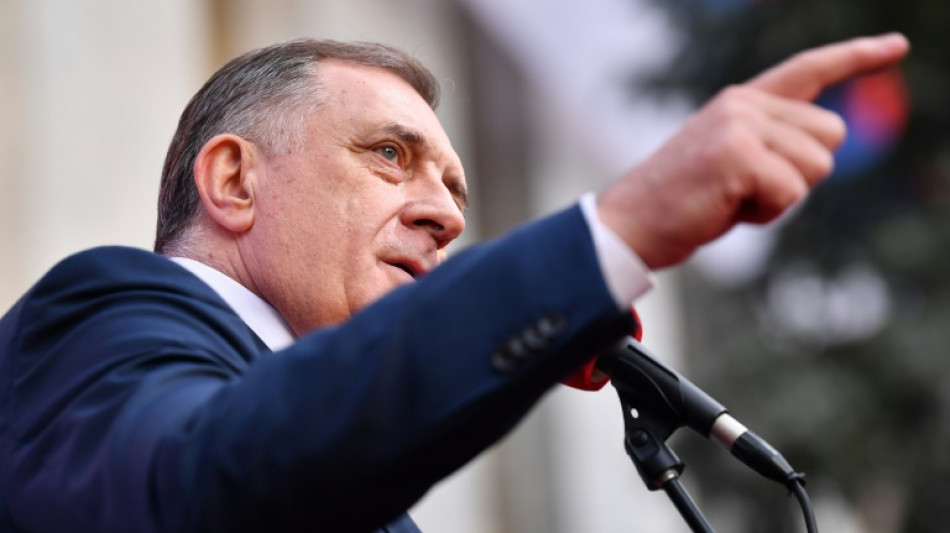
The battle to control assets behind Bosnia crisis / Photo: ELVIS BARUKCIC - AFP

 Amazon surges as US stocks shrug off bond yield worries

 Google rolls back new satellite image AI tool after backlash

 Ryu leads in bid for third straight major at women's British Open

 Fire-hit France region 'coming up for air' as main blaze calms
 Wembanyama to get signature shoe in Nike contract extension: reports
 Oil giants report blowout profits on war, warn high gas prices could persist
 Google launches new satellite image AI tool, alarming researchers

 Eddie Howe resigns as Newcastle boss to 'recharge'

 High winds hamper firefighting efforts in western Turkey

 Howe resigns as Newcastle boss
 Full-scale tour will benefit All Blacks, says coach Rennie

 US Fed dissenters call for rate hikes over sustained inflation
 Trump and far-right seize on Spanish migration crisis

 Hamas agrees to disarm under Trump plan
 French, Italian winegrowers face earliest ever harvest

 Alarm over climate-linked low level of German waterways
 UK court rejects challenge against new Chinese embassy in London

 New York sues online prediction markets giant Kalshi

 Commerzbank agrees to talks with UniCredit after two-year standoff
 A rumour, a rush: chaos at Morocco border with Spain's Ceuta

 Fornaro Legal Releases Guidance to Help Businesses Maintain Clear Ownership Records During Growth
 Hamas agrees to disarm: what are the challenges ahead?
 Turkey fights to last major blaze inland from Bodrum

 Japan probe made closest-ever asteroid flyby: space agency

 Wildberries: 'Russia's Amazon' targeted by Ukraine

At the heart of the deepening crisis in Bosnia -- where Serb leader Milorad Dodik has been pushing the weak central government to the brink with threats of secession -- is a battle over who owns what.
The 1995 Dayton peace deal that put an end to years of bloody war, forced ethnic Serbs -- who make up about 31 percent of the population -- to accept Bosnia's independence.
In exchange they got their own statelet of Republika Srpska (RS) with 49 percent of the Balkan nation's territory.
The Muslim majority and Catholic Croats live together in the country's other semi-autonomous half.
But the thorny issue of who owned state property -- everything from rivers and forests to military installations -- was never resolved, putting a break on Bosnia's already ailing economy.
Bosnian Muslims see the central state as the owner, a view shared by Christian Schmidt, the international envoy tasked with overseeing the Dayton accords and the country's governance.
But Dodik insists each entity owns the property under its control, saying the issue is a "red line".
He has accused Schmidt and Western powers of trying to deprive RS of "its assets" in order to weaken it and leave it as an "empty shell".
- Legal brinkmanship -
The game of legal brinkmanship began in 2022 when the RS parliament passed a law claiming all state property on its territory, but Schmidt annulled it the following year, as did Bosnia's constitutional court.
Bosnian Serb lawmakers hit back passing laws saying rulings by the high representative and the constitutional court no longer apply in RS.
Schmidt again suspended the laws and amended Bosnia's penal code to allow the courts to prosecute politicians who rejected decisions of the high representative and the constitutional court.
Dodik ignored the threat and signed the suspended laws.
As a result, he was charged with defying the decision of the high representative in August 2023.
The 66-year-old Serb leader has repeatedly attacked Schmidt's actions as "illegal", arguing that his appointment was not approved by the UN Security Council.
But in February Dodik was found guilty by the Sarajevo-based state court and sentenced to a year in prison and banned from office for six years.
Dodik rejected the verdict, saying he would no longer attend the court, with the RS parliament upping the stakes further by banning Bosnia's judiciary and police from the statelet.
- Cat and mouse game -
In a further "provocation", he floated a new constitution for the statelet, as well as a breakaway army, border police, and possible confederation with neighbouring Serbia.
That prompted Bosnia's state prosecutors to investigate Dodik, RS Prime Minister Radovan Viskovic and parliamentary speaker Nenad Stevandic for flouting the constitution.
All three have refused to be questioned and last month Bosnia issued warrants for them.
But their arrest was deemed too risky by the authorities, and Dodik travelled to Serbia on March 24 and then to Israel.
Three days later Bosnia's state court issued an international arrest warrant for him.
Despite being a wanted man, Dodik travelled to Moscow, from where he sent a video message late Monday praising Vladimir Putin. The Russian president said he was "very happy" to receive the Bosnian Serb leader when the two met in the Kremlin Tuesday.
As of Tuesday evening, Interpol had yet to issue a "red notice" for Dodik's arrest on its website.
While Bosnia has gone from one crisis to another, many analysts see this one -- with Dodik making open secessionist threats -- as the most serious since the end of the 1992-1995 war.
Dodik's aim has been to slowly chip away at Bosnia's central institutions, said Veldin Kadic, a professor at the Sarajevo University Faculty of Political Science.
He said he wanted to create a "state of legal anarchy... that could politically make Bosnia senseless as a state".
"It's either Dodik or Bosnia and Herzegovina," he told AFP.
A.Williams--AT