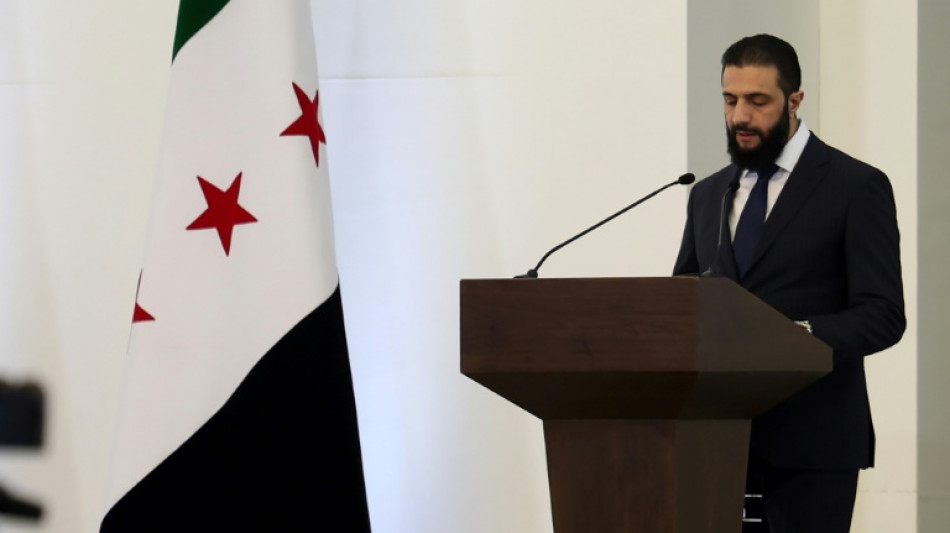
What we know about Syria's new government / Photo: OMAR HAJ KADOUR - AFP

 Amazon surges as US stocks shrug off bond yield worries

 Google rolls back new satellite image AI tool after backlash

 Ryu leads in bid for third straight major at women's British Open

 Fire-hit France region 'coming up for air' as main blaze calms
 Wembanyama to get signature shoe in Nike contract extension: reports
 Oil giants report blowout profits on war, warn high gas prices could persist
 Google launches new satellite image AI tool, alarming researchers

 Eddie Howe resigns as Newcastle boss to 'recharge'

 High winds hamper firefighting efforts in western Turkey

 Howe resigns as Newcastle boss

 Full-scale tour will benefit All Blacks, says coach Rennie

 US Fed dissenters call for rate hikes over sustained inflation
 Trump and far-right seize on Spanish migration crisis

 Hamas agrees to disarm under Trump plan
 French, Italian winegrowers face earliest ever harvest

 Alarm over climate-linked low level of German waterways
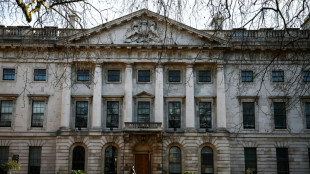 UK court rejects challenge against new Chinese embassy in London

 New York sues online prediction markets giant Kalshi

 Commerzbank agrees to talks with UniCredit after two-year standoff
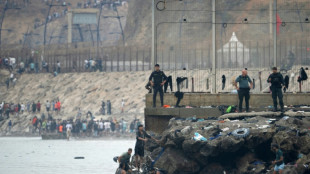
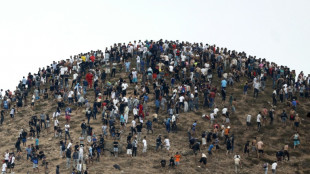 A rumour, a rush: chaos at Morocco border with Spain's Ceuta

 Fornaro Legal Releases Guidance to Help Businesses Maintain Clear Ownership Records During Growth
 Hamas agrees to disarm: what are the challenges ahead?
 Turkey fights to last major blaze inland from Bodrum

 Japan probe made closest-ever asteroid flyby: space agency
 Wildberries: 'Russia's Amazon' targeted by Ukraine

Syria's new government, dominated by interim President Ahmed al-Sharaa's inner circle, faces the daunting challenge of gaining the trust of Syrians, as well as that of Western countries to secure sanctions relief.
The transitional 23-member cabinet -- without a prime minister -- was announced on Saturday, more than three months after Sharaa's Islamist group Hayat Tahrir al-Sham (HTS) led an offensive that toppled longtime president Bashar al-Assad.
Succeeding the caretaker authorities in place since December, the formation of the government follows a constitutional declaration signed into force earlier this month, which experts and rights groups have warned concentrates power in Sharaa's hands and fails to include enough protections for minorities.
- Allies in key roles -
Some of Sharaa's closest supporters and other figures aligned with him make up the majority of the cabinet.
Most members are Sunni Muslim, reflecting the demographic make-up of Syria, ruled for decades by the Assad clan which belongs to the Alawite minority.
Syria expert Fabrice Balanche said that key portfolios have been given to "former brothers-in-arms who were already part of the Salvation Government that ran Idlib province" in Syria's northwest, the rebel bastion controlled by HTS before Assad's fall.
These include Assaad al-Shaibani, who as caretaker foreign minister already met with numerous Western and Middle Eastern officials, and retained his cabinet post in the new government.
Defence Minister Murhaf Abu Qasra, who as a rebel commander led the offensive that overthrew Assad, also kept his role. His main challenge is building a new national army.
Anas Khattab, who has been sanctioned by the United Nations, was appointed interior minister after serving as intelligence chief in a caretaker capacity.
The justice ministry went to Mazhar al-Wais, also from the Idlib rebel government. He replaced Shadi al-Waisi, who as interim minister faced criticism from activists and rights groups after old footage resurfaced linking him to the summary executions of two women accused of prostitution.
The leader of the White Helmets, the Syrian rescuers who worked in rebel-held areas, Raed al-Saleh, was appointed minister of emergency situations and disasters.
- Minority representatives -
Amid international calls for an inclusive transition, the new government has four ministers from minority groups in Syria -- a Christian, a Druze, a Kurd and an Alawite, none of whom were handed key portfolios.
"Mr Sharaa is seeking to broaden his support base well beyond" the ranks of Islamist groups that already back him, said Aron Lund of the Century International think tank.
"Seeing a radical Islamist faction coming to power and including minorities, even in a symbolic way, may not be ideal but it could have been worse," added Lund.
Yarub Badr, who is Alawite and served in a government under Assad before the war, was appointed transportation minister.
Veteran opposition figure Hind Kabawat, a member of Syria's Christian minority and longtime Assad opponent, was named social affairs and labour minister, the first woman to be appointed by Sharaa.
- Challenges -
The autonomous Kurdish-led administration in northwestern Syria rejected on Sunday the legitimacy of the new national government, saying it "does not reflect the country's diversity".
About 15 percent of Syria's population is Kurdish.
The sole Kurdish member of the new cabinet is not affiliated with the regional administration, which earlier this month had struck a deal with the national authorities to integrate into state institutions, eyeing unity after more than a decade of civil war.
Some analysts have expressed concern that the deal was effectively dead on arrival as the Kurdish administration has since also criticised the transitional constitutional declaration.
Lund said that in this context, "any government would have struggled to bring stability to the country."
"The real question", according to him, has to do with the level of influence the ministers will actually have.
With no prime minister, there is the risk of "extreme personalisation of power", Balanche warned.
According to him, the National Security Council formed on March 13 under Sharaa's chairmanship "is the real government".
Y.Baker--AT