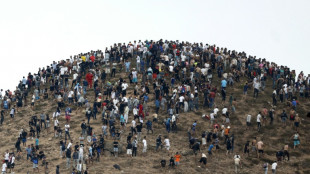
Sudan's booming wartime gold trade flows through the UAE / Photo: Giuseppe CACACE - AFP/File

 Strengthening El Nino 'adding fuel to a planet already on fire': UN chief

 Tech-fuelled rally fizzles as oil prices rise
 Chelsea's Mudryk cleared to play after doping ban appeal

 A side of oysters for France's flat-out firefighters

 England cricket chief Key refuses to rule out Stokes return

 New blazes in Greece as strong winds hamper firefighting
 Springboks star Feinberg-Mngomezulu back for Argentina Test
 Shops closed, businesses quiet as Spain's Ceuta faces migrant surge
 Chelsea fined £10mn, handed suspended transfer ban for breaching agent rules
 Residents defend Spain’s ancient 'El Abuelo' tree from flames
 Forever chemicals and pesticides: what to know

 Spaniard Santi Denia takes over as Czech Republic coach

 EU races to contain new migrant crisis as thousands cross into Spain's N. Africa enclave
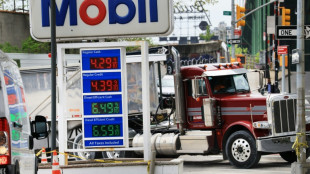 Profits surge at US oil giant amid Iran war supply shock
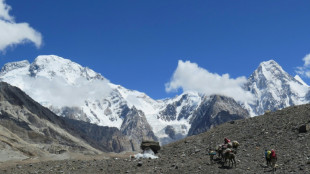 Bodies of four climbers found near Pakistan avalanche site: police
 UK court dismisses challenge against new Chinese embassy in London
 Stock markets rally on tech rebound
 Tyla drops Lagos show as South Africa, Nigeria row over immigration

 BP seeks to sell North Sea business as UK faces drilling dilemma

 Pro-Kremlin commentator denounces 'censorship' in France

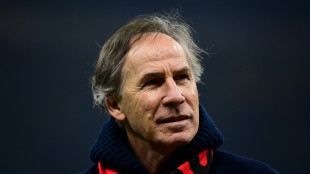 AC Milan 'in tears' at death of Italian football legend Baresi

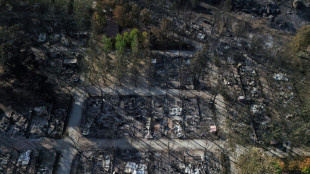 France, Spain assess scorched terrain as new wildfires threaten other regions

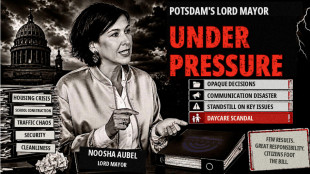
 Нооша Аубель під тиском: мерія Потсдама між самостійними кроками та скандалом із дитячими садками
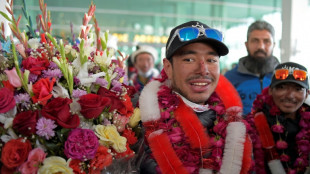 Missing climber Nirmal Purja redefined mountaineering

 British oil giant BP aims to sell North Sea business
Sudan's gold industry has become the lifeblood of its war, with nearly all of the trade channelled through the United Arab Emirates, enriching both the army and paramilitaries, according to official and NGO sources.
The two-year conflict has decimated Sudan's economy, yet last month the army-backed government announced record gold production in 2024.
Demand for the country's vast gold reserves was "a key factor in prolonging the war," Sudanese economist Abdelazim al-Amawy told AFP.
"To solve the war in Sudan, we have to follow the gold, and we arrive at the UAE," said Marc Ummel, a researcher with development organisation Swissaid who tracks African gold smuggling to the Gulf country.
In a statement to AFP, a UAE official rejected "any baseless and unfounded allegation regarding the smuggling or profiting of gold".
But according to Sudanese officials, mining industry sources and Swissaid's research, nearly all of Sudan's gold flows to the UAE, via official trade routes, smuggling and direct Emirati ownership of the government's currently most lucrative mine.
In February, the state-owned Sudan Mineral Resources Company said gold production reached 64 tonnes in 2024, up from 41.8 tonnes in 2022.
Legal exports brought $1.57 billion into the state's depleted coffers, central bank figures show.
But "nearly half of the state's production is smuggled across borders," SMRC director Mohammed Taher told AFP from Port Sudan.
Nearly 2,000 kilometres (1,240 miles) away, on Sudan's borders with South Sudan and the Central African Republic, lie the mines controlled by the paramilitary Rapid Support Forces.
Much of the gold produced by both sides is smuggled to Chad, South Sudan and Egypt, before reaching the UAE, according to mining industry sources and experts.
- Emirati assets -
This month, Sudan filed a case with the International Court of Justice, accusing the UAE of complicity in genocide committed by the RSF in Darfur.
Abu Dhabi, which has repeatedly denied accusations of funnelling weapons to the RSF, has called the case a "publicity stunt" and said it would seek to have it thrown out.
But the UAE has also played a major role in the government's wartime gold rush, indirectly helping to fund its war effort.
According to Taher, 90 percent of the state's legal exports of gold go to the UAE, though the government is eyeing alternatives, including Qatar and Turkey.
In the heart of army territory, halfway between Port Sudan and Khartoum, Sudan's Kush mine is the centrepiece of the government's gold industry.
Evacuated when the war began, it is now back to producing hundreds of kilograms per month, according to an engineer at the Russian-built facility, owned by Dubai-based Emiral Resources.
On its website, Emiral lists Kush as one of its holdings, alongside subsidiary Alliance for Mining, which it says is "the largest industrial gold producer in Sudan".
According to a gold industry source, who spoke on condition of anonymity for his safety, in 2020 the mine "was bought by an Emirati investor who agreed to keep Russian management on".
- Underground -
According to data from Dubai's commodities exchange, the UAE became the world's second-largest gold exporter in 2023, overtaking Britain.
It is also the leading destination for smuggled African gold, according to Swissaid.
Abu Dhabi says it has adopted a "responsible gold sourcing policy", including a regulatory legal framework revised in January 2023, to develop a "well-regulated gold sector".
According to Ummel, "when you look at the figures, that's not the case."
"If this 'Due Diligence Regulations for Responsible Sourcing of Gold' was really implemented, all refineries in the UAE would have to do due diligence, the most basic element of which is to make sure your gold was declared in the country where it comes from," he said.
In 2023, data obtained by Swissaid showed UAE gold imports from Chad -- on Sudan's western border -- were more than double the country's estimated maximum capacity, suggesting the majority of it was undeclared and smuggled across borders.
Ummel says there is no indication the UAE's conflict-gold market has shrunk in recent years.
In the vast Darfur region, RSF commander Mohamed Hamdan Daglo has controlled gold mines for years.
According to Sudan expert Alex de Waal, these enabled him to establish a "private transnational mercenary enterprise", mainly through his family's Al-Junaid Multi Activities Co -- sanctioned by both the United States and the European Union.
A UN panel of experts last year concluded that Daglo's gold wealth, through a network of up to 50 companies, helped him buy weapons and bankroll his war effort.
Three former Al-Junaid engineers estimated the company's wartime earnings at a minimum of $1 billion per year, based on approximate production and gold prices.
Darfur's southern border area alone produces at least 150 kilograms of gold per month, one former engineer told AFP.
It is sent first to an airport in the South Sudanese town of Raga, "and then transported by plane to Uganda and Kenya, and then to the UAE", the engineer, who had taken the trip himself, said on condition of anonymity.
According to Ummel, "the UAE is not really implementing their regulation, they don't carry out all the necessary controls and at the end they are continuing to fund the war."
S.Jackson--AT