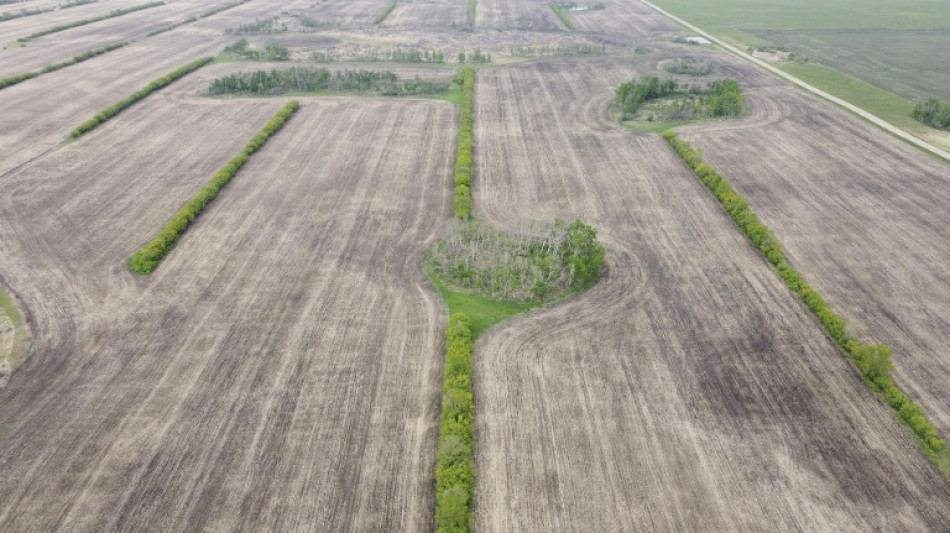
Canada canola farmers squeezed by trade wars on two fronts / Photo: Geoff Robins - AFP/File

 South Korea to prosecute students cheating with smart glasses

 Surging costs of living top US voter concerns

 Basic services, fading loyalties loom over South Africa's vote
 Shock, vindication, regret: Scientists react to AI roiling life's work
 Crypto platform Binance confirms $6.3 bn hack
 Boozer shines as Grizzlies top Blazers in battle of NBA unbeatens
 Jorge Martin confirmed to race at Malaysian MotoGP

 Bayern and Kane host Dortmund after week of 'extremes'

 Packers beat Panthers 27-19 as Watson returns from hospital
 Affordable supermarket fashion offers designer-inspired autumn alternatives
 Judge throws out Australian mushroom killer's appeal, imposes harsher sentence
 Pelicans down Kings for first win of NBA season

 Tech firms take fresh hit as earnings misses fan AI fears

 Worcestershire leaders back renewed two-unitary council reorganisation

 India's animal megacentre vows reset after criticism

 Dodging fuel price hikes, Damascus drivers turn to electric cars

 Alvechurch manager praises resilience but seeks improvement after Anstey draw
 Crypto platform Binance confirms major hack, more than $2.5bn frozen

 Sports chiefs face losing battle to keep sport separate from politics
 Nvidia's web of AI bets: smart strategy or bubble risk?
 Carrick fights for Man Utd job, Arsenal face Liverpool test

 Apple TV crime drama Nocturne brings a Scandinavian thriller to Pennsylvania

 Charity crowdfunds millions to buy historic English estate

 How to Build a "Fun Fund" Without Guilt

 InterContinental Hotels Group PLC Announces Transaction in Own Shares - October 30

To sow or not to sow? Canola farmers in Canada's vast western Prairies region have found themselves in the crossfire of trade wars with both the United States and China.
"We have two economic superpowers of the world having a trade war with us at the same time," Rick White, head of the Canadian Canola Growers Association, told AFP.
"We've had our challenges but nothing of this magnitude. This is the worst of all scenarios," he said, weeks before planting is to begin.
Canada, a major agricultural economy, is among the world's top producers of canola -- an oilseed crop that is used to make cooking oil, animal meal and biodiesel fuel.
But the bulk of canola exports go to just two customers, the United States and China, two countries with which Ottawa is now in standoffs over tariffs.
A few days ago, Beijing announced 100 percent tariffs on canola oil and meal in response to Ottawa's levies on Chinese electric vehicles, which align with those imposed on China by the United States under former president Joe Biden.
Meanwhile, since coming to office in January, US President Donald Trump has threatened widespread tariffs on imports of Canadian goods into the United States.
The price of canola has plunged as a result of the Chinese tariffs, dragging the price of European rapeseed down with it.
- Seeding soon -
All of this must be sorted out in the coming weeks, fumes Jason Johnson, a farmer from Manitoba province in Canada's agricultural heartland.
"We're going to be seeding in about a month and once we do, we can't change crops," he said, while waiting for a call from a seed dealer about possible alternative crops.
China accounts for nearly one third of Canadian canola exports, mainly canola seeds, while the United States is the largest market for canola oil and meal.
Johnson believes it was wrong for Canada to impose tariffs on China.
"We should go back to China and say, 'We'll lift our tariffs if you lift yours,' basically doing a Trump by threatening tariffs and then retracting them," he told AFP.
On his 2,500-acre farm just north of the Canada-US border, he grows canola each year on about 1,000 acres, and feels certain the United States will ramp up tariffs against Canada that will be widespread and hit hard.
Those tariff threats have already sent shockwaves through Canada, as more than 75 percent of its exports go to the United States. A trade war between the two neighbors, with Canada retaliating, would cause significant damage to the Canadian economy.
- 'Engage with China' -
Canola Council of Canada chief executive Chris Davison is urging the Canadian government "to immediately engage with China, with a view to resolving this issue."
Ottawa and Beijing have been at loggerheads for several years, relations having soured after Canada detained a senior Huawei executive on a US warrant in December 2018 and Beijing retaliated by holding two Canadians.
A deal was reached that saw all three detainees released in September 2021, but bad blood remains, with Beijing criticizing Ottawa for aligning itself with Washington's China policies and Canadian authorities regularly accusing China of interference.
As this goes on Canadians wonder if bright yellow fields of canola will be seen in the Prairies this spring.
Johnson says switching from canola to alternative crops at the last minute wouldn't be easy.
Markets for other crops are mostly smaller and if canola farmers switch to cultivating them it would lead to an oversupply and a drop in prices for those agricultural commodities too.
He noted also that Canada has "invested a lot in the last 20 years in infrastructure" to crush canola into oil and meal.
A.Ruiz--AT