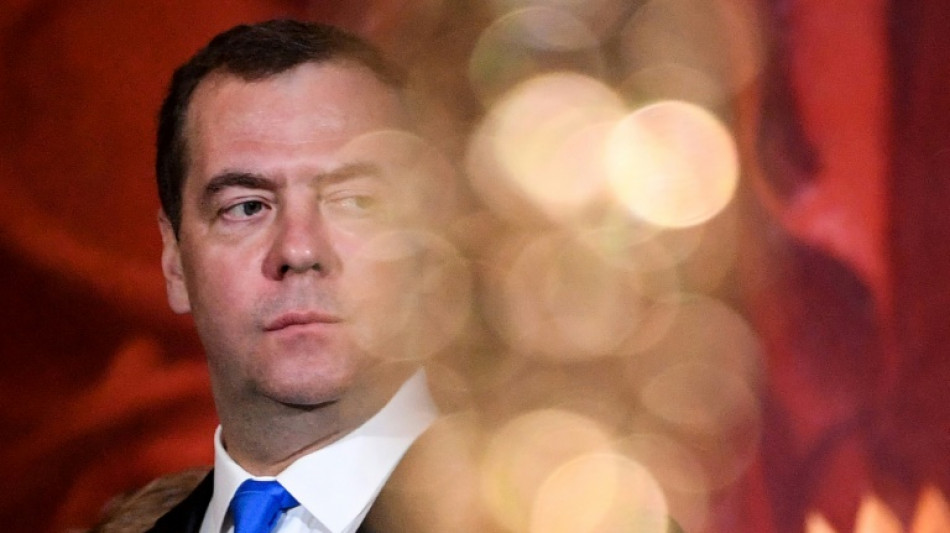
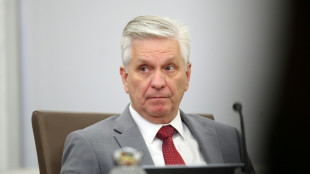
Medvedev: Russia's reforming president turned arch-hawk / Photo: AFP Photographer - AFP/File

 Stoic Verstappen looking beyond 'painful' Monza weekend
 OpenAI begins rollout of new powerful AI model GPT-6 Astra
 FIFA blasts UEFA 'smear campaign,' fights World Cup plan disclosures
 Zelensky hopes to host US envoys in Kyiv in 'coming days'
 Martinelli joins Al-Hilal from Arsenal for reported £60 million
 Tesla's semi-autonomous driving could be adapted to EU norms: France
 37 people die from fumes during oil pipeline theft in Nigeria: NGO
 Ahead of elections, Israel tests West's patience on West Bank violence
 Antonelli will obey Mercedes orders to help 'tow' teammate Russell
 UK fintech Revolut gains conditional US banking licence
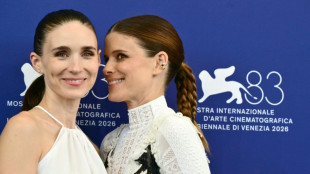 Mara sisters channel childhood energy for twins performance at Venice
 UN's Sudan probe says foreign fighters fuelling conflict
 Violence erupts at S.Africa anti-migrant protest
 Nothing left: Nepal flood survivors face loss and uncertainty
 Tesla to launch self-driving 'Cybercab' in Texas
 Europe struggles to respond as Russia escalates shadow warfare
 Malta PM urges 'caution' after acquittal in journalist's murder
 Spanish PM says no 'solid proof' Morocco planned Ceuta migrant rush
 Venezuela's Maduro seek immunity from US drug charges
 Tazapay Now Live on the Borderless.xyz Network For Seamless Money Movement to Asia Pacific and Latin America
 DWF Labs Expands Global Regulatory Footprint with BVI Virtual Asset Service Provider Approval
 Just the beginning of the journey, Broeders-Bol says of 800m adventure
 US trade gap in July hits biggest in over a year on AI buildout
 Study shows plug-in hybrids polluting far more than expected
 Lost tool disrupted Airbus jet deliveries for months
Dmitry Medvedev as Russian president chomped on a burger at an American diner with Barack Obama, praised independent media and made ambitious promises of reform to create a more open Russia.
But with the Kremlin's war against Ukraine raging for over three months, he now vows to make enemies of Russia "disappear", warns of military strikes on the West and darkly comments the "horsemen of the apocalypse" are on their way.
What happened to Medvedev, 56, president from 2008-2012 and premier from 2012-2020, once seen by admirers as Russia's great hope for reform?
His path is also emblematic of that of Russia over the last two decades, as the country swung from a potential reliable member of the international system to the current isolation, inwardness and radicalism.
"Dmitry Medvedev is, it seems, trying to demonstrate his relevance -- and loyalty -- in a system that has become markedly more hawkish and less tolerant of shades of grey," said Ben Noble, associate professor of Russian Politics at University College London.
As president, Medvedev never stepped out of the shadow of Vladimir Putin, his fellow Saint Petersburger to whom he owes his political career.
Putin in 2008 had to switch jobs, becoming premier in order not to break constitutional rules, with Medvedev assuming the presidency. Putin returned to the Kremlin in 2012 as Medvedev stepped aside.
He became prime minister –- dubbed a Putin-Medvedev "castling" in Russia –- before becoming deputy chairman of the national security council eight years later.
- 'Make them disappear' -
But the presidency of Medvedev –- which now appears to belong to a different epoch –- still contained remarkable gestures towards change.
He championed a "reset" of relations with Washington that saw Obama visit Moscow in 2009 and Medvedev the US the next year, famously being presented with an iPhone in Silicon Valley by Apple founder Steve Jobs.
In April 2011, he popped into the studios of independent TV channel Dozhd (Rain), giving an interview and declaring it a "great place" as his Kremlin sought to cautiously cultivate independent media.
He attempted to take on the mantle of reforming Tsar Alexander II who abolished serfdom, saying Russia's current hydrocarbon-dependent economic model was at a "dead end" while political freedom "cannot be put off for another day".
Medvedev boasted of an affinity with Western culture, proclaiming to be a fan of US rock band Linkin Park and seizing the chance to meet his music heroes like Bono of U2 and Deep Purple.
Most remarkably of all, it was on Medvedev's watch that Russia abstained -- rather than using its veto -- on a UN Security Council resolution authorising military action in Libya. The move prompted a rare public spat between him and Putin.
Medvedev -- unlike the perennial Internet-sceptic Putin -- always embraced tech and social media, sending his first tweet (a jolly "Hello everyone!") from Silicon Valley in 2010.
He was also tripped up by new media in a 2017 viral video by the now jailed opposition challenger Alexei Navalny which alleged he had embezzled over a billion dollars from the state and sparked anti-government protests.
But today messaging channel Telegram has become the forum for Medvedev's radical pronouncements.
"I am often asked why my Telegram posts are so harsh. The answer is I hate them. They are bastards and degenerates," he wrote Tuesday.
"They want death for us, Russia. And while I'm alive, I will do everything to make them disappear," he added, without making explicit who "they" represented.
- 'Horsemen of the apocalypse' -
His comments shocked even those who had become accustomed to his tough-talking.
"This is indeed remarkable. Medvedev... threatens the people of Ukraine with extermination," Carl Bildt, who was Swedish foreign minister throughout Medvedev's presidency, wrote on Twitter.
Tikhon Dzyadko, the editor in chief of TV Rain, wrote: "Someone better sometimes get hold of his phone." TV Rain, the channel Medvedev visited so eagerly, is now blocked in Russia and due to resume broadcasting from abroad.
It was far from the first time Medvedev has raised hackles on Telegram, in an account he only opened on March 17 with a declaration that Russia has "enough power to put in their place all the brazen enemies of our country".
On May 12, he issued a spine-chilling warning that the West's arming of Ukraine was creating a proxy war "with the risk it will transform into full-scale nuclear war".
He warned on May 30 that if Ukraine launched missile attacks on Russia with systems from the US, Moscow would hit back with strikes on "decision-making centres" in the West.
The most jolting of all his statements came in an interview with Al-Jazeera where he stated that in the current circumstances "the horsemen of the apocalypse are already on their way and we can only now put faith in God."
- 'A river you can swim in twice' -
Yet Medvedev's shift in tone also keeps him in line with Russian politicians adopting ultra-hawkish rhetoric, such as parliament speaker Vyacheslav Volodin or security council secretary Nikolai Patrushev.
Both have been mooted as possible successors to Putin as rumours swirl about his health. But might Medvedev be tempted by a Kremlin return?
"Never say never, especially as I swam in that river once and this is a river that you can swim in twice," he told AFP in a November 2012 interview.
Noble, co-author of a recent book on Navalny, said the chances of Medvedev had been discounted as he lacks a support base, including within the security services.
"Might his recent radical rhetoric be an attempt to try to change that? That's one possibility," he said.
Y.Baker--AT