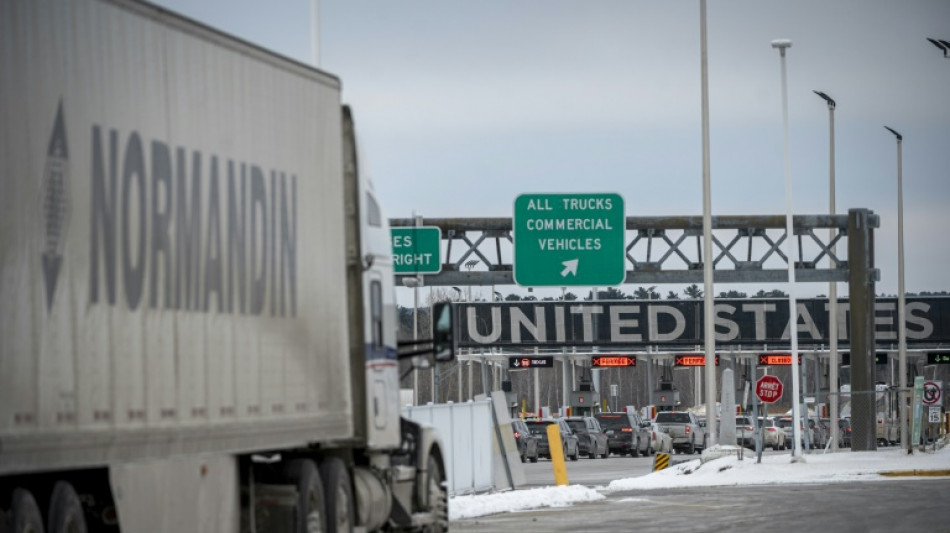
US tariffs threat a 'shock' to Canadian businesses / Photo: ANDREJ IVANOV - AFP/File

 Selection process for next UN chief under way

 UEFA says will boycott World Cup if FIFA pushes private investor proposal

 Volunteers rush to feed scared animals in fire-stricken France

 Russian missile strike destroys family home, 10 feared dead

 Djokovic to make return at Cincinnati Masters

 Selection process for next UN chief begins

 Southern Europe 'becoming more flammable' in hotter climate, experts say

 Prada profits pinched as growth hard to chase

 Turkey confronts growing wildfires on tourist coasts

 Stocks climb on earnings and rates, oil retreats

 Russia blamed for missile that blasted crater in Polish field

 US economic growth slows in second quarter, missing expectations

 Russia adds Telegram founder Durov to 'terrorist' blacklist

 MEXC Ventures Supports Alpha Arena's APAC Debut at Coinfest Bali

 Grealish hits back over Man City tour snub claims

 Firefighters battle to contain deadly Crete blaze in Greece

 Chelsea sign France defender Lacroix from Crystal Palace

 Root named England Test captain, Fleming appointed coach

 May, June heatwaves caused 2,877 extra deaths in England: govt

 France firefighters hopeful, as Spain reports 'almost no flames'

 Shell profit surges as Mideast war fuels oil prices

 Russian strikes kill 8 across Ukraine, including 6 from one family

 Rain dampens France fire, as Spain reports 'almost no flames'

 India's history-making stand-in cricket captain Rahane retires
 Car maker Stellantis says back in profit in second quarter

Donald Trump's threats of import tariffs have sent shockwaves through Canada, forcing businesses to question their dependence on the United States -- a reassessment that is creating headaches for many sectors.
"It was an absolute shock," Matthew Holmes, vice president of the Canadian Chamber of Commerce, told AFP. "There's an incredible anxiety that comes from the unpredictability and the uncertainty."
"It got everybody talking in Canada about (how) we can't trust this partnership anymore," he added.
Earlier this month US President Trump announced 25 percent tariffs on Canadian and Mexican imports, then granted a 30-day reprieve.
The pause, however, has done little to reassure Canadian businesses that send more than 75 percent of Canada's exports to the United States, and who worry that a trade war would lead to a recession and hundreds of thousands of job losses.
Canada must prepare for the tariffs by removing barriers to trade between provinces and diversify its export markets, Holmes said. "We need to be ready and have the infrastructure and relationships and start building those out now."
Otherwise, he said, Canadian businesses will be "really, really screwed."
- 'No quick fix' -
According to a recent survey, nine out of 10 Canadians agree on the need to lessen Canada's trade reliance on the United States.
Prime Minister Justin Trudeau recently hosted a summit in Toronto that brought business leaders together to discuss ways of growing the Canadian economy, including removing internal trade barriers, diversifying export markets and boosting productivity.
Provincial governments and business leaders, he told delegates, must "step up and push hard" to make Canada more competitive, while acknowledging that it has been easy to just sell to the country's southern neighbor.
But that may be easier said than done, according to Robert Gillezeau, an economics professor at the University of Toronto.
"The two economies are extremely interconnected with over a trillion dollars in trade between the two countries," he told AFP, pointing to their close proximity and "longstanding good relations" for how ties developed.
"For some sectors, it'll be a little bit easier" to disentangle from the United States, Gillezeau said.
For others, "it's going to be a mess," he added. "You can't just snap your fingers and take that integrated industry and have it work with someone else or have it become fully domestic... There is no quick fix."
The food industry is a case in point.
"We've frozen our purchases of some American goods and we're looking elsewhere for alternatives," explains Mike Bono of Can-Am Food Services.
But it is not possible for the company -- which is one of the largest distributors of fruits and vegetables in Quebec and Ontario with nearly 3,000 customers including restaurants and hotels -- to find substitutes for all of its American offerings.
- Interprovincial trade barriers -
The removal of interprovincial trade barriers was flagged in a report as a way to boost Canada's economy as far back as 1940.
Ottawa led efforts to dismantle them in 2017 but hundreds of exceptions were kept in an agreement signed by the provinces.
Removing these barriers would improve productivity and increase Canadian GDP, but "would take a level of effort and coordination that we rarely see in the federation," Gillezeau said.
Internal Trade Minister Anita Anand, who wants to see these barriers abolished as soon as possible, believes that "in the face of Donald Trump's repeated threats, we must choose Canada."
She explained that removing the barriers -- such as alcohol sales restrictions, different labelling rules, varying professional licensing certifications, and independent dairy marketing boards in each province -- could lower prices by 15 percent, boost productivity and inject up to Can$200 billion into the economy.
Some are also calling for east-west oil and gas pipeline projects to be revived in order to lessen dependency on US infrastructure. Oil from western Alberta, for example, is currently shipped via a pipeline that dips into the United States before emerging in Ontario.
M.O.Allen--AT