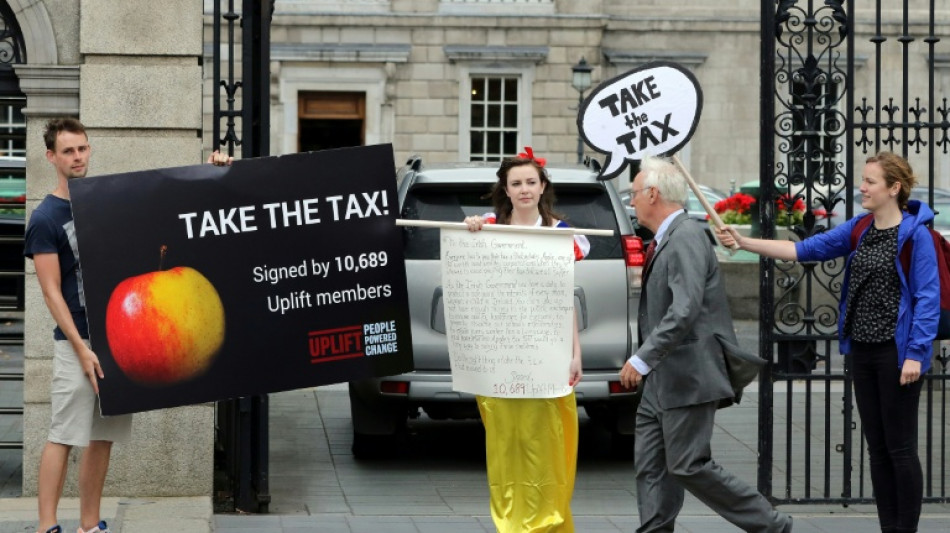
Irish economy faces the test of Trump's protectionism / Photo: PAUL FAITH - AFP

 US Fed begins meeting with markets expecting steady interest rates
 Ukraine's Zelensky arrives for Trump talks at White House

 Dozens feared trapped in quake-hit Japan mall

 Diaz and Olise set to stay at Bayern, says CEO

 British drugs group GSK targets savings after profits slide

 France evacuates thousands as Spain PM says tide turning in wildfire fight
 Boeing reports loss on Air Force One but sees progress in turnaround

 First image taken of Betelgeuse's elusive companion star

 Man City's Rodri sidelined for 'short period' following back surgery

 Pedro bags three as Alonso starts Chelsea reign with 6-4 win over Western Sydney Wanderers

 Tech stocks tank on AI jitters, oil falls further

 Mercedes CEO urges German 'productivity offensive' as China woes hit profit

 Praise the Gods! Greek PM thanks Nolan for the 'The Odyssey' spotlight

 Zidane's long road leads back to France helm

 Firefighters on offensive in France, Spain as new heatwave arrives

 Seoul, Tokyo lead fresh tech rout as most of Asia retreats

 US tariffs refund boosts Philips

 Taiwan detains Nvidia worker in chip smuggling probe: source familiar with case

 Why are tech stocks tanking?

 BitMart под давлением: 22 000 USDT и 930 000 SNC не разблокированы по истечении 48 часов — у BitMart не хватает средств?

 Made by AI? EU tells firms to stick a label on it from Sunday

 Open champion Fox welcomed home by thousands after 'whirlwind few days'

 Seoul, Tokyo lead Asian plunge as tech stocks suffer fresh rout

 More than skin deep: Dutch abuse victims erase forced tattoos

 AI cameras spot suicide attempts in South Korea's capital

With a general election next week, Ireland and its 5.4 million inhabitants fear finding themselves in the eye of a protectionist storm promised by incoming US president Donald Trump.
Ireland has a budget surplus -- a rarity in the European Union -- as well as record growth, putting its economy in rude health, despite the conflicts in Ukraine and the Middle East that have hit its nearest neighbours.
Its long-standing asset has been a corporate tax rate that has enticed major US tech giants such as Apple, Google and Facebook parent company Meta to set up European headquarters in Dublin.
Much to the annoyance of other capitals in the bloc, they send their European profits to Dublin to pay less tax, in a deal that in turn ensures Ireland billions.
"Corporate tax is a major source of revenues," said economist James Charles Stewart.
But the return of Trump is worrying the Irish.
If he follows through on a promise to lower the US corporate tax rate from 21 percent to Ireland's rate of 15 percent, fears are growing that the tech firms will pack up and head home.
- Don't panic... yet! -
Stewart, from Trinity College Dublin Business School, described the looming Trump presidency as "a matter of concern" but said "not to panic at this stage".
"The big tech companies will need to stay in Europe for their investments in the continent and Ireland is a good country to do that," he told AFP.
The main danger for Ireland's economy could be the 10-20-percent customs duties promised by Trump on imports, said Dan O'Brien, chief economist at the Institute of International and European Affairs in Dublin.
"Ireland per person sells more goods to the United States than any other European country or even Mexico and Canada," he said.
"So Ireland is hugely exposed to protectionism between the United States and Europe, and this is my biggest concern in the short-term for the Irish economy."
As an economic hub in the transatlantic economy, Ireland is particularly vulnerable, even though there has been more talk about "deglobalisation" than action, he added.
- Back-tax billions -
Pharmaceuticals and the agri-food industry are major industries in Ireland and are likely to lobby hard against any hike in US import tariffs.
Unlike other EU countries, Ireland earns more than it spends and expects to generate a budget surplus of 9.7 billion euros ($10.2 billion) by 2025.
Other countries may look on enviously. This year the surplus was 23.7 billion euros, if the 14 billion in undue tax advantages that Apple has to pay are counted, after a years-long saga between Brussels, Dublin and California.
Ireland was reluctant to accept the unexpected windfall and has since decided to place a chunk of it in a fund to finance the increasing health and pension costs of its ageing population.
"My view is that this money should be kept in reserve in case we have an economic shock and that's the time for government to invest when there is too little demand in an economy," said O'Brien.
"Hopefully we won't get to that point but it would better to keep that money and use it to boost demand if we get a fall in demand because of, for example, a transatlantic trade war."
Y.Baker--AT