Crunch time: What still needs to be hammered out at COP29? / Photo: Lise KIENNEMANN, Valentina BRESCHI, Sabrina BLANCHARD - AFP

 US Fed begins meeting with markets expecting steady interest rates
 Ukraine's Zelensky arrives for Trump talks at White House

 Dozens feared trapped in quake-hit Japan mall

 Diaz and Olise set to stay at Bayern, says CEO

 British drugs group GSK targets savings after profits slide
 France evacuates thousands as Spain PM says tide turning in wildfire fight
 Boeing reports loss on Air Force One but sees progress in turnaround

 First image taken of Betelgeuse's elusive companion star

 Man City's Rodri sidelined for 'short period' following back surgery

 Pedro bags three as Alonso starts Chelsea reign with 6-4 win over Western Sydney Wanderers
 Tech stocks tank on AI jitters, oil falls further
 Mercedes CEO urges German 'productivity offensive' as China woes hit profit
 Praise the Gods! Greek PM thanks Nolan for the 'The Odyssey' spotlight

 Zidane's long road leads back to France helm
 Firefighters on offensive in France, Spain as new heatwave arrives
 Seoul, Tokyo lead fresh tech rout as most of Asia retreats
 US tariffs refund boosts Philips

 Taiwan detains Nvidia worker in chip smuggling probe: source familiar with case

 Why are tech stocks tanking?

 BitMart под давлением: 22 000 USDT и 930 000 SNC не разблокированы по истечении 48 часов — у BitMart не хватает средств?
 Made by AI? EU tells firms to stick a label on it from Sunday

 Open champion Fox welcomed home by thousands after 'whirlwind few days'

 Seoul, Tokyo lead Asian plunge as tech stocks suffer fresh rout

 More than skin deep: Dutch abuse victims erase forced tattoos
 AI cameras spot suicide attempts in South Korea's capital

The UN climate summit in Azerbaijan is scheduled to wrap up on Friday, yet it remains unclear how much money will be provided to developed countries to fight global warming -- and who will pay for it.
Here are the big questions and key figures about what is still expected from the COP29 talks.
- How much money? -
Developing countries need $1 trillion a year in external aid by the end of the decade and $1.3 trillion by 2035, according to estimates from two expert economists commissioned by the United Nations, Amar Bhattacharya and Nicholas Stern.
The figure that has sparked the most intense debate at COP29 has been how much of this total will be provided by wealthy countries.
In 2009, developed nations pledged $100 billion a year in climate aid for 2020-2025. COP29 is tasked with laying out their new commitment until 2030 -- or even 2035.
- Which countries should pay? -
Under a framework established by the UN back in 1992, 23 developed countries -- and the European Union -- historically responsible for most planet-heating emissions are obliged to contribute to climate finance.
These include the United States, 18 European countries as well as Japan, Canada, New Zealand and Australia.
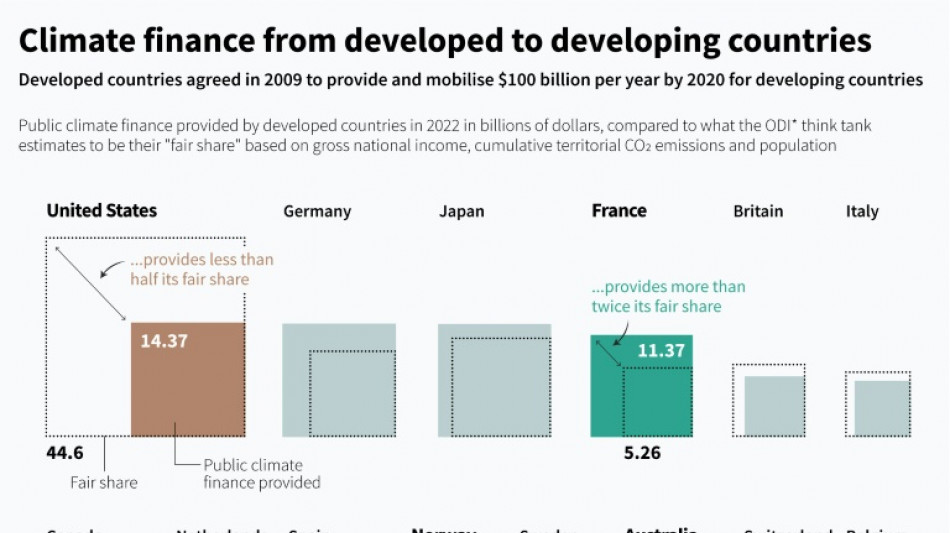
These countries coughed up $116 billion in 2022, according to the OECD, through a variety of channels including financing private projects.
The EU paid for around a third of the total.
The three biggest contributors were Germany, Japan and the United States with $14 billion followed by France with $11 billion, according to calculations by the ODI think tank.
But if wealth and the weight of historical emissions are taken into consideration, the United States is well behind, it added.
- Who does not have to pay? -
Qatar, Kuwait, Singapore, the United Arab Emirates, South Korea and other relatively well-off countries were not included in the 1992 list because they were not as rich at the time.
But the current global economy is very different from 1992, Germany's climate envoy Jennifer Morgan has emphasised. The traditionally wealthy nations are calling for the number of contributors to climate finance to be expanded.
China, the biggest current emitter of greenhouse gases, is also not on the list.
China's historical emissions have now surpassed the EU's -- and it has a bigger economy, the Europeans have repeatedly noted.
Beijing has defended itself by pointing to the financial aid it already provides to the global south.
- Key points to be decided at COP29 -
A major decision to be made at COP29 is the new target amount -- beyond the current $100 billion -- that the developed countries will provide to developing nations.
The demands from developing countries have ranged from $500 billion to $1.3 trillion a year. The EU is among the parties which have not yet named a specific figure.
Another outstanding question is whether any commitment will run to 2030 or 2035.
Other key points to be decided at the talks include:
- How should the climate finance provided by recently wealthy countries be counted? Should these countries also face mandatory funding targets? And should it all be thrown in a single pot or counted separately?
- Should there be specific rules for how climate is distributed to different groups of countries? The 45 least developed nations -- most of which are in Africa -- are asking for at least $220 billion a year, while the small island states want $39 billion.
- Should the money provided by wealthy countries include relief for nations suffering from climate disasters -- which is called "loss and damage" in UN climate-speak -- or should it be limited to efforts to reduce greenhouse gas emissions and adapt to climate change?
- How much of the money should be grants, rather than loans? Nearly 70 percent of climate finance is currently loaned, which means it is piled onto the debt of developing countries, according to the OECD.
D.Lopez--AT