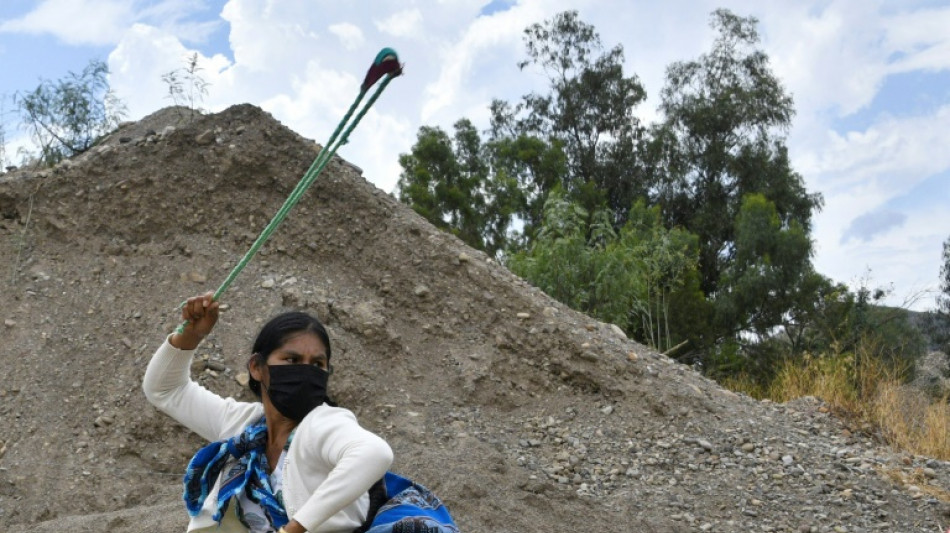
With stones and slings, supporters of Bolivia's Morales gird for battle / Photo: AIZAR RALDES - AFP

 'Appy marriages: AI helps hundreds of Japanese wed

 Netanyahu heads to US for first Trump meeting since Iran war

 Documentary on Stan Lee's final years faced industry opposition, filmmaker says

 Fritz takes 250th hardcourt win in ATP Washington opener

 US singer D4vd to stand trial in killing of teenage girl

 Sudan RSF leader 'unleashes' fighters after army gains in Kordofan
 Ramsay-Peaty to learn lessons for LA after missing out on Commonwealth gold

 Spain wildfire burns campsite to ash, leaving tears and despair

 'Thrilled' 76ers sign James with eyes on NBA title run

 Brazil's Amazonia theaters earn UNESCO World Heritage status

 Fury of fire-ravaged French village at being 'sacrificed' for millionaires' peninsula

 Border crossings shut as heavy snow coats Argentine Andes
 Singer Carly Simon diagnosed with Parkinson's: statement

 Burnham meets Zelensky, pledges new 'Stone Cloak' for Ukrainian drones
 Newcastle winger Barnes signs long-term contract extension
 Iran, US hold fire as Saudi Arabia intercepts drones

 Chad says will withdraw from the International Criminal Court

 UK funeral director faces jail over bodies left 'on racks'
 German authorities criticised after Pride attack

 Flooding forces residents to flee homes by boat in Pakistan
 Polish village puts faith in Europe's tallest Virgin Mary statue

 Farmers help battle French forest inferno before new heatwave

 Heat, overcrowding, pushes Italian prison guard union to sue
 UK TV comedy star and naturalist Bill Oddie dies at 85

 AstraZeneca profit rises on strong cancer drug sales
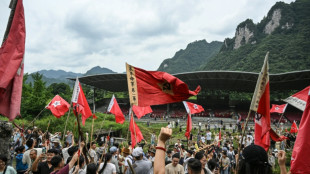
Under a bridge in central Bolivia, supporters of former president Evo Morales, armed with slingshots and stones, practice their aim as they prepare to do battle with security forces.
"Evistas," as Morales's supporters are known, have blocked nearly two dozen roads, mostly in his stronghold of Cochabamba, since October 14 to prevent his threatened arrest on rape charges.
The protests, which have caused widespread food and fuel shortages, have grown more radical with each passing day.
On Friday, a group of Morales supporters stormed a barracks in the central Chapare province and took a group of soldiers hostage.
In Parotani, which lies on the main road from Cochabamba to the capital La Paz, AFP saw a group of protesters being schooled in firing slingshots.
Carlos Flores, a 45-year-old agronomist, ordered them to spin their "huaracas" (slingshots, in the local Quechua language) over their heads.
- 'We are ready to fight' -
A black-clad youth with a face mask, who used the alias "Choque," whirled his sling and then released the stone, which whipped 100 meters (300 feet) through the air.
"This is our secret weapon... we inherited it from our grandparents," Flores told AFP proudly.
Since the protests began last month, 70 people have been injured in clashes between the demonstrators and police sent to clear the roads.
Most of the injured were police, some of whom sustained head injuries, according to the authorities.
In Parotani, a police officer nearly lost a foot. President Luis Arce said the officer was attacked with dynamite.
While the demonstrations initially focused on the rape charges against Morales, which he claims were fabricated to thwart his attempted political comeback, they have snowballed into a broader revolt against Arce's economic policies.
On Wednesday, Arce ordered an "immediate" end to the blockades and warned the government would "exercise its constitutional powers" to restore order, seen as a veiled threat to deploy the military.
"If he sends in his soldiers, we are ready to fight," said Flores.
- Plentiful stones -
In the rocky hills that surround Parotani, dozens of sentries scan the horizon for signs of the security forces.
The police want to clear the bridge to allow the passage of trucks supplying food and fuel to Cochabamba, where prices have risen due to shortages.
Shepherdess Nicolasa Sanchez, 59, makes new huaracas by threading sheep's wool between her bare toes and braiding them.
She makes about three a day.
"We could have thousands of huaracas as we will never run out of stones," says Juanita Ancieta, leader of a group of rural women from the outskirts of La Paz.
From time to time, loud explosions can be heard in the area.
"We ask the armed forces and the police not to attack their people... not to stain their hands with our blood," said Mariluz Ventura, representative of a union of Indigenous farmers.
- Bolivia's 'heart' -
The demonstrators said they were prepared for weeks, even months of "resistance."
In a sign the protests are becoming further entrenched, small shops selling clothes, cell phone accessories and even vinegar -- an antidote to tear gas -- have popped up around the bridge-turned-training ground. Out-of-town protesters have set up camp nearby.
"Cochabamba is the heart of Bolivia. That's why it is the site of the biggest blockade in the country," said Constancio Vallejos, a 37-year-old farmer who traveled around four hours from the east with a delegation of young farmers to join the protest.
Humberto Alegre, 31, heads one of the organizations that brings food to the protesters.
He said that he alone distributed about 500 rations a day.
Parotani has been without electricity and running water for days, leaving the townspeople reliant on water collected from the river.
"We are going to resist. This is the struggle we have begun. We will see it through to the end," said Flores.
F.Wilson--AT