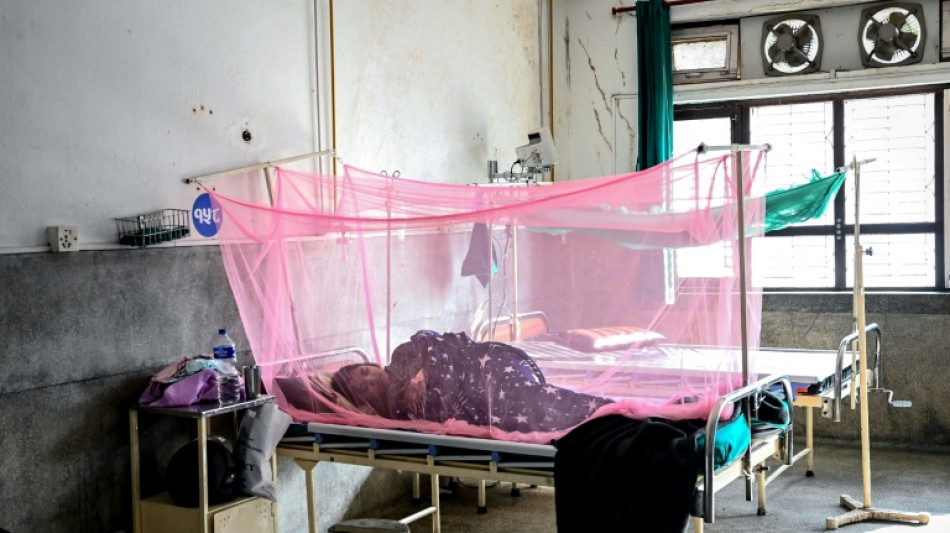
Climate shifts and urbanisation drive Nepal dengue surge / Photo: PRAKASH MATHEMA - AFP

 'Appy marriages: AI helps hundreds of Japanese wed

 Netanyahu heads to US for first Trump meeting since Iran war
 Documentary on Stan Lee's final years faced industry opposition, filmmaker says

 Fritz takes 250th hardcourt win in ATP Washington opener

 US singer D4vd to stand trial in killing of teenage girl

 Sudan RSF leader 'unleashes' fighters after army gains in Kordofan
 Ramsay-Peaty to learn lessons for LA after missing out on Commonwealth gold

 Spain wildfire burns campsite to ash, leaving tears and despair

 'Thrilled' 76ers sign James with eyes on NBA title run
 Brazil's Amazonia theaters earn UNESCO World Heritage status

 Fury of fire-ravaged French village at being 'sacrificed' for millionaires' peninsula

 Border crossings shut as heavy snow coats Argentine Andes

 Singer Carly Simon diagnosed with Parkinson's: statement

 Burnham meets Zelensky, pledges new 'Stone Cloak' for Ukrainian drones
 Newcastle winger Barnes signs long-term contract extension
 Iran, US hold fire as Saudi Arabia intercepts drones
 Chad says will withdraw from the International Criminal Court

 UK funeral director faces jail over bodies left 'on racks'
 German authorities criticised after Pride attack

 Flooding forces residents to flee homes by boat in Pakistan

 Polish village puts faith in Europe's tallest Virgin Mary statue

 Farmers help battle French forest inferno before new heatwave
 Heat, overcrowding, pushes Italian prison guard union to sue

 UK TV comedy star and naturalist Bill Oddie dies at 85

 AstraZeneca profit rises on strong cancer drug sales

Nepal is fighting a surge in dengue cases, a potentially deadly disease once unheard of in the country's high-altitude Himalayan regions, as climate change and urbanisation nurture fever-bringing mosquitoes in new zones.
Only a single case of dengue was recorded in Nepal in 2004. Two decades later, thousands of cases are being reported across the country.
Once confined to tropical regions in the country's plains, dengue-carrying mosquitoes have begun breeding in the valleys and even cool mountainous areas, reaching elevations where its bite was once unknown.
Twelve people have died and more than 28,000 people have been infected this year, including 18 cases in Solukhumbu district, home to Mount Everest.
Doctors say the real number might be higher, as not everyone is tested.
"It should not be seen here at all," Suman Tiwari, district health chief for Solukhumbu, which sits at an altitude of some 2,500 metres (8,202 feet).
"What is surprising is that some people with no travel history have also tested positive for dengue".
In the worst cases, dengue causes intense viral fevers that trigger bleeding, internally or from the mouth and nose.
The capital Kathmandu, at an elevation of approximately 1,400 metres (4,600 feet), has seen over 4,000 cases.
"Unfortunately, it is expanding itself geographically," said Sher Bahadur Pun, a doctor at Kathmandu's Sukraraj Tropical and Infectious Disease Hospital.
"Once upon a time, it was just seen in a certain area, but it is moving up towards mountainous regions, even up to the Himalayan foothills."
- 'Grown exponentially' -
In some districts, hospitals have been overwhelmed with dengue patients suffering from crippling fevers, body aches and rashes.
"In the last decade, it has grown exponentially," Pun said.
"After every outbreak, the number of infected people has increased... and my experience is that after every outbreak, it has become more deadly."
In October, the UN health agency said the number of reported dengue cases worldwide has approximately doubled each year since 2021, with over 12.3 million cases, including more than 7,900 deaths, reported in just the first eight months of 2024.
WHO chief Tedros Adhanom Ghebreyesus called the global spread an "alarming trend".
Experts say changes in temperature and rainfall patterns driven by climate change and urbanisation are creating favourable conditions for Aedes aegypti, the mosquito responsible for transmitting dengue.
That means it can survive and breed at higher elevations.
Narayan Gyawali, a virologist who specialises in zoonotic diseases, said that urbanisation and increased mobility of people were also driving the dengue surge.
"When microclimates are established with urbanisation in new areas, internal temperatures become warm and there is humidity," Gyawali said.
"A favourable environment is created for breeding and survival."
- 'Injustice' -
This is the third consecutive year that Nepal has seen a dengue outbreak -- an apparent shift from cyclical patterns where outbreaks are expected every two to three years.
The country's worst outbreak was in 2022, with 88 deaths and nearly 55,000 cases, according to government figures.
Last year, 20 people died, with more than 50,000 cases.
"Dengue used to be reported in a cyclical trend, but in the last few years, it has been seen every year," said Gokarna Dahal of the Health Ministry's Epidemiology and Disease Control Division.
"Our preparation now is to fight with it every year".
Dahal said it was an "injustice" that a developing country like Nepal -- which makes a minimal contribution towards the burning of fossil fuels driving the planet's warming -- should shoulder greater impacts of climate change.
Meenakshi Ganguly, from Human Rights Watch, said that while the primary responsibility to protect its public's health lies with Nepal, countries most responsible for global emissions also have an obligation.
"Those countries which are primarily responsible for global emissions need to do a lot more to protect people in countries like Nepal from the consequences of global warming," Ganguly said.
"Combatting mosquito-borne diseases like dengue, which are spreading fast to new areas, needs to be part of that."
J.Gomez--AT