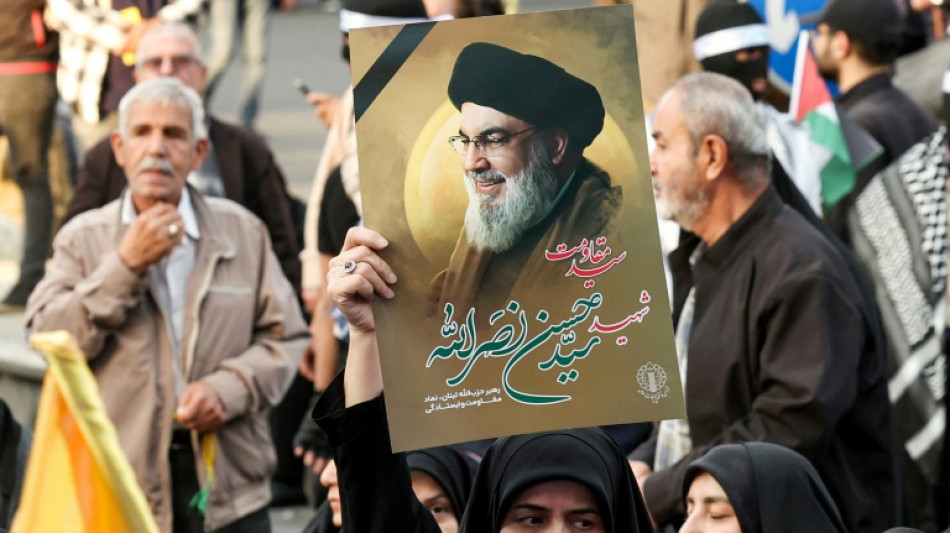
'End of an era' for Hezbollah after Israel killed its leader / Photo: - - AFP

 West Indies lead Pakistan by 155 at close of third day
 Ramsay-Peaty beaten again as Australia reign supreme in Commonwealth pool
 IMF boss hails 'much sounder' Argentine economy under Milei
 HIV progress in 'real danger' as global funding plummets
 Commonwealth Games as 'training day', says Olympic champion McClenaghan
 Trump says 'good chance' of progress in Iran talks as foes hold fire

 Renault to face criminal trial in France over dieselgate
 Trump sees 'good chance' for Iran deal, warns strikes could resume
 India activists demand release of detained 'cockroach' protesters

 LVMH says growth accelerates in second quarter
 France and Spain race to contain fires before new heatwave
 Wildlife face 'catastrophic' losses as France's forests burn
 UN lists South Sudan antelope route as heritage in danger
 German govt vows to toughen laws after jihadist attack on Pride event
 What are 'fire clouds', the ominous phenomenon seen in France?
 'Fresh' Evenepoel answers Tour de France questions
 Paris police arrest man who wounded three women with knives
 German sports carmaker Porsche to cut 5,000 jobs by 2035
 Oil prices slump as US and Iran pause strikes
 South Africa's Ramaphosa calls for African action on migration
 German creator of 'Body Worlds' anatomy exhibits dead at 81
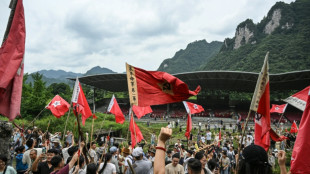 Explosions, red flags: Chinese tourists reenact communist victory

 Oil prices sink as US and Iran pause strikes
 Philippines' Marcos says 'perhaps time to revisit nuclear energy'
 France forest fire wanes ahead of new heatwave
The killing of Hezbollah's powerful leader Hassan Nasrallah a month ago has marked a fundamental shift for the Iran-backed Lebanese movement and revived calls for it to surrender its vast weapons arsenal.
"The death of Nasrallah marked the end of an era," said analyst Sam Heller of the US-based think tank Century Foundation.
After decades at the helm, Nasrallah's death "will necessarily mark a shift for the organisation", Heller added.
Nasrallah's influence extended far beyond his loyal Shiite Muslim support base in Lebanon.
He was a key pillar in Iran's "axis of resistance" against the United States and Israel, which includes other armed groups in the Middle East as well as Syria.
Israel dealt Hezbollah a seismic blow when it assassinated Nasrallah on September 27 in a huge air strike on Beirut's southern suburbs that has thrust the movement into a new age.
Hezbollah was already mired in a year of cross-border exchanges of fire with Israel, which it began in support of its Palestinian ally Hamas after the October 7, 2023 attack.
Last month, Israel ramped up strikes on Hezbollah strongholds and sent in ground forces while killing one member of the group's top leadership after another.
Nasrallah, who had led the group since 1992, spearheaded operations against Israel for decades, and gained cult status among his supporters during the 2006 war.
According to Heller, "he was the foremost decision-maker in the organisation as it rose to prominence in Lebanon and regionally."
The group's governing Shura Council has yet to appoint a successor.
Hashem Safieddine, a cleric tipped for the post, was killed by Israel just days after Nasrallah.
- Home turf -
Hezbollah is now run by a group of leaders, according to its deputy head Naim Qassem.
Lebanese officials, including Prime Minister Najib Mikati, have said that their contact with the group has been cut off for weeks.
Nabih Berri, Lebanon's parliament speaker who heads the Hezbollah-allied Amal Movement, is tasked with speaking on the group's behalf, Qassem said in a recent speech.
Berri is believed to be pushing for a ceasefire, according to local media reports.
Hezbollah had long linked a ceasefire in Lebanon to an end to fighting in Gaza, a position it has yet to formally reverse.
Even with the group appearing on the back foot, its fighters continue to fire dozens of rockets daily into Israel, some reaching major cities like Haifa and Tel Aviv.
This week, Hezbollah claimed a drone strike on Israeli Prime Minister Benjamin Netanyahu's home in the coastal town of Caesarea.
The group says Israeli forces have not been able to take full control of any village in Lebanon, weeks into a ground invasion.
Israeli forces operating in Lebanon "face very fierce resistance and are forced to retreat under heavy blows", said a source close to Hezbollah.
"The maximum depth the Israelis have reached is estimated at about two kilometres (1.2 miles)," said the source, requesting anonymity to discuss sensitive matters.
Hezbollah, he said, has the advantage because it is fighting on its own terrain, knowing which "trees and rocks" to hide behind.
- 'Disarm' -
Hezbollah is widely believed to be better armed than Lebanon's national military, and remains the only group that did not surrender its weapons after the 1975-1990 civil war.
After years of dominating political life in Lebanon, Hezbollah is facing new calls from its critics within the country to change.
Lebanese computer engineer Elie Jabbour told AFP he believes the only way forward is for Hezbollah to give up its weapons.
"The war cannot end before Hezbollah is disarmed," he said.
"When that happens, it can join state institutions as a political party only," said the 27-year-old.
A ceasefire in Lebanon has been tied to the implementation of a UN resolution that ended the last Israel-Hezbollah war in 2006.
UN Security Council Resolution 1701 states that only the Lebanese army and UN peacekeepers should deploy in areas south of the Litani River -- an area Hezbollah has long operated in.
But Lebanon is grappling with a prolonged crisis, leaving the country rudderless until a president is elected after a two-year void.
Many in Lebanon blame Hezbollah for blocking the vote.
Samir Geagea, leader of the Lebanese Forces party and a longtime Hezbollah opponent, said any new president must not "leave any group or weapon outside the framework of the state".
Prime Minister Najib Mikati said on Thursday that only the state should carry weapons.
But in a country long wracked by division, attempts to "marginalise Hezbollah politically will... invite a violent response" from the group, Heller said.
It "will end in intra-Lebanese conflict," he added.
P.Hernandez--AT