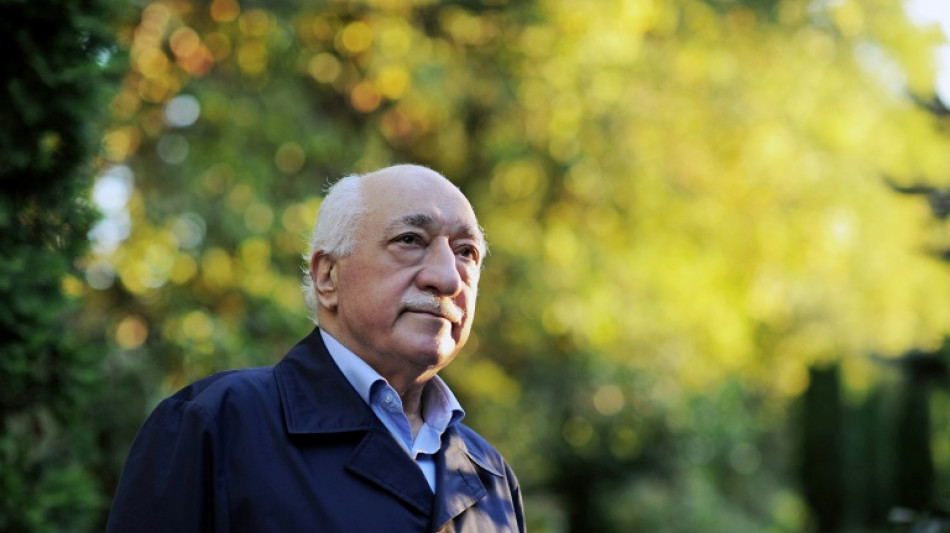
Fethullah Gulen: ex-Erdogan ally who became public enemy number one / Photo: SELAHATTIN SEVI - ZAMAN DAILY/AFP/File

 Trump Signals Willingness to Work With Democrats After Midterm Defeat

 Qatar media bodies discuss support for humanitarian initiatives

 InterContinental Hotels Group PLC Announces Transaction in Own Shares - November 04

 No. 22 UCLA defeats No. 5 Arizona 84-75 despite Kharchenkov's 38 points

 Vessel operator seeks witnesses after Vancouver grounding

 US Air Force deploys F-16 fighters to remote Aleutian base for readiness drill

 Bezos grant helps Seattle nonprofit move thousands of families toward housing

 Shrini Srivastava joins crew of Varanasi-Delhi Vande Bharat Sleeper service

 Nearly Half of Australian Workers Overqualified, Survey Finds

 RBI eases export-declaration compliance for individual service exporters

 India proposes more import entry points for drugs and medical devices

 Derek Tierney Outlines Ten-Year Strategy for National Digital Health System

 NBC’s Steve Kornacki Reveals Tech Habits Ahead of Midterm Elections

 India and Israel oppose UN draft on regional conventional arms control

 BLS Polymers shares open 65.3% above IPO price

 Capital-markets shares rally as Motilal Oswal and Angel One lead gains

 Latino Voters Defy ICE Fears, Turn Out in Record Numbers for Midterms

 ITC shares rise as analysts anticipate gradual cigarette-business recovery

 Reliance rally puts historical one-year return pattern in focus

 Kuwait edges Oman 1-0 in veterans Gulf Cup in Doha

 Saudi Aramco quarterly profit climbs 34.6% amid elevated oil prices
A former ally of Recep Tayyip Erdogan, US-based Muslim cleric Fethullah Gulen spent years eluding the clutches of Turkey's president, who accused him of masterminding a failed 2016 coup.
After nearly 25 years living away from Turkey, Gulen died in hospital overnight, Turkish public television said, citing groups close to the 83-year-old preacher.
The head of the influential Hizmet group became the sworn enemy of the president.
Erdogan's government accused him of heading a "terrorist" organisation as well as organising the 2016 bid to overthrow the president.
But Gulen insisted Hizmet -- Turkish for "service" -- was simply a network of charitable organisations and businesses.
The pair were once allies.
Erdogan profited from Gulen's network to consolidate power after becoming prime minister in 2003 in the face of an entrenched secular establishment.
- From ally to nemesis -
But tensions began emerging in 2010 only to explode into full-on enmity three years later when a corruption scandal shattered Erdogan's inner circle.
Erdogan blamed Gulen for masterminding the graft probe through his network of supporters in the judiciary and the police, turning him into "public enemy number one".
Since then, Erdogan has since accused the influential cleric -- whose movement is present on every continent with its sprawling network of public schools -- of leading a parallel state designed to overthrow him.
The president's hatred intensified following the botched coup of July 2016, which he believes was engineered by his former ally.
In the immediate aftermath, the authorities began a crackdown on the preacher's supporters, or "Gulenists".
Nearly 700,000 people were prosecuted and some 3,000 were sentenced to life jail for playing a role in the coup, authorities say.
During the unprecedented purge, more than 125,000 public sector workers were sacked or suspended, including around 24,000 military personnel and thousands of judges.
The authorities shut down private schools, media outlets and publishing houses.
Turkish intelligence services also staged multiple overseas raids in countries across central Asia, Africa and the Balkans to round up Gulen's suspected supporters.
- From anonymity to spiritual leader -
Gulen was born in the eastern Turkish province of Erzurum. Public records say it was 1941 but Gulen said he was born in 1938.
Despite being "just another imam in the 1970s" Gulen quickly became "the spiritual leader of a vast community with millions of supporters", wrote researcher Bayram Balci.
Supporters were "present in all sectors of the economy, in education, in the media, and also in the administration", Balci, a researcher at the Paris Institute of Political Studies (Sciences-Po), said in a 2021 study.
"With a taste for secrecy and influence, and even manipulation and intimidation... Gulen's movement is very similar to various Catholic movements like the Jesuits, Opus Dei and others, from which it has clearly drawn inspiration," he said.
Turkish officials refer to Gulen's movement as the "FETO terrorist organisation".
It has sometimes been described as a "sect", with members known to help each other in business and expected to contribute their time or money, whether students, housewives or wealthy businessmen.
Gulen moved to the US state of Pennsylvania in 1999, ostensibly for health reasons.
Despite multiple attempts by Turkey to extradite him, Gulen led a reclusive life in exile on the edge of the Poconos, a scenic mountainous, wooded region of Pennsylvania.
burs-hmw/tw/gil
H.Gonzales--AT