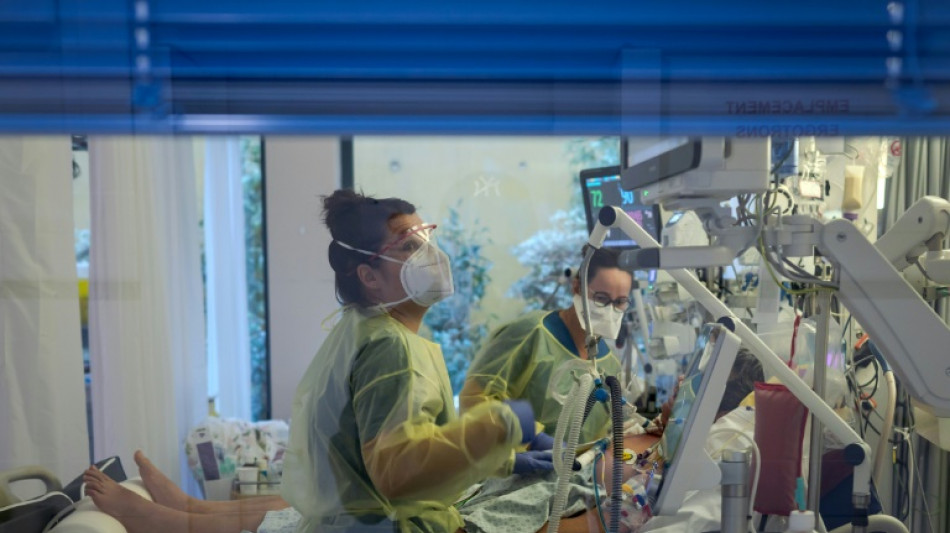
Swiss switch to 'presumed consent' on organ donations / Photo: Fabrice COFFRINI - AFP/File

 Dukascopy Bank Unveils AI-Powered Trading, 25,000+ Stock CFDs and a New Flagship E-Banking App
 Tech firms rally but Asian markets mixed, with eyes on US inflation

 Nepal holds day of mourning as families pray missing still alive

 African players in Europe: Mbeumo fires solo goal as United draw

 Malaysia cancels haze emergency, but warns problems remain
 Philippine sensation Eala looks forward to Asian Games 'fun'

 Jakarta airport extends closure after volcano eruption

 Lonely woman director in Venice sees industry backsliding on gender
 Tech firms rally on mixed day for Asian markets, with eyes on US inflation

 World number one An sends Asian Games warning with China hat-trick

 PSG go for three in a row as Champions League returns
 "Super-human' Alcaraz books US Open quarter-final clash with Shelton

 ECB set to hike interest rates as Iran war flares anew

 AI data centers are less thirsty now, tech giants say

 North Korea vows nuclear-armed navy as US ally drills open

 Under-fire Labuschagne named in Australia Test squad for South Africa

 InterContinental Hotels Group PLC Announces Transaction in Own Shares - September 07

 Best Way to Protect A 401(k) in 2026: Guide Released by Experts

 Tiafoe tops Medvedev in straight sets at US Open

 Zverev seeks US Open last eight as Osaka faces Rybakina

 Alcaraz turns up heat to reach US Open quarters
 Gatti salvages Juve draw with AC Milan in Serie A

 Sinayoko stars as unbeaten Paris FC down Marseille

 Still on top: 'Spider-Man' dominates North American box office
 Zelensky in fresh talks with US envoys: Ukraine official
Switzerland voted Sunday to boost the availability of transplant organs by making everyone a potential donor after death unless they have expressly objected.
The legal change, approved by 60 percent of voters in a referendum, marks a dramatic shift from the current system.
Under the existing laws, transplants are only possible if the deceased person consented while alive -- and their wishes are often unknown.
In such cases, the decision is left up to relatives -- who in most cases opt against organ donation.
This has left many of those in need of a transplant waiting in vain for an organ.
At the end of 2021, more than 1,400 patients were awaiting transplant organs in Switzerland, a country of around 8.6 million people.
Last year, 166 deceased persons donated their organs in Switzerland, and a total of 484 organs from deceased donors were transplanted.
But 72 people died in 2021 while waiting on an organ transplant waiting list, according to the organisation Swisstransplant.
"The public have shown that they are ready to give a chance to the people who are on the waiting list," said Swisstranspant director Franz Immer.
In a bid to reduce the backlog, the government and parliament wanted to change the law to a "presumed consent" model, something already adopted in a number of other European countries.
According to that system, people who do not wish to become an organ donor after death must explicitly say so.
Those who have not made their wishes clear would be assumed to be in favour. However, relatives would still be given a say. The rules would only apply to people aged 16 and over.
The medical conditions for donation remain the same: only people who die in a hospital intensive care unit can donate their organs, and two doctors must confirm the death.
- Evolution not revolution -
Under the incoming laws, relatives can refuse if they know or suspect that the person concerned would have chosen not to donate an organ.
In cases where no relatives can be contacted, no organs may be removed.
"It's not a revolution, but an evolution," Health Minister Alain Berset said following the result.
Not everyone had agreed with the government's proposals.
A group headed by a midwife and a doctor, with support from some theologians and jurists, as well as the populist and religious right, gathered enough signatures to force the issue to a referendum.
They claimed it was ethically dubious to assume that someone who has not made their wishes clear would consent to donate an organ.
They insisted on the need for patients to provide explicit, informed consent before any and all medical procedures.
They also warned that the shift would place greater strain on relatives of the deceased, who might not dare refuse, for fear that they would be viewed as selfish.
W.Moreno--AT