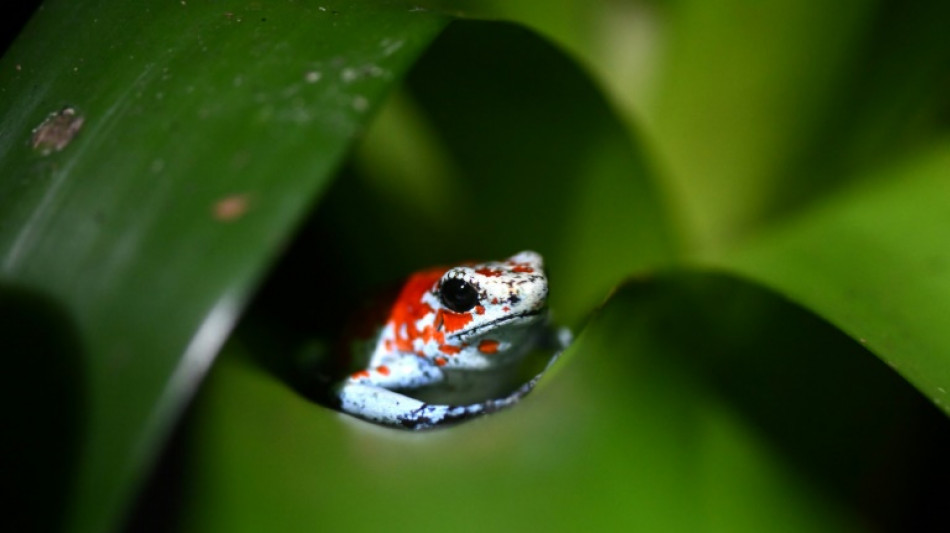
Lab-grown frogs: a Colombian's response to wildlife trafficking / Photo: Raul ARBOLEDA - AFP

 Flooding forces residents to flee homes by boat in Pakistan

 Polish village puts faith in Europe's tallest Virgin Mary statue

 Farmers help battle French forest inferno before new heatwave

 Heat, overcrowding, pushes Italian prison guard union to sue

 UK TV comedy star and naturalist Bill Oddie dies at 85

 AstraZeneca profit rises on strong cancer drug sales

 Olympic triathlon champ Beaugrand to sit out European athletics

 Spain races to contain blazes before temperatures rise

 Pirlo bitter over debate that cost him Italy coaching job

 Infantino slams World Cup critics for 'spreading hate'
 France, Spain race to contain 'monster' fires ahead of new heatwave

 Indonesia bank chief quits, adding uncertainty to struggling economy

 Vita Hydrokultur Opens £1.5m Series A Round to Scale Plant-Grown Skincare Ingredients

 Chinese chipmaker CXMT soars 500% on debut as AI fuels shortages

 Alonso says 'great signing' Rogers can rejuvenate Chelsea

 Oil prices sink as US-Iran pause fuels fresh Hormuz hopes

 Indonesia central bank chief steps down early: govt

 Gaza teen triumphs despite war, loss and displacement

 Whales at risk, hungry pelicans: Marine heat wave hits California

 With minutes to flee, Spain fire evacuees grab what they can

 Ioane, Holland back for All Blacks' blockbuster South Africa tour

 HyProMag USA to Establish Early Magnet Finishing Capability as Part of Phased Texas Hub Development

 International Battery Metals Announces CEO Transition

 Nextech3D.ai Provides Update on Acquisition of Remaining ARway Shares; Closing Expected in October 2026

 Orogen Royalties Announces Project, Partner and Royalty Update

Down a dirt track in Colombia, deep in a forest, conservationists are breeding prized exotic frogs to try to undercut traffickers who are plundering the country's jungles of its amphibians.
A critically-endangered harlequin poison-dart frog (oophaga histrionica) is among the 14 species bred for sale at the Tesoros de Colombia (Treasures of Colombia) laboratory near Bogota -- one of several schemes worldwide to combat the illegal trade in wildlife by supplying specimens bred legally, in captivity.
The illegal trade in wild flora and fauna is the fourth-most profitable illicit business in the world, with annual revenues of $23 billion (21 billion euros), according to the United Nations.
At the UN COP16 biodiversity conference starting this weekend in the Colombian city of Cali, delegates will discuss ways to combat poaching of everything from elephant ivory to pangolin scales.
In Colombia, which is home to about 10 percent of the world's amphibians, poison dart frogs are captured alive in the Choco jungle and smuggled abroad to adorn foreign terrariums.
The venom causes collectors' frissons: the frogs secrete a toxin that can cause respiratory failure.
To tame the trafficking of these and other species, some countries have authorized a legal trade in wildlife.
Costa Rica, another Latin American biodiversity hotspot, has licensed butterfly breeding schemes to try to protect its forest habitats.
"If there is an international demand for frogs, it is important to provide legal frogs that can also reproduce in (their new) home," Tesoros de Colombia founder Ivan Lozano said.
- Frog 'passport' -
Frog trafficking is a crime punishable by between five and almost 12 years in prison in Colombia, the world's second-most biodiverse country after Brazil.
But in the United States and many European countries, there is no ban on trafficked amphibians.
Tesoros de Colombia exports seven species of frog and is waiting on permits for seven others.
"When we export them we operate on the basis that they are going to a better place," Alejandra Curubo, a veterinary technician told AFP, proudly showing off one of her charges which had just finished its metamorphosis from a tadpole.
From Colombia, some amphibians traveled more than 5,000 kilometers (3,100 miles) north to Michael Heinrichs' terrarium in Colorado, United States.
The 65-year-old collector, who works for a healthcare company, has amassed a collection of 40 specimens, including a poison-dart frog, which he keeps in a room he calls his "zen place".
Heinrichs paid up to $1,000 each for legally-traded specimens that come with a unique code based on their spot patterns.
"Each owner gets a unique frog, with traceability," Lozano said.
The availability of legal amphibians has driven down prices for trafficked specimens.
The golden poison frog or phyllobates terribilis, used to be worth $150. Now it comes with a list price of $40.
- Noah's ark -
Conservationists are divided on the merits of legalizing the wildlife trade.
Science mazagine in its October 11 edition warned that legalizing the seemingly insatiable market for rhino horn, used in traditional medicine in Asia, "could increase demand... and complicate law enforcement's ability to distinguish legal sources from illegal sources."
It took Lozano years before obtaining his first Colombian export permit.
Since he began exporting to the United States "the market for the illegal trade of animals from Colombia has really dried up," Heinrichs, his customer in Colorado, said.
"Today it would be really hard" to find Colombian frogs in the US, he said.
Colombian police have also stepped up their efforts against traffickers.
In January, a woman was found with 130 dehydrated poisonous frogs stashed in film canisters in her luggage at Bogota airport.
Lozano hopes to gradually release his frogs back into the wild once "international demand has decreased."
Warning that trafficking risked wiping out entire species, he said: "I hope we don't have to be a Noah's Ark".
H.Gonzales--AT