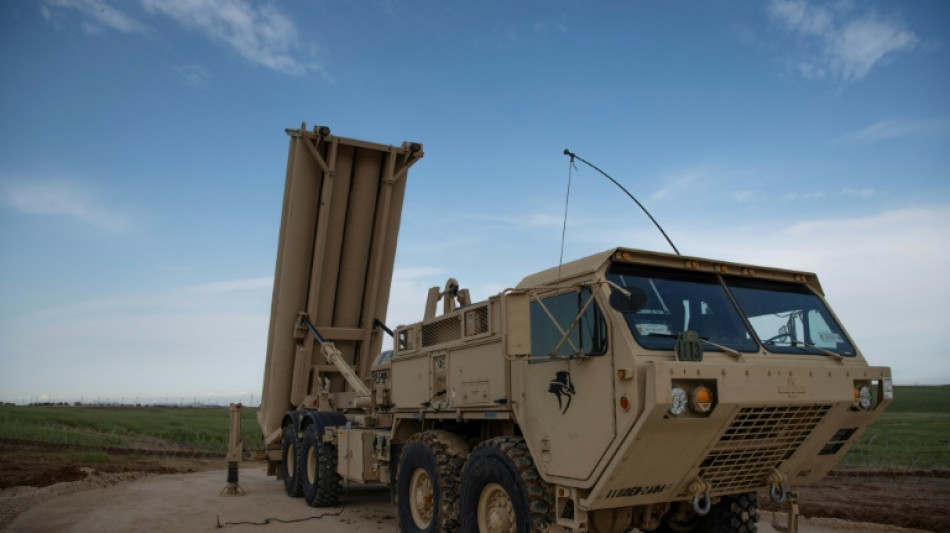
US missile battery deployment deepens role in Israel-Iran conflict / Photo: Cory PAYNE - DVIDS/AFP

 Trump Signals Willingness to Work With Democrats After Midterm Defeat

 Qatar media bodies discuss support for humanitarian initiatives

 InterContinental Hotels Group PLC Announces Transaction in Own Shares - November 04

 No. 22 UCLA defeats No. 5 Arizona 84-75 despite Kharchenkov's 38 points

 Vessel operator seeks witnesses after Vancouver grounding

 US Air Force deploys F-16 fighters to remote Aleutian base for readiness drill

 Bezos grant helps Seattle nonprofit move thousands of families toward housing

 Shrini Srivastava joins crew of Varanasi-Delhi Vande Bharat Sleeper service

 Nearly Half of Australian Workers Overqualified, Survey Finds

 RBI eases export-declaration compliance for individual service exporters

 India proposes more import entry points for drugs and medical devices

 Derek Tierney Outlines Ten-Year Strategy for National Digital Health System

 NBC’s Steve Kornacki Reveals Tech Habits Ahead of Midterm Elections

 India and Israel oppose UN draft on regional conventional arms control

 BLS Polymers shares open 65.3% above IPO price

 Capital-markets shares rally as Motilal Oswal and Angel One lead gains

 Latino Voters Defy ICE Fears, Turn Out in Record Numbers for Midterms

 ITC shares rise as analysts anticipate gradual cigarette-business recovery

 Reliance rally puts historical one-year return pattern in focus

 Kuwait edges Oman 1-0 in veterans Gulf Cup in Doha

 Saudi Aramco quarterly profit climbs 34.6% amid elevated oil prices
US troops have arrived in Israel as part of the deployment of a THAAD missile defense battery, the Pentagon said Tuesday, a move that will help protect Washington's ally but deepens the United States' involvement in the conflict.
The deployment of the Terminal High Altitude Area Defense (THAAD) system comes as Israel prepares to hit back against Iran for a major ballistic missile attack earlier this month, and the battery will boost Israeli defenses in case Tehran strikes back again.
Israel has targeted leaders of groups backed by Iran -- including Hezbollah and Hamas -- during the Gaza war, and has been accused of killing Hamas's political chief on Iranian soil, which Tehran cited as part of its justification for its October strikes.
US ships and warplanes have helped defend Israel from the Iranian attacks, but the deployment of the battery will put the roughly 100 US troops who will operate it -- as well as the system itself -- on the ground in Israel and more directly in harm's way.
"Putting US servicemembers in Israel proper shows that Washington is very visibly and tangibly committed to Israel's security and will fight if necessary," said Raphael Cohen, a senior political scientist at the RAND Corporation.
US President Joe Biden's administration "likely hopes that this move will increase the deterrence vis-a-vis Iran and reassure the Israelis," he added.
Cohen said the move may give the Biden administration greater leverage to shape the Israeli response to the October 1 Iranian strikes.
Israel already has an advanced, multi-layered network of air defenses, but Cohen said it has been stretched by a year of combat with the various Iran-backed groups in the region.
- 'Very expensive target' -
"Particularly if Iran increases its volume of fire and Hezbollah continues to attack, more missiles will get through and hit their targets," he said, referring to the Lebanon-based group that Israel has launched a renewed military offensive on since last month.
Pentagon spokesman Major General Pat Ryder said Tuesday that an advance team of US personnel and initial components needed for the battery had arrived in Israel the previous day, with more to follow soon.
"The battery will be fully operational capable in the near future," he said in a statement, adding that the deployment "underscores the United States' commitment to the defense of Israel and to defend Americans in Israel from any ballistic missile attacks by Iran."
The THAAD system -- which was developed in the 1990s, with the first battery activated in 2008 -- is operated by 95 soldiers and consists of six truck-mounted launchers with eight interceptors each, a radar, and a fire control component, according to the US Congressional Research Service.
Tom Karako, director of the Missile Defense Project at the Center for Strategic and International Studies, said the battery -- which includes a billion-dollar radar -- is "potentially a very expensive target" that needs to be well-protected.
He said the United States only has a limited number of THAAD batteries, and also noted that the country is "not producing very many THAAD rounds at the moment, and so we have to be very deliberate about our inventory."
The THAAD deployment to Israel "obviously adds a lot of capability and capacity, but it... comes with some strategic risk, and it comes with some operational and opportunity costs," Karako said.
W.Nelson--AT