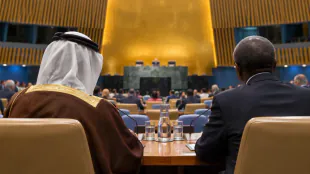
Painkiller sale plan to US gives France major headache / Photo: Valentine CHAPUIS - AFP

 Trump Signals Willingness to Work With Democrats After Midterm Defeat

 Qatar media bodies discuss support for humanitarian initiatives
 InterContinental Hotels Group PLC Announces Transaction in Own Shares - November 04

 No. 22 UCLA defeats No. 5 Arizona 84-75 despite Kharchenkov's 38 points

 Vessel operator seeks witnesses after Vancouver grounding

 US Air Force deploys F-16 fighters to remote Aleutian base for readiness drill

 Bezos grant helps Seattle nonprofit move thousands of families toward housing

 Shrini Srivastava joins crew of Varanasi-Delhi Vande Bharat Sleeper service

 Nearly Half of Australian Workers Overqualified, Survey Finds

 RBI eases export-declaration compliance for individual service exporters

 India proposes more import entry points for drugs and medical devices

 Derek Tierney Outlines Ten-Year Strategy for National Digital Health System

 NBC’s Steve Kornacki Reveals Tech Habits Ahead of Midterm Elections

 India and Israel oppose UN draft on regional conventional arms control
 BLS Polymers shares open 65.3% above IPO price

 Capital-markets shares rally as Motilal Oswal and Angel One lead gains

 Latino Voters Defy ICE Fears, Turn Out in Record Numbers for Midterms

 ITC shares rise as analysts anticipate gradual cigarette-business recovery

 Reliance rally puts historical one-year return pattern in focus
 Kuwait edges Oman 1-0 in veterans Gulf Cup in Doha

 Saudi Aramco quarterly profit climbs 34.6% amid elevated oil prices
The planned sale of France's best-selling medical drug to US investors has caused the government a splitting headache after an outcry against the project from politicians on all sides.
Even President Emmanuel Macron is involved in the debate centred on a perceived "loss of sovereignty" if popular painkiller Doliprane falls into American hands.
Doliprane is the brand under which healthcare giant Sanofi sells paracetamol, a non-opioid analgesic for the alleviation of mild to moderate pain, and of fever.
In French pharmacies, the brand's colourful boxes often line entire shelf walls, and Doliprane comes in many doses -- from 100 mg for newborn babies to 1,000 mg for adults -- and in tablet, capsule, suppository and liquid forms.
It is so ubiquitous that French people call any paracetamol product Doliprane, even when it is made by a different manufacturer.
Sanofi, which is France's biggest healthcare company and among the world's top 12, has found out over the past few days just how attached the French are to the drug.
Political and trade union reactions came in hard and fast after the company announced last week that it was in talks with New York-based private equity firm Clayton, Dubilier & Rice (CD&R) to sell a 50-percent controlling stake in its subsidiary Opella, which makes Doliprane along with other consumer healthcare products.
The planned spinoff, it said, would be part of Sanofi's strategy to focus less on over-the-counter medication and more on innovative medicines and vaccines, including for polio, the flu and meningitis.
"This is another symbol for the loss of our sovereignty," thundered Fabien Roussel, France's Communist party leader, calling the planned sale "shameful".
At the other end of the political spectrum Jordan Bardella, president of the farright RN party, said that "the piecemeal sale of France carries on".
- 'Protect France' -
Green party deputy Marine Tondelier said the government had "learned nothing" from the Covid pandemic when France suffered from medication bottlenecks blamed mostly on the outsourcing of production to foreign countries.
An adhoc group of centre-right lawmakers -- including from Macron's party -- meanwhile stated that the sale represented "a very worrying risk for our national security".
Boris Vallaud, parliamentary leader for the Socialists, reminded the government of 2022 when a sharp rise in demand for paracetamol caused some shortages in French pharmacies.
"Already some months ago, paracetamol was nowhere to be found," he said. "And now they want to give it up completely?"
In a message to Finance Minister Antoine Armand -- in the job only since last month -- the group of deputies said the planned sale went against "the re-establishment of France's sovereignty in the health sector".
The government had the legal option, they said, of posing conditions or blocking the sale on the grounds that it concerns a "sensitive" industry.
Macron himself entered the fray Monday, saying that "the government has the instruments needed to protect France" from any unwanted "capital ownership".
The American investment fund is offering more than 15 billion euros ($16.4 billion) for Opella, according to Les Echos, a French business daily.
Faced with the protests, Armand on Friday told Sanofi and the potential buyer that Opella's "headquarters and decision-making centres" had to remain in France.
On Monday, Industry Minister Marc Ferracci said that current production also had to stay, "to safeguard employment and to secure supply for French people".
The same went for research and development facilities, he said.
Speaking to broadcaster France 3, Ferracci said the government would invoke a procedure for the control of foreign investment if the buyers failed to meet the demands.
But he added: "I honestly believe that those commitments will be made."
burs-jh/as/rl
Y.Baker--AT