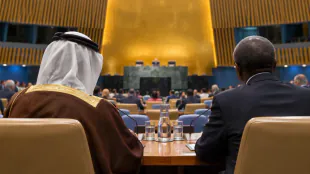
Iraq walks fine line with pro-Iran factions to avoid war / Photo: أحمد الربيعي - ا ف ب

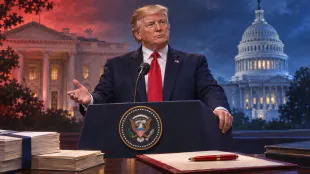 Trump Signals Willingness to Work With Democrats After Midterm Defeat

 Qatar media bodies discuss support for humanitarian initiatives

 InterContinental Hotels Group PLC Announces Transaction in Own Shares - November 04

 No. 22 UCLA defeats No. 5 Arizona 84-75 despite Kharchenkov's 38 points

 Vessel operator seeks witnesses after Vancouver grounding

 US Air Force deploys F-16 fighters to remote Aleutian base for readiness drill

 Bezos grant helps Seattle nonprofit move thousands of families toward housing

 Shrini Srivastava joins crew of Varanasi-Delhi Vande Bharat Sleeper service

 Nearly Half of Australian Workers Overqualified, Survey Finds

 RBI eases export-declaration compliance for individual service exporters

 India proposes more import entry points for drugs and medical devices

 Derek Tierney Outlines Ten-Year Strategy for National Digital Health System

 NBC’s Steve Kornacki Reveals Tech Habits Ahead of Midterm Elections

 India and Israel oppose UN draft on regional conventional arms control

 BLS Polymers shares open 65.3% above IPO price

 Capital-markets shares rally as Motilal Oswal and Angel One lead gains

 Latino Voters Defy ICE Fears, Turn Out in Record Numbers for Midterms

 ITC shares rise as analysts anticipate gradual cigarette-business recovery

 Reliance rally puts historical one-year return pattern in focus

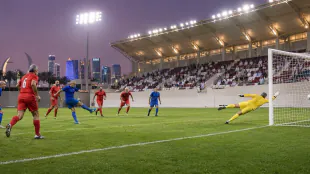 Kuwait edges Oman 1-0 in veterans Gulf Cup in Doha

 Saudi Aramco quarterly profit climbs 34.6% amid elevated oil prices
The Iraqi government is struggling to rein in powerful pro-Iran factions that risk pulling Iraq into a regional war, as fighting in Gaza and Lebanon threatens to spread further.
The Islamic Resistance in Iraq, a loose alliance of armed groups backed by Iran, has claimed several drone attacks targeting Israel in recent months, which they say are in support of their Palestinian ally Hamas in the Gaza Strip.
While most of the attacks have been intercepted, a drone strike last week that Israel said was launched from Iraq killed two Israeli soldiers.
Israeli Prime Minister Benjamin Netanyahu the following day said his country was "defending itself on seven fronts", including against Shiite groups in Iraq.
After nearly a year of war in Gaza following Hamas's October 7, 2023 attack, Israel in September escalated its strikes against Iran-backed Hezbollah and sent ground troops into the south of Lebanon.
Iran launched its second-ever direct attack on Israel on October 1 this year, firing 200 missiles towards its arch-foe, prompting a promise of retaliation.
With warnings of all-out regional war multiplying, the fact that the Iraqi government is itself led by the Iran-aligned Coordination Framework coalition may make it harder for Baghdad to stay clear of further spillover.
Still, after decades of successive wars and crises, Iraq wants to prevent the violence already wracking the region from spreading into its turf.
On Sunday, Iraqi Foreign Minister Fuad Hussein said Baghdad was against any "expansion towards the Islamic Republic of Iran and (Israel's) exploitation of Iraqi airspace", during a visit by his Iranian counterpart.
"The continuation of the war and its expansion towards the Islamic Republic of Iran and (Israel's) exploitation of Iraqi airspace as a corridor is completely unacceptable and rejected," he said.
- 'Spare Iraq' -
Iraqi Prime Minister Mohammed Shia al-Sudani, on the first anniversary of Hamas's attack on Israel that triggered the Gaza war, said that his government had worked "with great effort to spare Iraq an escalation".
He also called for greater efforts to "save the region from the evils of a war that will leave nothing behind".
But according to Iraqi political analyst Sajad Jiyad, Baghdad has realised that it cannot "control events" on its own turf, nor will it be able to "prevent any response from outside the country."
A source close to Iraq's pro-Iran groups told AFP that officials in the Coordination Framework recently met "with a number of faction leaders and stressed to them that attacks on Israel expose the country to the risk of air strikes that we can do without."
During the meeting, the armed groups reportedly urged the government not to intervene, arguing that they alone would bear responsibility for any consequences, according to the same source, who spoke on condition of anonymity.
Ahmad al-Hamidawi, secretary-general of Iraqi armed faction Kataib Hezbollah, has said the groups should be readying for an escalation.
"The Islamic Resistance is preparing for the possibility of this war expanding and to continue directing precise strikes at the heart" of Israel, he said.
- Media war? -
Iraqi national security adviser Qasim al-Araji told Iraqi television channel Al-Rabia last week that Baghdad is exerting "internal and external pressure to reduce the escalation".
"The government is the one that exclusively has the authority to issue the decision of war and peace, and Iraq has no intention of entering a war that may have dire consequences," he said.
But Jiyad, a fellow at the New York-based Century International think tank, said that ultimately, it might not be up to Iraq whether or not it gets dragged in.
In the event of an Israeli attack on Iraqi infrastructure or oil fields, he said, "the Iraqi government will have no alternative but to support any military response to Israel".
After Iran's missile attack on Israel, the pro-Tehran Iraqi Resistance Coordination Committee vowed to target US bases and interests in Iraq and the region if Israel used Iraq's airspace to strike Iran.
But according to Iraqi military expert Munqith Dagher, the factions know any confrontation with Israel would not be an equal fight, given its intelligence and military prowess.
The Iraqi groups are fighting, in his words, "a media battle", because "they know the limits of their military capabilities".
Ch.P.Lewis--AT