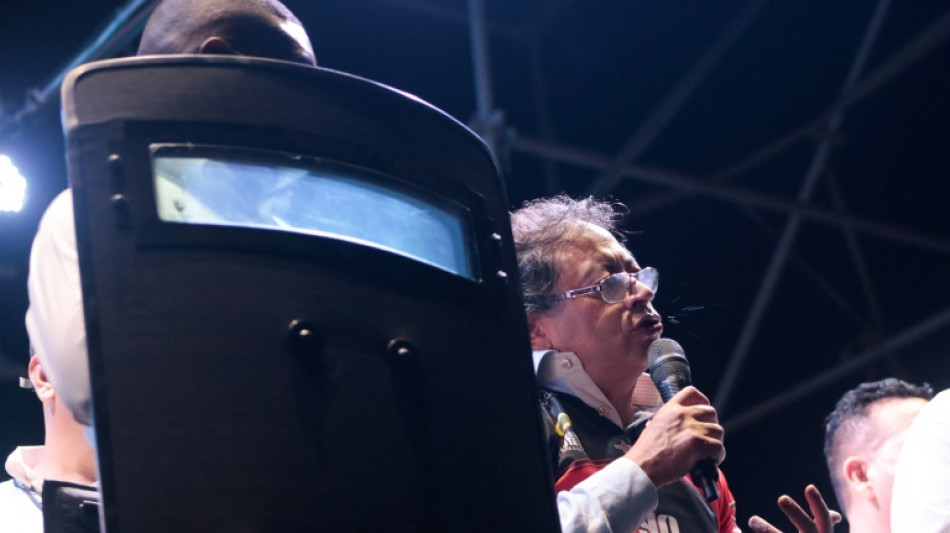
Colombia elections: the spectre of political assassination / Photo: SCHNEYDER MENDOZA - AFP/File

 Pietersen joins England coaching team ahead of World Cup

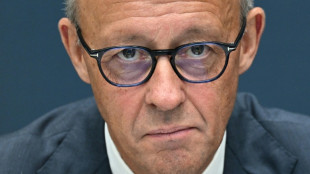 Germany's triumphant far-right AfD aims fire at Merz

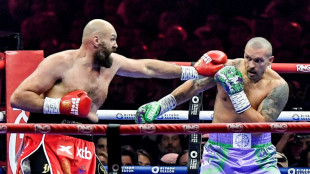 Fury claims Joshua bout is off, calls for Usyk trilogy

 British family bids to row back against suicide taboo

 China's teenage 223cm basketball player 'just a little girl'
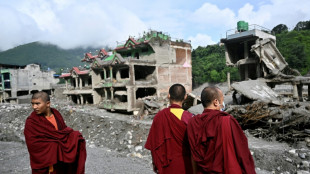
 Tokyo's Shinjuku to ban more than half of vacation rentals

 Australian Rules limits contact training to reduce concussion

 Germany's Merz under pressure from far-right election triumph

 Nepal tunnel rescues face 'unprecedented' challenge
 Mourinho's Real Madrid European revival bid starts with Inter reunion

 Solomons PM survives attempt to oust government

 Ohtani 'unlikely' to pitch again this season, says Dodgers manager
 Driver thanks 'superhero' rival for saving him from flaming race car

 Can dogs sniff cancer? AI joins the hunt in India

 Shelton steams into US Open quarter-final clash with Alcaraz

 25 years on, America seeks to keep 9/11 memories alive

 'Trumpapalooza' tests Republican bet on unpopular US president
 Pegula tops Cirstea to reach US Open quarter-finals
 Australians could opt out of social media algorithms under new law

 Genflow Biosciences PLC Announces Appointment of Investor Relations Adviser

 Enjoying the moment: Alcaraz steps it up to reach US Open quarter-finals
 Five dead, five injured after Amazon cargo plane overshoots Miami runway
 La Rochelle half-backs lead fightback against Toulouse
 US envoys have 'more effective proposals': Ukraine official

 Defending champion Alcaraz powers into US Open quarter-finals
Every time Colombian leftist presidential candidate Gustavo Petro, who leads opinion polls, steps out in public the scene is striking: he is surrounded by a wall of nervous-looking bodyguards brandishing bullet-proof shields.
The spectre of assassination is haunting the electoral campaign in which the left has a real chance of taking power for the first time in a country that has a history of political careers ending in a hail of bullets.
In the 20th century, five presidential candidates were assassinated by opponents, drug traffickers or paramilitaries working in complicity with the state.
Three were from the left or far left, and the other two were liberals.
The country was gripped by more than five decades of conflict between the state and the Revolutionary Armed Forces of Colombia (FARC) that ended with a 2016 peace deal.
And while the level of violence has dropped since then, Colombia remains wracked by a multi-faceted conflict involving drug traffickers and a multitude of armed groups.
- 'Very high' risk -
"The spectre of death accompanies us," Petro told AFP in February. "It does not stop appearing to me like a flash, when I'm in a crowd, when I'm on a platform and there is a full square, someone could shoot from anywhere."
Earlier this month, the 62-year-old senator, a former left-wing guerrilla, had to call off a public appearance after his team received "first-hand information" about an assassination plot by two paramilitaries.
Two days later he did appear in the northern city of Cucuta behind the bullet-proof shields.
His 60-strong bodyguard has since been beefed up while local security forces have provided extra officers for his numerous trips to provincial areas that have contributed to his successful campaign.
The assassination risk "is very high", according to Felipe Botero, a political science professor at the Andes University.
"They won't just (try to) kill Petro the candidate but it is also highly likely they will try to assassinate him if he wins the presidency," Botero told AFP.
His running mate Francia Marquez, a black environmentalist, has also received threats.
Conservative candidate Federico Gutierrez has spoken of his concern, not just for Petro but also himself, having claimed to have been threatened by the Marxist National Liberation Army (ELN), the last remaining recognized rebel group in the country.
"Take care of Federico Gutierrez," said former president Alvaro Uribe, who escaped a FARC assassination attempt using explosives in 2002.
- Fear of the left -
In the history of modern Colombia a date that stands out is April 9, 1948 when liberal presidential candidate Jorge Eliecer Gaitan was shot dead on a street in Bogota.
His murder inflamed the city and set off a bloody internal conflict that, more than a half century later, has still not been extinguished.
Four decades later, communist Jaime Pardo Leal (1987), liberal Luis Carlos Galan (1989), and leftists Bernardo Jaramillo and Carlos Pizarro (1990), all presidential hopefuls, were assassinated.
Alexander Gamba, a professor at the Saint Thomas University, says there are three reasons for a "possible" attack on Petro.
Firstly, Colombia has "violence professionals" like the almost two dozen mercenaries who took part in the assassination of Haiti's president last year.
Secondly, Petro's opponents have claimed his victory would be "a huge national catastrophe", which has contributed to an atmosphere in which his assassination would almost be presented as a "patriotic act."
Lastly, the country has "never had political change" involving the left wing, which conservatives continue to link to the armed rebellion.
"In a country like Colombia, marked by political violence and with the record for the murder of social leaders, we obviously take all threats against Mr Petro seriously," said Alfonso Prada, one of the candidate's advisors.
"If we hope to run the country, we need to be capable of looking after our own security," he added.
For its part, the outgoing government of President Ivan Duque, has said Petro "is one of the best protected people" in the country.
P.Smith--AT