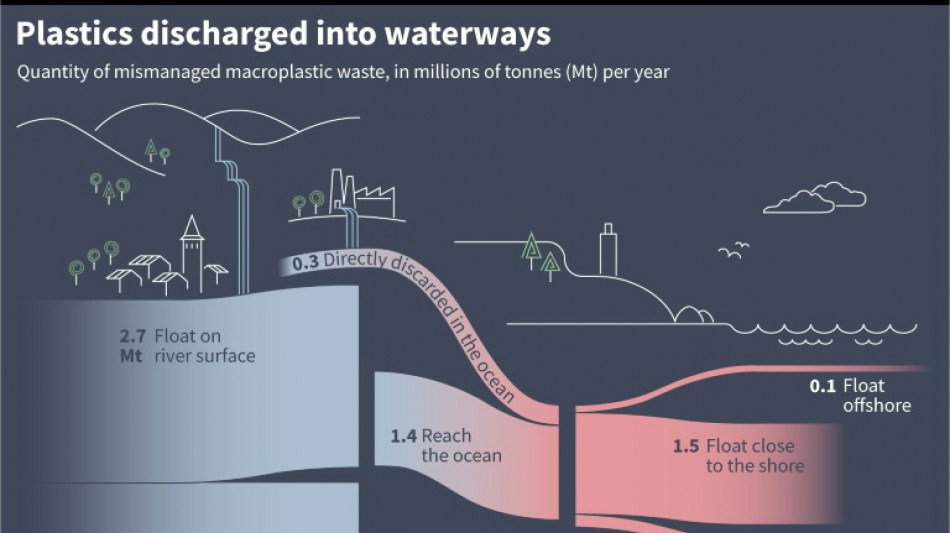
So where does the oceans' plastic waste come from?
/ Photo: Valentin RAKOVSKY, Valentina BRESCHI - AFP

 Berlin police shoot dead chief suspect in deadly Islamist Pride attack

 'Fire calling the shots': France's blaze pushes crews to the brink

 Proud Antonelli salvages third as Mercedes limit damage

 Iran halts strikes as Trump gives space to talks

 Berlin mourns deadly Islamist Pride attack as police hunt for suspect

 Ex-president Hernandez returns to Honduras after Trump pardon

 Norris grabs first race win of season in Hungary

 Sooryavanshi's 81 steers India to Zimbabwe T20 series sweep
 Spanish wildfires intrude on holidaying foreign visitors

 France and Spain battle 'unpredictable' wildfires as 300,000 evacuated

 Taiwan's Chou Tien-chen snatches China Open title at age 36

 Ramsay-Peaty bounces back at Commonwealth Games after tearful outburst

 Iran says halts Middle East attacks as US holds fire

 Wildfires overwhelm exhausted firefighters in France and Spain

 Urgent search for suspect after deadly attack near Berlin Pride

 D-Day beaches inscribed on UNESCO World Heritage List

 As Zimbabwe's raw lithium ban pays off, ambitions grow
 German manhunt after deadly car ramming near Berlin Gay Pride

 Vienna's venerable vineyard taverns forced to move with the times
 Thousands crowd shelters as wildfires force exodus in France, Spain

 Burnham offers sweeteners, hopeful vibes in first week as UK PM

 'The Odyssey': Christopher Nolan's latest cultural phenomenon

 'Star Trek' celebrates 60th anniversary at Comic-Con

 Jenny Shin Goes Wire-to-Wire to Capture ISPS HANDA Women's Scottish Open
 ELEKTROS Pursues Strategic Growth Through U.S. Lithium Partnerships and Customer-Focused EV Charging

In the form of bottles, tyres, packaging and piping, millions of tonnes of plastic waste are dumped every year in the world's waterways, often ending up in the oceans.
And their amount could almost double by 2060, unless strong measures are taken against the pollution, the Organisation for Economic Cooperation and Development (OECD) warns.
Due to mass production of the material from the 1950s to 2019, 140 million tonnes have already accumulated in the rivers, lakes and oceans, the OECD said in a 2023 report.
Some 22 percent of this forms a "plastic soup" in the oceans and 78 percent is found in freshwater ecosystems.
- Poor waste management -
Plastic burned in open pits or tossed in uncontrolled or unauthorised dumpsites is the main source of pollution of the aquatic environment.
Most of this plastic waste ends up in freshwaters, with a large part, including bottles and plastic used in the construction sector, sinking in waterways and lakes.
The rest, including food packaging and closed bottles, floats for "years, even decades", before ending up in the oceans, the OECD says.
Waste from shipping activity, including nets and fishing gear, is to a much lesser extent another source of plastic waste in the oceans, as well as so-called microplastics, pieces of plastic which measure less than five millimetres.
So called macroplastic, which is bigger than five millimetres, has an average life cycle of six months to 35 years and slowly decomposes to become microplastic, which is "more likely to be ingested by aquatic species", the OECD says.
- Asia's rivers -
The risk of plastic moving from land to the waterways, and then into the sea, differs from location to location.
Out of some 100,000 waterways, only 1,000 are responsible for four-fifths of the macroplastic waste in the oceans, according to a 2021 study by researchers for NGO Ocean Cleanup published in the Science Advances journal.
The remaining fifth comes from 30,000 other rivers.
Out of the 50 main rivers carrying plastic to the oceans, including small urban waterways, 44 are in Asia, "due to population density and bad waste management", Laurent Lebreton, Ocean Cleanup's director of research, told AFP.
The Philippines, which has thousands of islands, dumps the most plastic into the sea. Its Pasig River, which flows into Manila Bay, is "the most (plastic) polluted" in the world.
With the Philippines' Tullahan and Meycauayan Rivers, India's Ulhas River and Malaysia's Klang River, it is one of the top five carrying plastic into the oceans.
- Gloomy forecast -
Driven by rising population and economic growth, the global use of plastics should almost triple between 2019 and 2060, to 1,231 million tonnes (Mt) per year, according to the OECD.
That is a gloomy outlook for the aquatic environment where 493 Mt of plastic could pile up by 2060, of which more than half from sub-Saharan Africa, China, India, and other developing Asian countries, it says.
In Europe and the United States, on the contrary, plastic industrial waste in the aquatic environment should decrease, due to improved waste management, the OECD forecasts.
T.Sanchez--AT