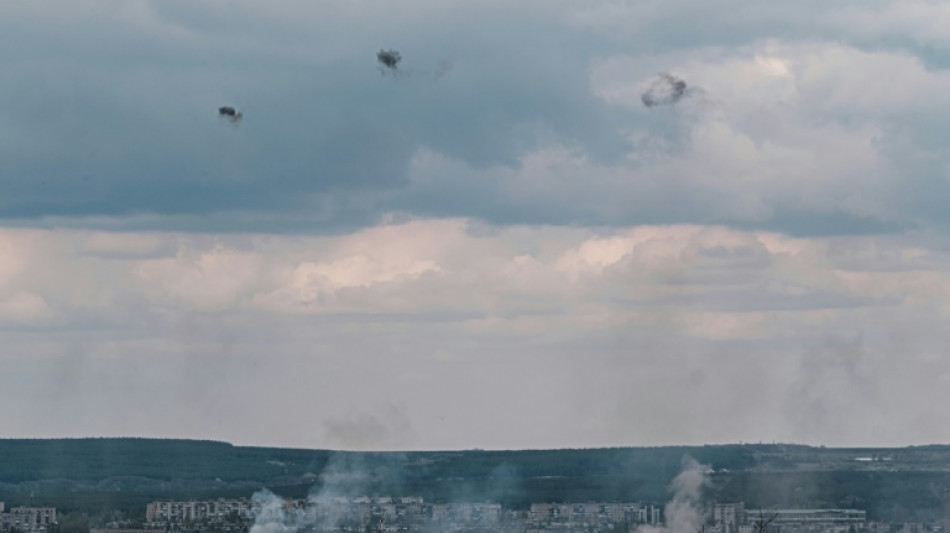
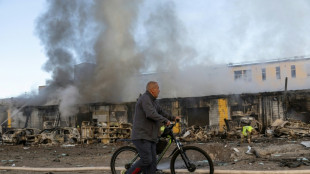
In east Ukraine, the war-weary listen out to stay alive / Photo: Yasuyoshi CHIBA - AFP

 Nepal flood death toll rises as rescuers scour tunnels

 France's Mistral sees value soar with 3 bn euro cash infusion

 Nepal glacier saw exceptional heat before collapse caused deadly floods: researcher

 Ethiopia boosts drone production to fight rebels
 Yemen rebels hit Saudi Arabia with wave of strikes, wounding 73

 Nepalis mark a year since deadly protests that toppled government

 Rubio launches Latin America tour to cement US influence

 France tries 14 over deadliest Channel migrant crossing disaster

 Australia threatens hefty fines if big tech fails 'duty of care'
 Zverev romps into quarter-finals as Darderi downed

 Kauai on tornado watch as Hurricane Lowell nears Hawaiian islands

 Pakistan roll the dice in search of consolation win over England

 Yen extends gains as traders eye rate hike, tech rallies again

 'The ber months': Christmas arrives early in the Philippines

 N. Korea calls Russia bridge a sign of tighter ties

 US sanctions threaten to crush Iranian students' dreams

 Former champ Gauff holds off Jovic to reach US Open quarter-finals

 Battery X Metals to Appoint Accomplished Technology and Consumer Brands Executive Nicholas Reichenbach to Board of Directors
 Equitech-Bio Expands Reagent Portfolio with New IgG Offering and Publication-Backed Product Validation from Bioz

 CPG Life Fund I Launches $20 Million Operator-Led CPG Fund

 Who is the Best Female Cosmetic Surgeon in Florida?

 CANEX Metals Announces C$6.5 Million Strategic Financing Led By C$3 Million Investment by Eric Fier

 Helio Sets September Roadshow Across Austin, Houston, Phoenix, Scottsdale
 Gaming Realms PLC Announces Interim Results

 Universal Edge Technologies Establishes Senior Advisory Committee, Names Mark Powell and Mark P. Mills as Founding Members
After hearing the shells raining down around her for weeks, 58-year-old Ludymyla is still learning to differentiate between the sounds of the explosions ripping apart towns in war-scarred Donbas.
"It starts with a whistle and then everything shakes. It's a hail of bombs," the care worker who declined to give her last name tells AFP during a run for groceries in Lyman, a village in the crossfire.
"Do you hear it, too? We've been hearing this sound for an eternity," she says.
For residents of Donbas who, like Ludymyla, have dismissed official calls to flee, and Ukrainian soldiers holding the line, interpreting the omnipresent sounds of war has become key to staying alive.
They are learning to game-out loud duels between Russian and Ukrainian artillery, the buzzing of drones overhead, and slow wailing of sirens to gauge threat levels.
Ludymyla says she hasn't learned to tell yet whether the shelling she hears is "plus" or "minus" -- war jargon in Donbas for outgoing shelling by Ukraine's army, or incoming bombardments from Russian forces and their proxies.
"I'm not an expert. I leave that to the guys," she says, referring to Ukrainian soldiers, before taking off on her bike.
Plus or minus? Since 2014, when fighting erupted between Ukrainian forces and Kremlin-backed separatists, that is the first question asked when shooting starts.
Twenty-two-year-old Ukrainian solider, Denis, has been holed up in a trench in Barvinkove on the eastern frontline long enough to know exactly which is which.
- 'First a whistle, then explosions' -
"You know when it's plus because it's louder the closer it is. First it's a whistle and then explosions. It's one per shot and you can count them," he told AFP.
"When it's minus -- on us -- there's a high-pitched sound, loud and clear. It just goes 'boom'".
The war in Donbas is primarily a duel between Russian and Ukrainian artillery tens of kilometres apart.
This tit-for-tat starts with a muffled detonation that sends a vibration through the body, then there is a hissing noise from the sky, and finally the explosion as shells land.
They are Grad rockets that are launched by the dozen and shroud Ukrainian military positions and villages in a terrifying and deadly shroud of explosions.
"The Grad goes 'vziou, vziou, vziou,'" says Denis. "Rockets in general -- it's a very high-pitched noise".
And these are sounds that can echo and reverberate dozens of kilometres across grassy plains in eastern Ukraine, particularly when these heavy weapons fire off barrages.
Ukrainian soldiers on the frontline said listening out for those barrages -- and knowing and when they are close -- is especially important at night, when soldiers on lookout are mostly listening out.
"It takes a long time to get good at figuring out the threat level. You have to listen constantly," says a Ukraine sergeant who goes by the name of Viking.
- War 'embedded in our bodies' -
"Like, with bombers, you have to know how to identify them while they're still at a distance, before they strike. It's an apprenticeship in itself," he says in a trench on the outskirts of Lyman.
And while Russian or Ukrainian Sukhoi fighter jets do not regularly fly over Donbas, the buzz of drones is a more frequent feature on the frontline -- one that sends troops immediately taking cover.
The rat-a-tat-tat of small arms that so dominated fighting between separatists and the Ukrainian army after 2014 is almost non-existent now, replaced with bigger guns for bigger goals.
Throughout Ukraine -- not only in the eastern frontline regions -- the slow wail of air-raid sirens warning of imminent strikes is another sound the country is adjusting to day and night.
Since the first week of the war, that piercing shrill has been accompanied by the pings of push notifications issuing the same warning on phones.
But in east Ukraine, where authorities for weeks have been urging residents to flee, the few who remain hardly heed the warning wail.
Some town and cities have even lowered the volume of the sirens to spare local the ear-splitting shrill.
That is not the case in Sloviansk, an urban hub in east Ukraine and key prize for invading Russian troops, where sirens emit a high-pitched scream more likely to push out residents than the attack it is warning against.
Outside Lyman, which is expected to fall imminently to Russian troops, 59-year-old farmer Anna Sysouyouk tells AFP that these sounds of war have been "embedded in our bodies since 2014."
"Our grandchildren are born into them. But you never get used to these sounds and you shouldn't get used to them," she said.
T.Wright--AT