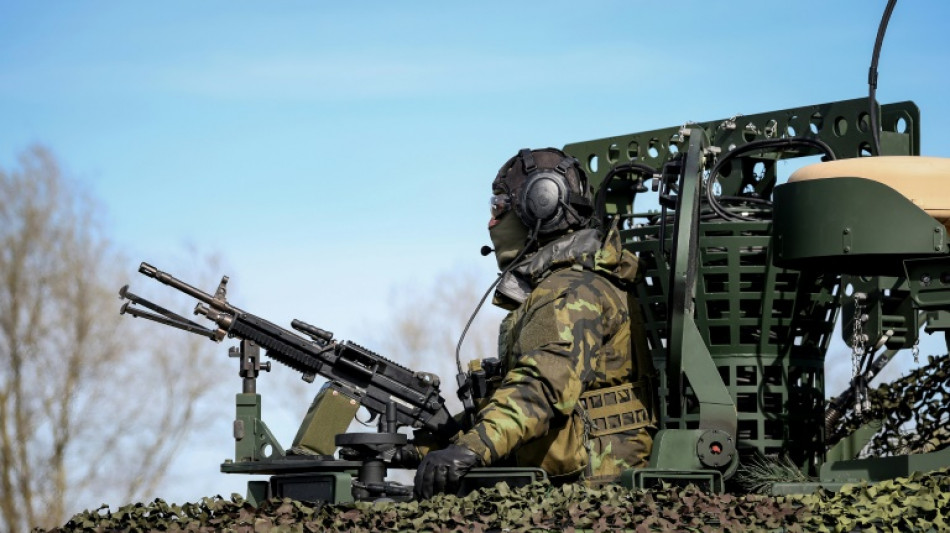
NATO is spending more on defence, but it's likely not enough / Photo: Ronny Hartmann - AFP

 Mixed day for global equities as oil prices retreat
 Trump says hasn't decided on big Iran strikes, Tehran getting 'serious'
 Karim Khan: Forensic ICC prosecutor with a tarnished legacy
 Sinner, Djokovic withdraw from Montreal Masters

 Ferrari boss cautious after Hamilton and Leclerc shine in Hungary

 Pogacar breaks Alpe d'Huez record to extend Tour de France lead

 Fury stops Wach in Thailand to close in on Joshua fight
 US court rules abortion pill restrictions 'unlawful'
 Tens of thousands flee forest infernos in France and Spain

 Many thousands flee burning France holiday haven by road and sea

 Charli XCX pivots from hyperpop in post-Brat album
 Worst wildfire in Madrid's history forces thousands to flee homes
 Pogacar extends Tour de France lead with 'cool' Alpe d'Huez win
 Pogacar extends Tour de France lead with
Alpe d'Huez win
Pogacar extends Tour de France lead with
Alpe d'Huez win
 Россия после Путина: «Парламент с шансом в один процент»

 Despite Haas struggles, youthful Bearman believes he can win
 First person vaccinated during trial of new Ebola jab
 Iryna Terekh: the trained architect behind Ukraine's deep-strike drones
 At least 21 killed in Russian and Ukrainian long-range strikes
 Stock markets recover as oil retreats

 US singer Chris Brown admits new brawl charge, avoids UK trial
 'Cockroach' protest leaders, India govt say no breakthrough in talks
 Leclerc on top for Ferrari but suffers car failure
 UK PM Burnham back in Manchester to kickstart English 'devolution'

 Autonomous fighter jets target Europe market at Farnborough airshow

Spurred on by Russia's war in Ukraine and the spectre of Donald Trump's potential return to the White House, more of NATO's European members are finally hitting the alliance's defence spending target.
But as leaders gear up to celebrate at a NATO summit in Washington there is a clear feeling that will not be sufficient to tackle the challenges it faces.
"Even in countries historically reluctant to spend more on defence, there is now a growing sense of the importance of greatly increased defence spending," said Ian Lesser, from the German Marshall Fund of the United States think tank.
"I think, broadly speaking, in the next years we're looking at levels of defence spending that will begin to approach those of the Cold War."
A decade after setting a spending goal at two percent of gross domestic product, just over two-thirds of NATO's 32 countries are now expected to reach or top that threshold this year.
That is up from only three allies in 2014.
The increase in spending, which includes European heavyweights Germany and France, will be heavily showcased in Washington as NATO stages its show of unity.
That is designed to send a message to Russia's President Vladimir Putin as he wages his war in Ukraine and menaces NATO from the east.
But it is also a message for former US leader Donald Trump as he seeks to reclaim the Oval Office from incumbent Joe Biden at elections in November.
Like other US leaders, upset that Washington shoulders too much of the burden with its vast defence budget, Trump spent his time in office demanding European countries do more.
On the campaign trail in February he unleashed a firestorm by saying he would encourage Russia to "do whatever the hell" it wants to NATO allies not coughing up enough.
- 'Hot war' -
A year after turning the two-percent benchmark from a target to a floor for spending at a summit in Vilnius, a growing number of NATO allies are already pushing to go further.
Chief among them are the Baltic States and Poland -- with all comfortably spending more, and Warsaw even reaching over four percent.
"In 1988 all of the allies were spending more than two percent, actually some even six percent on defence because the threat was real -- there was a Cold War going on," Estonian Prime Minister Kaja Kallas said.
"Now we have a hot war in Europe and we are not spending enough," said Kallas, who was nominated last month as the European Union's next foreign policy chief.
But the Washington summit still looks too early to set a more ambitious target.
"I think we're keen to celebrate the progress," a US defence official said. "There's not an appetite this year to change that benchmark to three percent."
- Defence plans -
A major motivation for ramping up spending is making sure NATO countries can actually fulfil ambitious new defence plans agreed last year to ward off any potential attack from Russia.
After years of slashing budgets as fears of conflict eased in the wake of the Cold War, numerous allies have major gaps in their arsenals -- including key requirements such as air defences.
As part of its planning, NATO commanders are telling capitals what they need to spend on.
"We have specific capabilities targets for each and every ally," said alliance chief Jens Stoltenberg.
"For many allies, this will mean three percent, and at least something more than two percent."
Diverting money away from issues like welfare, education and health is never an easy sell for governments.
The likes of Canada, Italy and Spain still lag behind the NATO target and are reluctant to commit to going further.
But diplomats at NATO said the direction of travel is clear -- spending targets will need to be hiked.
"Some countries are still sticking their heads in the sand," said one diplomat. "But it will happen eventually."
Another diplomat agreed -- adding that if Trump starts breathing down the necks of European allies again that could speed things up.
"This is where we are heading towards -- in order to fill the new plans it is clear that two percent won't be enough," the diplomat said.
"I think we're going to move to something beyond that, regardless of who wins the next US elections -- but if Trump wins it could come sooner."
W.Stewart--AT