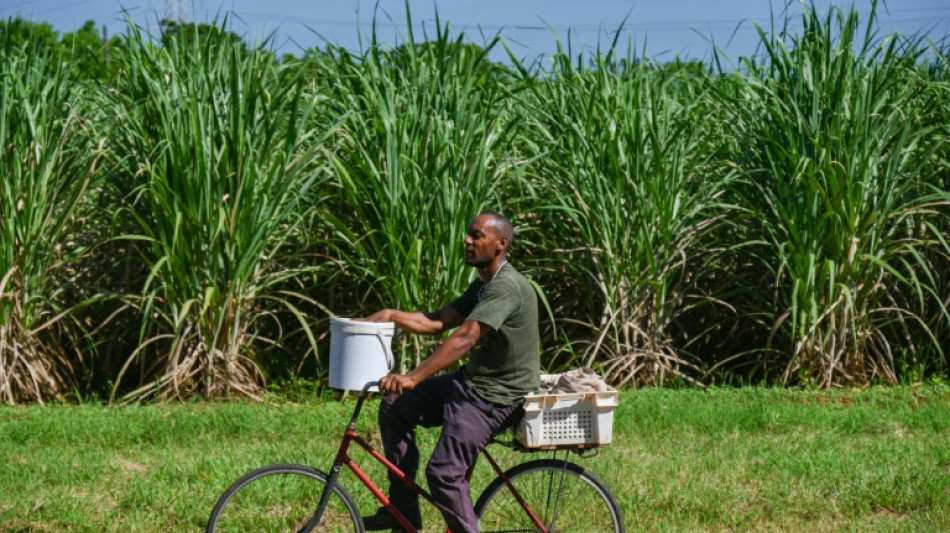
Fuel shortages a bitter pill for Cuba's sugar cane producers / Photo: YAMIL LAGE - AFP

 Ferrari boss cautious after Hamilton and Leclerc shine in Hungary

 Pogacar breaks Alpe d'Huez record to extend Tour de France lead

 Fury stops Wach in Thailand to close in on Joshua fight

 US court rules abortion pill restrictions 'unlawful'

 Tens of thousands flee forest infernos in France and Spain

 Many thousands flee burning France holiday haven by road and sea

 Charli XCX pivots from hyperpop in post-Brat album

 Worst wildfire in Madrid's history forces thousands to flee homes

 Pogacar extends Tour de France lead with 'cool' Alpe d'Huez win

 Pogacar extends Tour de France lead with
Alpe d'Huez win
Pogacar extends Tour de France lead with
Alpe d'Huez win

 Россия после Путина: «Парламент с шансом в один процент»

 Despite Haas struggles, youthful Bearman believes he can win

 First person vaccinated during trial of new Ebola jab
 Iryna Terekh: the trained architect behind Ukraine's deep-strike drones
 At least 21 killed in Russian and Ukrainian long-range strikes

 Stock markets recover as oil retreats

 US singer Chris Brown admits new brawl charge, avoids UK trial

 'Cockroach' protest leaders, India govt say no breakthrough in talks
 Leclerc on top for Ferrari but suffers car failure

 UK PM Burnham back in Manchester to kickstart English 'devolution'

 Autonomous fighter jets target Europe market at Farnborough airshow

 Antonelli has his neck on the line with ever watchful father
 Firefighters race to stop wildfires merging near Madrid
 UN urges evacuation of 6,000 sailors stranded in Hormuz strait

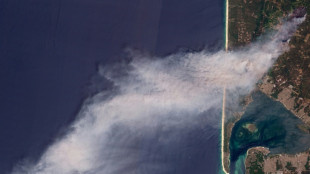 Thousands flee wildfires in France, Spain

Cuba's sugar cane industry, once the world leader, first lost the United States as its main client 60 years ago, then the Soviet Union three decades later.
Today, the industry is teetering on the brink with Cuba in the grips of a crushing economic crisis marked by frequent power blackouts and severe shortages of basic supplies such as fuel, fertilizer and pesticides.
"It is the worst time in the history" of the industry, said Reinaldo Espinosa, the 54-year-old boss of a sugar cane-producing cooperative in the province of Artemisa, southwest of the capital Havana.
"Recovering our national sugar production will take years," Espinosa told AFP as he described preparing for the planting season "with zero resources."
He said his cooperative's output has fallen from 84 to 28 tons of cane per hectare in the past five years as he rattled off a long list of obstacles: "Zero fertilizer, zero herbicide," a dire shortage of fuel and power blackouts "quite often in the productive hours."
"It's really hard" to keep going, Espinosa said.
- Plummeting production -
Agricultural cooperatives were set up by the communist state 30 years ago in a bid to revitalize the industry after the fall of the Soviet Union, which was Cuba's main ally, investor and client.
It had replaced the United States as Cuba's main sugar importer until the 1960s, when sanctions kicked in as the island shifted towards communism.
When the USSR collapsed 30 years later, Cuba abruptly lost 75 percent of its exports and its main source of credit.
Most state-owned farms were converted into cooperatives that remained in government hands.
But sugar prices plummeted at about the same time and US sanctions left the industry -- and others -- in dire straits.
The number of sugar mills in Cuba has since dropped from 156 to 56, and the 2022-2023 harvest barely reached 350,000 tons -- 4.4 percent of what the country produced until the early 1990s.
- 'We are paralyzed' -
Since the coronavirus pandemic, which hit its tourism sector hard, Cuba has experienced its worst economic crisis since the 1990s.
Structural weaknesses in the centralized economy have meant it has been unable to adapt, and limited economic opening in recent years has not done enough to create stability or raise foreign reserves.
Since March, Cuba has faced a fresh wave of power blackouts as the government is unable to import sufficient fuel or the equipment needed to repair the country's aging thermoelectric plants.
For producers, it has meant hardship and uncertainty.
"We must work with hoes... and with machetes because we have nothing else," said Leonardo Hernandez, 64, a co-manager at the Artemisa cooperative, whose irrigation and weeding machines sit unused without fuel.
"We are idle... we have nothing to work with," added Jose Clavijo, a 59-year-old machinist. "We are paralyzed and we want to work because we need to."
M.White--AT