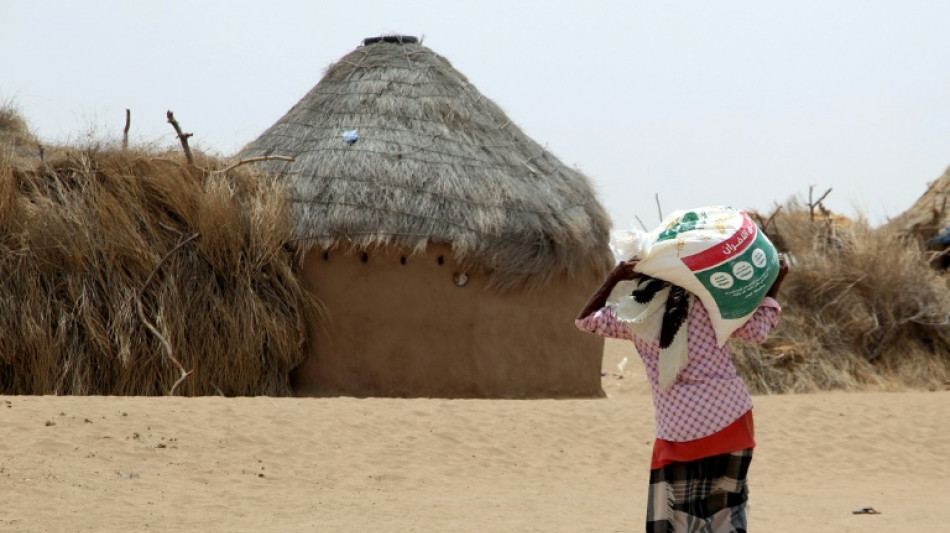
Yemen's new leaders say focused on peace path / Photo: Khaled Ziad - AFP

 Qatar-gifted Air Force One replacement unveiled
 Niemann fires 65 at US Open after upsetting two-shot penalty
 Spain's Yamal says 'too soon' to play full match at World Cup

 Neymar? He is working remotely at the World Cup, jokes Lula

 Three-time Stanley Cup champion Toews retires

 Japan wary of fired up and wounded Tunisia for World Cup landmark game

 'Like a fridge': France cave homes offer lucky few respite from heat

 Hormuz ship traffic climbs after war deal: trackers

 Kane hails World Cup 'Wonderwall' singalong as England highlight

 Sabalenka roars back to make Berlin WTA semis

 Narvaez takes Swiss Tour third stage after 100km breakaway
 Europe swelters as temperature records tumble

 French mountain lodges worry over strained water supply
 Heatwave hits more than one in two people in France
 Zverev sets up Fritz semi at Halle Open

 Clark stumbles but still leads by two at US Open

 Ogura pulls off stunner to top Czech MotoGP practices

 Turkey bars public World Cup screening over university entrance exam

 Ebola spreading 'fast' in DR Congo, warns WHO
 The Sun may not engulf Earth after all, scientists say

 Russia signals slower rate cuts amid high Ukraine war spending

 Henry strikes as New Zealand lead England by 100 runs in 2nd Test

 Online threats, insults fuel S.Africa's anti-foreigner hate

 Clark completes first round with two-stroke US Open lead

 Italian FM cancels US visit over reported Trump comments

Yemen's new leaders are "ready for war" should the latest push for peace with Huthi rebels fail, but a senior official told AFP they genuinely want the years-long conflict to end soon.
"Our first option is peace, but we are ready for war," Abdullah al-Alimi said late Saturday in his first interview since being named to an eight-member leadership council tasked with running the country after President Abedrabbo Mansour Hadi stepped down earlier this month.
"We believe the council is in a position, with the coalition support, to score a decisive military victory," Alimi told AFP in the Saudi capital.
Hadi's internationally recognised government had been locked in conflict for seven years against the Iran-backed Huthis, who control the capital Sanaa and most of the north despite a Saudi-led coalition's military intervention launched in 2015.
The war has killed hundreds of thousands directly or indirectly, and triggered what the United Nations calls the world's worst humanitarian crisis, with millions on the brink of famine.
Hadi's April 7 announcement handing power to the council came at the end of talks in the Saudi capital Riyadh that brought together anti-Huthi factions but were boycotted by the Huthis themselves.
The developments followed the start of a renewable two-month truce that has brought a rare respite from violence and spurred cautious hopes the war could finally end.
Hadi said the council would be tasked with "negotiating with the Huthis for a permanent ceasefire".
"We hope the dire situation in Yemen will make people have a desire to leave personal and partisan interests behind in pursuit of peace," said Alimi, formerly Hadi's chief of staff.
He said council leaders are due to meet in the coming days with UN special envoy to Yemen Hans Grundberg, who last week visited Sanaa for the first time during his mandate and held talks with Huthi leaders.
After meeting Grundberg, the council will travel to Yemen to be sworn in, though Alimi refused to specify exactly where.
The new council has not yet decided how long it will give the Huthis to join talks, Alimi said.
- Rebel resistance -
The Huthis refused to participate in the negotiations in Riyadh, which they consider enemy territory, but Alimi said future talks could take place in a more neutral location such as Oman.
So far, however, the Huthis have been dismissive, denouncing the new council as "a desperate attempt to rearrange the ranks of the mercenaries" fighting in Yemen.
Analysts note the Huthis have said peace will only come once foreign forces leave and some believe they are only really interested in talks with the Saudis.
"The Huthis don't see themselves in a conflict with Yemenis. The Huthis see themselves in a conflict with Saudi Arabia," said Fatima Abo Alasrar of the Middle East Institute in Washington.
If the push for peace goes nowhere, the newly-aligned anti-Huthi forces are positioned to pursue "a concerted multifront campaign" against the rebels, provided the council's diverse membership can hold together, said Peter Salisbury, senior Yemen analyst for the International Crisis Group.
"They (the leadership council) have the potential to more aggressively pursue peace and more aggressively pursue war, and the most likely outcome is they do a little bit of one and a little bit of the other," he said.
A.Anderson--AT