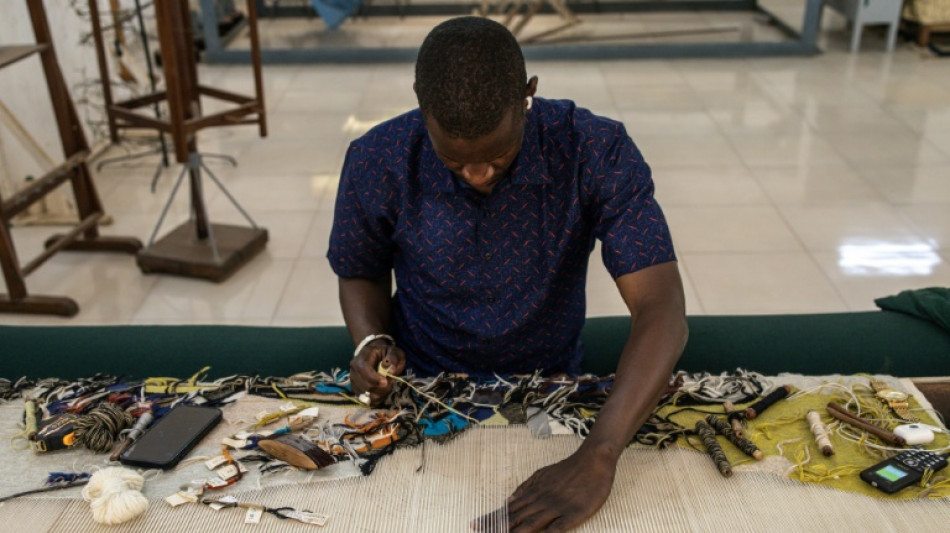
Senegal tapestry production finds new lease of life / Photo: JOHN WESSELS - AFP

 Surrounded by militias, Sudanese fear endless cycle of war

 Commonwealth Games 'where champions are made' despite slimmed down model, argues president
 Trump family project in Albania has already caused 'irreparable' damage: NGOs

 Bollywood blast master keeps it real with fire and fury

 Tearful fights, edible offerings: A glimpse into the Maradona trial
 What's the deal with peptides? The hyped market under US review

 Tesla shares fall as Musk touts ambitious -- and costly -- plans

 Houthis claim Red Sea tanker strikes as US hits Iran again

 Wildfires ravage parts of southern France, Italy and Spain

 Alphabet beats expectations in second quarter, cloud revenue nearly doubles

 Trump threatens Iran infrastructure, Tehran vows 'eye for eye'

 US teen withdraws lawsuit against Meta over social media addiction

 Lebanon PM says Beirut working for 'complete Israeli withdrawal'
 EU conditionally clears Paramount bid for Warner Bros.

 Philipsen snaps 'horrible' drought with Tour de France stage 17 victory

 US trial of Venezuela's Maduro set for June 2027

 New UK PM Burnham gets early boost as inflation dips

 Samsung launches new, more expensive foldable smartphones

 Philipsen ends 'horrible' drought with Tour de France 17th stage victory

 Hungary's Orban says graft case is 'pretext' to target his party

 South African tycoon Motsepe rules out presidential bid

 Trump threatens Iran bridges, power as payback for Hormuz attacks
 Germany's Merz replaces leader ousted over surrogacy row
 CAF chief Motsepe backs Infantino despite criticism

 Evacuees from Spain's wildfire struggle with scale of devastation

After cutting away the loose woollen threads from his loom, 28-year-old Senegalese weaver Seydina Oumar Cisse turns the roll to watch the tapestry gradually take shape before his eyes.
Everything from the colours to the design is identical to the original work created by Senegalese artist Cheikh Diouf.
"It's very satisfying," Cisse said, seeing the result of six months' work for the first time.
Cisse is a weaver at the Senegalese manufacturers of decorative arts in the central city of Thies, a leading producer of high quality artistic goods on the African continent.
The establishment's creations adorn the walls of organisations the world over, from the UN headquarters in New York to the African Union in Addis Ababa, as well as the palaces of numerous heads of state.
Tapestry production in Thies was a flagship cultural policy of Senegal's first president, poet Leopold Sedar Senghor, with production now revitalised thanks to a broadening of operations and new partnerships, including with fashion giant Chanel.
The creations are "attracting renewed interest, driven locally by galleries with international stature and a resurgence of interest in textiles and tapestries" on the art market, said Coline Desportes, a researcher at the national institute of art history (INHA).
- 'Symbiosis of techniques' -
Senghor established national tapestry production in Thies in 1966, six years after Senegal gained independence from France, with the goal of "creating a new art for a new nation".
While weaving techniques had previously proved popular in African clothing designs, the art of wall tapestries was little known in Senegal.
Two years before production got underway, four craftsmen headed to France for specialised training, with the new art form representing "the symbiosis of techniques imported from France and traditional culture," according to Senghor.
Over the years the former president's legacy has been kept alive, but not without difficulty.
The state reduced support after Senghor's departure and tapestries went out of fashion, leading production in Thies to almost disappear before orders picked up again in the 2000s.
In the weaving workshops, situated within the white and green walls of former army barracks, the weavers have no room for error.
Each meticulously follows the cardboard lines on their looms, using wool from Europe and cotton from Thies to trace their designs.
- 'Cultural powerhouse' -
Not far away, a group of about 30 American school students listen to a talk given by the head of the cardboard workshop, where the models which guide the weaving process are produced.
The establishment now welcomes tourists and film crews onto the premises, evidencing its commitment to diversifying operations.
Fourteen rooms will soon be available for visitors, as well as an artists' residence, managing director Aloyse Diouf said.
"We want to turn the manufacturers into a cultural powerhouse, a link between art and tourism," he added, although government commissions remain essential to keeping production afloat.
"Tapestry is not necessarily linked to our history and has remained mainly elitist -- it is mainly the authorities who buy tapestries to contribute to Senegal's artistic influence," Diouf said.
"The ownership of this art form by the Senegalese is a long-term project that we are developing by inviting schools to visit the factories".
The establishment now also produces prayer rugs, batik and ceramics, which are slightly more affordable for the Senegalese than the wall tapestries, which cost 1.5 million CFA francs ($2,400) per square metre.
F.Wilson--AT