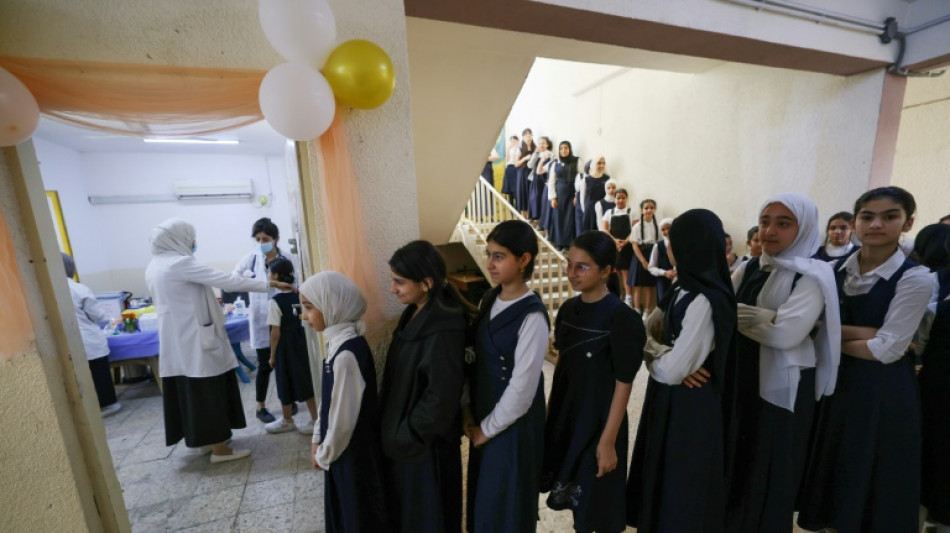
Vaccines save at least 154 million lives in 50 years: WHO / Photo: AHMAD AL-RUBAYE - AFP

 Argentine Football Association says US did not detain its president

 June heatwave cost UK economy more than £1bn: study
 Google-parent Alphabet beats expectations, cloud revenue nearly doubles
 US announces civilian nuclear deal with Saudi Arabia

 Tesla shares dip after profit misses expectations
 Red Sox tie club record with 15th straight MLB win

 US eyes offshore nuclear reactors

 The Sterling Announces Luxury Cocktail Lounge Concept and Investor Showcase in Orlando

 Inter Miami signs Brazil veteran Casemiro but MLS probes deal

 White House accuses China's Moonshot of stealing Anthropic AI
 Pogacar sweating on Yates's fitness ahead of Tour Queen stage

 Ukrainian soldiers and civilians welcome new army commander

 UK fintech Revolut valuation soars to $115 bn: source

 German FM, on Africa tour, eyes business ties amid US, China pressure

 Rubio says at ASEAN meeting he expects 'positive' US visit by China's Xi
 Philipsen wins Tour de France 17th stage
 DonnaPro Introduces AI-Trained Executive Assistants for European CEOs

 Happy birthday, George! UK prince becomes a teenager

 Oil prices jump on Mideast war, stock markets diverge

 US hits Iranian island, says war cost at $37.5 bn
 Metal mining's carbon footprint far larger than thought: study
 TokenInsight Q2 2026 Report: TradFi Momentum Lifts MEXC to No. 2 in Commodity Perpetuals

 Leonardo chief sees potential for Germany to join GCAP fighter jet project

 Louvre heist gallery reopens to public, but with nothing to steal

 Ukraine's new army chief: who is Mykhailo Drapaty?

Global immunisation efforts have saved at least 154 million lives in the past 50 years, the World Health Organization said Wednesday, adding that most of those to benefit were infants.
That is the equivalent of six lives saved every minute of every year of the half century, the UN health agency said.
In a study published in the Lancet, WHO gave a comprehensive analysis of the impact of 14 vaccines used under the Expanded Programme on Immunisation (EPI), which celebrates its 50th anniversary next month.
"Vaccines are among the most powerful inventions in history, making once-feared diseases preventable," WHO chief Tedros Adhanom Ghebreyesus said in a statement.
"Thanks to vaccines, smallpox has been eradicated, polio is on the brink, and with the more recent development of vaccines against diseases like malaria and cervical cancer, we are pushing back the frontiers of disease," he said.
"With continued research, investment and collaboration, we can save millions more lives today and in the next 50 years."
The study said infants accounted for 101 million of the lives saved through immunisation over the five decades.
"Immunisation was the single greatest contribution of any health intervention to ensuring babies not only see their first birthdays but continue leading healthy lives into adulthood", WHO said.
Over 50 years, vaccines against 14 diseases -- diphtheria, Haemophilus influenza type B, hepatitis B, Japanese encephalitis, measles, meningitis A, pertussis, invasive pneumococcal disease, polio, rotavirus, rubella, tetanus, tuberculosis, and yellow fever -- had directly contributed to reducing infant deaths by 40 percent, the study found.
For Africa, the reduction was more than 50 percent, it said.
The vaccine against measles -- a highly contagious disease by a virus that attacks mainly children -- had the most significant impact.
That jab accounted for 60 percent of the lives saved due to immunisation, according to the study.
The polio vaccine means that more than 20 million people are able to walk today who would otherwise have been paralysed.
The study also showed that when a vaccine saves a child's life, that person goes on to live an average of 66 years of full health on average -– with a total of 10.2 billion full health years gained over the five decades.
"These gains in childhood survival highlight the importance of protecting immunisation progress," WHO said, pointing to accelerating efforts to reach 67 million children who missed at least one vaccination during the Covid pandemic.
Ch.Campbell--AT