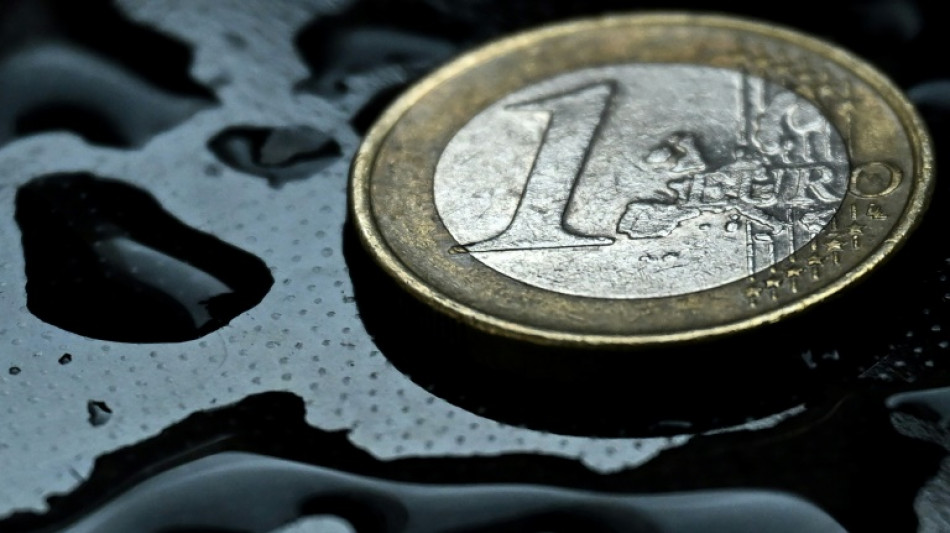
EU lawmakers greenlight new rules to rein in national spending / Photo: Kirill KUDRYAVTSEV - AFP/File

 Google-parent Alphabet beats expectations, cloud revenue nearly doubles

 US announces civilian nuclear deal with Saudi Arabia

 Tesla shares dip after profit misses expectations
 Red Sox tie club record with 15th straight MLB win

 US eyes offshore nuclear reactors

 The Sterling Announces Luxury Cocktail Lounge Concept and Investor Showcase in Orlando

 Inter Miami signs Brazil veteran Casemiro but MLS probes deal

 White House accuses China's Moonshot of stealing Anthropic AI

 Pogacar sweating on Yates's fitness ahead of Tour Queen stage

 Ukrainian soldiers and civilians welcome new army commander

 UK fintech Revolut valuation soars to $115 bn: source

 German FM, on Africa tour, eyes business ties amid US, China pressure

 Rubio says at ASEAN meeting he expects 'positive' US visit by China's Xi
 Philipsen wins Tour de France 17th stage
 DonnaPro Introduces AI-Trained Executive Assistants for European CEOs
 Happy birthday, George! UK prince becomes a teenager

 Oil prices jump on Mideast war, stock markets diverge

 US hits Iranian island, says war cost at $37.5 bn

 Metal mining's carbon footprint far larger than thought: study

 TokenInsight Q2 2026 Report: TradFi Momentum Lifts MEXC to No. 2 in Commodity Perpetuals

 Leonardo chief sees potential for Germany to join GCAP fighter jet project

 Louvre heist gallery reopens to public, but with nothing to steal

 Ukraine's new army chief: who is Mykhailo Drapaty?

 India student protests keep up pressure on Modi government

 Italian FA chief says in touch with Guardiola over coaching vacancy

European Union lawmakers on Tuesday backed new budgetary rules aimed at boosting investment while keeping spending under control despite fierce criticism from leftwing groups.
Brussels spent two years negotiating an overhaul of its budget rules that pitted fiscally hawkish states against the bloc's most indebted nations.
A majority of lawmakers backed the new rules during a session of the European Parliament in Strasbourg, France. It will become official once the EU's 27 member states endorse the text.
Leftwing MEPs claim the reform will bring in further austerity in Europe, but the bill had the backing of the three biggest political groups in parliament including socialists and conservatives.
Once in place, the EU believes the looser rules will keep the bloc on a sound financial footing, while giving greater leeway for investment in critical areas like the green and digital transitions, as well as defence.
The new rules are "more flexible, more growth oriented, more credible in their implementation", the EU's economy commissioner, Paolo Gentiloni, said during a parliamentary debate.
He said that, while "not perfect", the reform was "a good compromise".
Climate activists argue the rules will limit states' ability to pour money into important green projects.
"It will force many EU governments to take austerity measures and limit their ability to borrow to finance essential climate, environmental and social policies," Greenpeace EU said in a statement.
Margarida Marques, a socialist lawmaker who spearheaded the reform through the parliament, defended the text, insisting "significant improvements" had been made.
"There is no doubt that this deal is much better than no deal and going back to the old rules or having no rules at all," she said.
- 'Unfit for future' -
The old rules had been suspended between 2020 and 2023 to help the European economy weather the Covid pandemic and then Russia's assault on Ukraine, which sent energy prices soaring.
There was widespread agreement that there could be no return to the old rules without changes to make them practicable, despite public debt ballooning across the bloc.
Known as the Stability and Growth Pact, the rules stipulate a country's debt must not go higher than 60 percent of gross domestic product, with a public deficit of no more than three percent.
These goals remain in place, though there was fierce debate over how much the limits should be relaxed to give more room for investment.
The new text provides looser fiscal rules adapted to each state, allowing big spenders a slower route back to frugality.
The tailormade approach means each country presents its own adjustment trajectory to ensure debt sustainability. That gives them more time if they undertake reforms and investments and allows a less painful return to fiscal health.
The new rules will apply to member states' 2025 budgets.
Germany and its "frugal" allies pushed to impose a quantifiable minimum effort to reduce debt and deficits, but critics have slammed its complexity.
Left-wing groups say the new rules are a tool for imposing austerity on Europe.
In an open letter on Monday, Belgian, French, Italian and Spanish trade unions hit out at rules they said were "unfit for (the) future".
"This agreement, forced by the austerity approach of some European capitals, will require member states to reduce their debts rapidly and in ways that are economically and socially unsustainable: this will mark a return to austerity," they warned.
Ch.Campbell--AT