West Bank villagers vigilant but vulnerable after settler attacks / Photo: Zain JAAFAR - AFP

 New UK PM Burnham gets early boost as inflation dips

 Samsung launches new, more expensive foldable smartphones

 Philipsen ends 'horrible' drought with Tour de France 17th stage victory

 Hungary's Orban says graft case is 'pretext' to target his party

 South African tycoon Motsepe rules out presidential bid

 Trump threatens Iran bridges, power as payback for Hormuz attacks

 Germany's Merz replaces leader ousted over surrogacy row

 CAF chief Motsepe backs Infantino despite criticism

 Evacuees from Spain's wildfire struggle with scale of devastation

 Ancient Lebanese city of Tyre added to heritage danger list
 Extreme heatwave grips Tunisia as wide power cuts fuel frustration

 'Beautiful game' provides Venezuelans with welcome distraction in wake of tragedy

 Oil prices surge on Mideast war, stock markets diverge

 Fury says 'best yet to come' ahead of Thailand fight

 Japan suffers heat 'disaster as cities hit by 'cruelly hot' days

 In Kazakhstan, emptying villages and overcrowded cities

 Hitler's Austrian birthplace transformed into police station

 Mideast conflict lifts Brent back above $94, stocks give up gains

 Greece broils on year's warmest day as three-day heatwave peaks

 Japan cities 'cruelly hot' for first time
 Lithuania moves Red Army graves to leave behind Soviet past

 OpenAI reports 'unprecedented' autonomous hack by AI agents

 India opposition leader released after protest detention

 Australia cricket great Warner pleads guilty to drink-driving

 US hits Iran, says war cost at $37.5 bn
Sitting around a fire in the hills of the Israeli-occupied West Bank, Ibrahim Abu Alyah and some friends stood watch over his herd in the aftermath of a settler attack on their village.
"We are here so that we can put away the sheep and tell people to protect their homes in case settlers come," Abu Alyah told AFP.
After 14-year-old Israeli herder Benjamin Achimeir went missing on April 12 in the nearby illegal settler outpost of Malachi Hashalom, dozens of Jewish settlers raided his village of Al-Mughayyir, north of Ramallah.
Armed with rifles and Molotov cocktails, they set houses ablaze, killed sheep, wounded 23 people and displaced 86, according to the UN's Office for the Coordination of Humanitarian Affairs, OCHA.
One Palestinian was also killed in the violence.
Abu Alyah, a shepherd, lost "20 or 30 sheep" and the cash he made from selling milk products when his house was set alight.
Al-Mughayyir's mayor, Amin Abu Alyah, said the settlers, who were part of the search party for Achimeir, burnt "everything they found in front of them" including houses, a bulldozer and vehicles.
Several citizens tried to organise protection committees to defend themselves from raids, but were prevented from doing so, he said.
"We currently have more than 70 prisoners inside Israeli prisons on charges of joining protection committees or trying to form an organised body," he said.
- Duma, struck twice -
In the nearby village of Duma, five kilometres (three miles) north of Al-Mughayyir, old fears came true when hundreds of settlers came down through the surrounding fields on Saturday.
That day, Achimeir's body was found bearing marks of a stabbing attack. People watched powerless as settlers rampaged through the village.
"Hundreds of settlers entered the village followed by more than 300 Israeli soldiers who stormed the village and declared it a closed military zone," Suleiman Dawabsha, head of Duma's village council, told AFP.
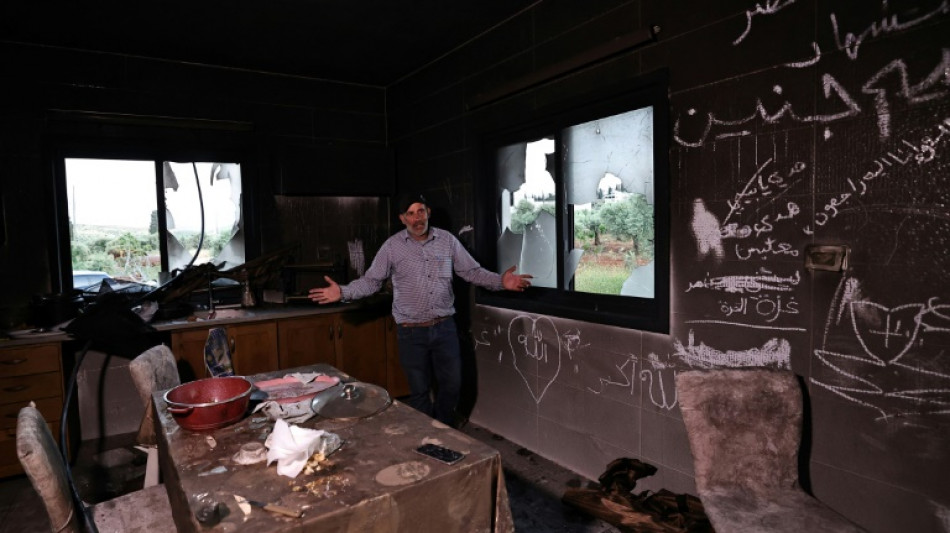
Mahmud Salawdeh, a 30-year-old iron worker whose house was torched in the attack, felt vulnerable when he realised the soldiers were not stopping the attack.
"We feel helpless because we are unable to protect ourselves, and the settlers are protected by the army," he said.
"I lost all my money and my future," he added from the ground floor of his charred house on the outskirts of Duma, near the fields the attackers came through.
At his feet, burnt furniture and shattered glass covered the floor, while walls black with soot served as a reminder of the firebombs thrown at the building.
His workshop in the adjacent room was torched, charred remnants of old tools lay around, while a large wooden box where he had been raising 70 chicks was now empty.
The incident opened old wounds for Duma residents, who still remember the tragedy that struck the Dawabsha family.
In 2015, the family's home was set ablaze by a settler extremist, killing the couple and their toddler, and leaving only one surviving member, four-year-old Ahmed Dawabsha.
- 'We will never leave' -
Duma residents, like many West Bank villagers, say they are protected neither by Palestinian security, which is only allowed to operate in 40 percent of the territory, nor by Israel, which controls the rest.
Israeli soldiers do not always restrain settlers from attacking Palestinians, OCHA said.
In January, "in nearly half of all recorded incidents (of settler violence) after 7 October, Israeli forces were either accompanying or reported to be supporting the attackers," it said.
OCHA recorded 774 instances of Israeli settler attacks against Palestinians since war broke in Gaza on October 7, and said 37 communities had been affected by violence between April 9 and 15, "triple the number" of the preceding week.
Nine Israelis, including five in Israeli forces, were killed in the West Bank over the same timeframe, OCHA said.
At least 462 Palestinians have been killed by Israeli troops or settlers in the West Bank during that period, according to Palestinian official figures.
The West Bank, occupied by Israel since 1967, has seen a surge in violence since early last year, which has intensified since the Israel-Hamas war in Gaza erupted.
Despite the hardships, "we will never leave", the herder Abu Alyah told AFP.
But the 29-year-old already had to move from his former herding grounds on the other side of Al-Mughayyir, closer to the settlement outpost, in September.
The weekend's attacks marked a peak in violence due to the sheer number of people who took part in them, but also reflects a wider trend in the West Bank, NGOs said.
"It is clear that the escalation of violence in the West Bank has occurred in tandem with the crisis in Gaza," charity ActionAid said in a statement.
On Wednesday evening, settlers were planting Israeli flags along the road that runs between Al-Mughayyir and Malachi Hashalom.
M.King--AT