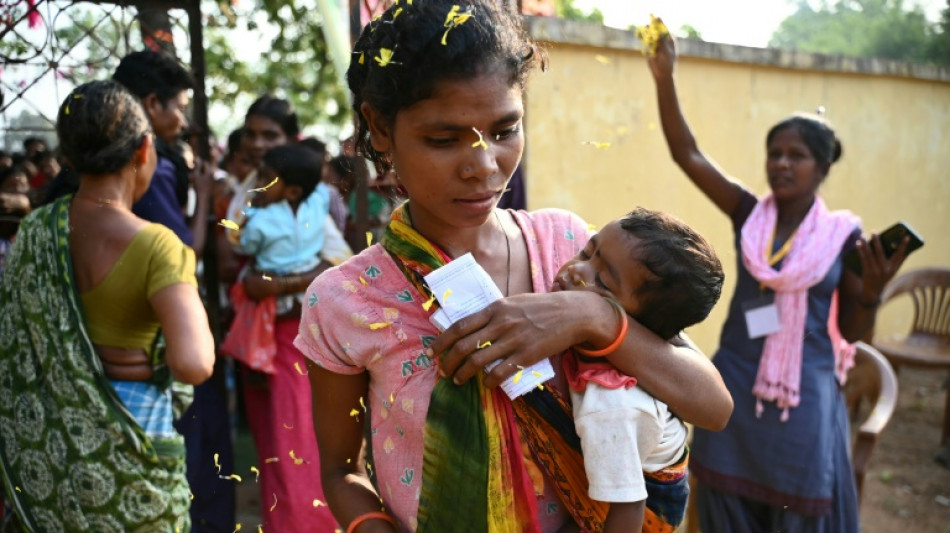
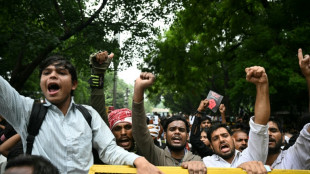
First-time voters rejoice in India's Maoist rebel heartland / Photo: Idrees MOHAMMED - AFP

 New UK PM Burnham gets early boost as inflation dips

 Samsung launches new, more expensive foldable smartphones

 Philipsen ends 'horrible' drought with Tour de France 17th stage victory

 Hungary's Orban says graft case is 'pretext' to target his party

 South African tycoon Motsepe rules out presidential bid

 Trump threatens Iran bridges, power as payback for Hormuz attacks
 Germany's Merz replaces leader ousted over surrogacy row

 CAF chief Motsepe backs Infantino despite criticism

 Evacuees from Spain's wildfire struggle with scale of devastation

 Ancient Lebanese city of Tyre added to heritage danger list
 Extreme heatwave grips Tunisia as wide power cuts fuel frustration

 'Beautiful game' provides Venezuelans with welcome distraction in wake of tragedy

 Oil prices surge on Mideast war, stock markets diverge

 Fury says 'best yet to come' ahead of Thailand fight

 Japan suffers heat 'disaster as cities hit by 'cruelly hot' days
 In Kazakhstan, emptying villages and overcrowded cities

 Hitler's Austrian birthplace transformed into police station
 Mideast conflict lifts Brent back above $94, stocks give up gains

 Greece broils on year's warmest day as three-day heatwave peaks
 Japan cities 'cruelly hot' for first time
 Lithuania moves Red Army graves to leave behind Soviet past

 OpenAI reports 'unprecedented' autonomous hack by AI agents

 India opposition leader released after protest detention

 Australia cricket great Warner pleads guilty to drink-driving

 US hits Iran, says war cost at $37.5 bn
In remote Indian forests home to a decades-old Maoist insurgency battling government rule, few in farmer Ajay Kumaroya's village had ever dared anger the guerrillas by voting.
But when the 23-year-old rose at dawn, Kumaroya found dozens of his neighbours already queueing at the polling station as general elections began on Friday, defying the insurgents to exercise their democratic right.
Known as Naxalites, the rebels have been fighting since 1967 for what they claim is for the rural poor -- and Chhattisgarh state's Bastar district, an area bigger than Belgium, was once their key heartland.
But India has deployed tens of thousands of security personnel to crush them, and the crowd at Kumaroya's village reflects government efforts to boost infrastructure and connect villages like his to the rest of the country.
"I am here for Prime Minister Narendra Modi," Kumaroya told AFP. "If he wins, our roads will get better."
Poll workers rolled out a red carpet outside the booth for the people of Dugeli village, showering flower petals on the first few voters to enter.
- 'Naxal problem' -
Fellow farmer Pradeep Kumar Karma, 27 said he was voting for Modi to "solve our Naxal problem", he said.
"If that happens, we will prosper with tourism and investments", he added.
Government security operations have badly dented the Naxalites.
One assault on Tuesday killed 29 rebels, following another clash this month that killed at least 13 insurgents.
But holding elections in Bastar is an immense logistical and security challenge, with dense forests providing ample cover for gunmen to lay landmines and carry out ambushes.
"Setting up polling stations and conducting voting in a peaceful manner has always been a challenge because of left-wing extremism," Chhattisgarh state chief electoral officer Reena Kangale told AFP.
"Much of the area is also mined, so access is a problem without loss of life and limb."
In recent days, hundreds of security personnel searching for improvised explosives have swept the new roads that have been driven deep into dense forests.
Indian paramilitary forces have deployed to hundreds of remote communities, to protect polling officials fearful of attacks.
Ajay Dikshit, 57, a government school principal seconded to election duty, said his family had pressed him to turn down the assignment.
"I am government employee and I can't refuse an order," he said before voting day, while awaiting a helicopter ride to his post. "I just hope that everything works out well."
- 'Afraid of punishment' -
Across the country, voting will be staggered over seven stages between April 19 and June 1, with more than a million polling stations across India.
A total of 968 million people are eligible to take part in the world's biggest vote.
In Bastar, veteran polling officers such as Gajendra Punem, 37, said the situation had changed radically as the insurgency has waned.
"When I was first sent to a sensitive area for polls in 2014, not a single villager came out to vote," Punem said. "Everyone there was afraid of punishment by Naxals."
Not everyone shares the enthusiasm of Kumaroya and his neighbours.
In Sitapal village, once accessible only on a rough track taking several hours to travel, is now reachable by a newly-paved road.
But apart from the road, residents say they have seen little of the development they crave -- and were ignored by politicians on the campaign trail.
"If any of them had come here for our votes, we'd have told them what we need: roads, water pumps, and a bus connection," said first-time voter Budhram Kavasi, 36.
"Since they didn't come before the election, they definitely won't be here after the polls."
W.Morales--AT