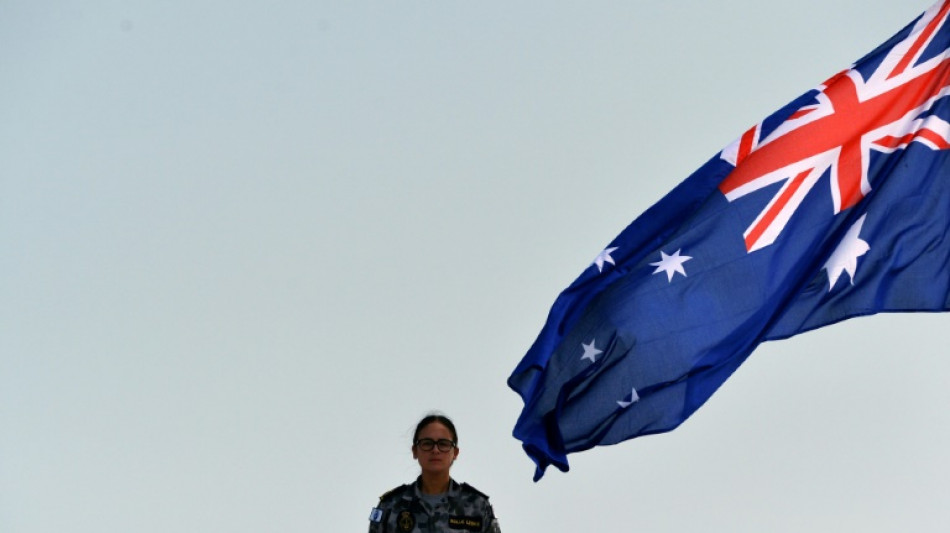
Australia unveils new defence strategy, with eye on 'coercive' China / Photo: ISHARA S. KODIKARA - AFP/File

 Trump threatens Iran bridges, power as payback for Hormuz attacks

 Germany's Merz replaces leader ousted over surrogacy row
 CAF chief Motsepe backs Infantino despite criticism
 Evacuees from Spain's wildfire struggle with scale of devastation

 Ancient Lebanese city of Tyre added to heritage danger list

 Extreme heatwave grips Tunisia as wide power cuts fuel frustration

 'Beautiful game' provides Venezuelans with welcome distraction in wake of tragedy

 Oil prices surge on Mideast war, stock markets diverge

 Fury says 'best yet to come' ahead of Thailand fight

 Japan suffers heat 'disaster as cities hit by 'cruelly hot' days
 In Kazakhstan, emptying villages and overcrowded cities

 Hitler's Austrian birthplace transformed into police station

 Mideast conflict lifts Brent back above $94, stocks give up gains

 Greece broils on year's warmest day as three-day heatwave peaks

 Japan cities 'cruelly hot' for first time

 Lithuania moves Red Army graves to leave behind Soviet past

 OpenAI reports 'unprecedented' autonomous hack by AI agents

 India opposition leader released after protest detention

 Australia cricket great Warner pleads guilty to drink-driving

 US hits Iran, says war cost at $37.5 bn
 Tech lifts Asia stocks, Brent crude back above $92

 Hitler's Austrian birthplace to become a police station

 Decomposed body in singer D4vd's car was 'unrecognizable,' court hears

 A once wary Hollywood slowly warms to AI

 Designing a Tour de France route: a three-year labour of love

Australia unveiled its first National Defence Strategy on Wednesday, signalling a new focus on deterring China's "coercive tactics" in a region seen as lurching towards conflict.
The 80-page document offers a gloomy assessment of Pacific security and sets out a massive increase in defence spending to retool Australia's military to cope.
"The optimistic assumptions that guided defence planning after the end of the Cold War are long gone," said Defence Minister Richard Marles, presenting the new strategy.
Warning that "China has employed coercive tactics in pursuit of its strategic objectives," the text describes an Australia vulnerable to foes strangling trade or preventing access to vital air and sea routes.
"We are a maritime trading island nation," Marles said.
"The invasion of Australia is an unlikely prospect in any scenario, precisely because so much damage can be done to our country by an adversary without ever having to step foot on Australian soil," he said.
So instead of focusing on maintaining a military that can do a range of tasks almost anywhere in the world, Marles said there would be a laser focus on building a deterrent force that can protect Australia's interests in its immediate region.
At the centre of the strategy are plans to develop a fleet of stealthy nuclear-powered submarines, to triple key missile capabilities and develop a large surface combatant fleet.
"Having the most capable Navy in our history will be at the heart of our projection and our strategy of denial," Marles said.
The strategy boils down to making any attack against Australia's interests prohibitively expensive and risky.
As a share of GDP, defence spending is set to increase from about two percent today to 2.4 percent within a decade.
That will only fuel an arms race that is taking place across the Pacific, with China, South Korea and Japan all piling more money into defence.
According to the Stockholm International Peace Research Institute, military spending in Asia and Oceania has increased 45 percent since 2013.
Given that backdrop, Australia predicts an increased risk of conflict in the Taiwan Strait, the South and East China Seas or on the border with India.
Marles said that old assumptions about how much time Australia would have to prepare for war were gone.
"Australia no longer has the luxury of a 10-year window of strategic warning time for conflict" he said, upending long-held belief.
Asked about Canberra's strategy at a regular briefing, Beijing urged Australia to "refrain from making accusations against China at every turn".
"China poses no threat to any country," foreign ministry spokesperson Lin Jian said.
"We hope that the Australian side can view China's development and strategic intentions in a correct light, abandon the Cold War mentality (and) do more to safeguard regional peace and stability," he added.
A.Ruiz--AT