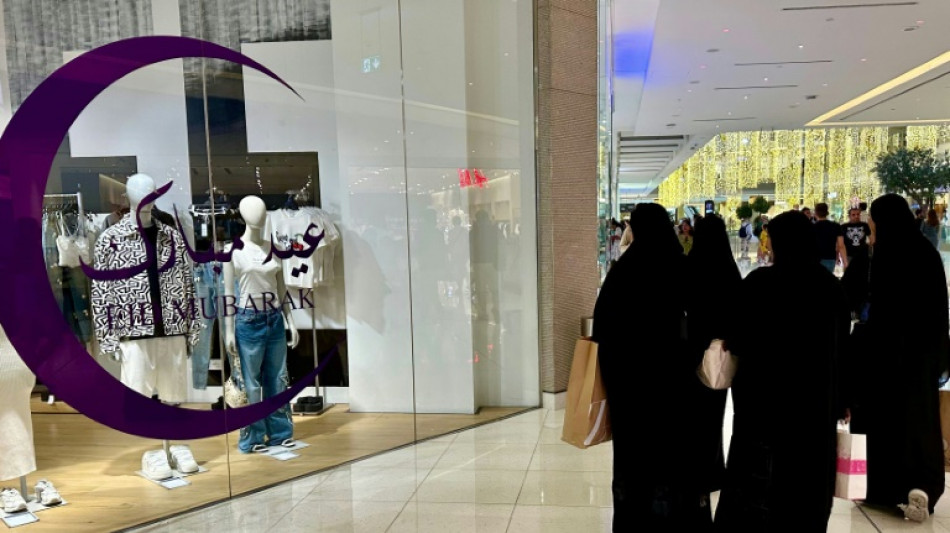
'Bad for business': Gulf states scramble to avert wider war / Photo: Giuseppe CACACE - AFP/File

 Trump threatens Iran bridges, power as payback for Hormuz attacks

 Germany's Merz replaces leader ousted over surrogacy row
 CAF chief Motsepe backs Infantino despite criticism
 Evacuees from Spain's wildfire struggle with scale of devastation
 Ancient Lebanese city of Tyre added to heritage danger list
 Extreme heatwave grips Tunisia as wide power cuts fuel frustration

 'Beautiful game' provides Venezuelans with welcome distraction in wake of tragedy

 Oil prices surge on Mideast war, stock markets diverge

 Fury says 'best yet to come' ahead of Thailand fight
 Japan suffers heat 'disaster as cities hit by 'cruelly hot' days
 In Kazakhstan, emptying villages and overcrowded cities

 Hitler's Austrian birthplace transformed into police station
 Mideast conflict lifts Brent back above $94, stocks give up gains

 Greece broils on year's warmest day as three-day heatwave peaks
 Japan cities 'cruelly hot' for first time
 Lithuania moves Red Army graves to leave behind Soviet past

 OpenAI reports 'unprecedented' autonomous hack by AI agents
 India opposition leader released after protest detention

 Australia cricket great Warner pleads guilty to drink-driving
 US hits Iran, says war cost at $37.5 bn
 Tech lifts Asia stocks, Brent crude back above $92

 Hitler's Austrian birthplace to become a police station

 Decomposed body in singer D4vd's car was 'unrecognizable,' court hears

 A once wary Hollywood slowly warms to AI
 Designing a Tour de France route: a three-year labour of love

Gulf states are grappling with the widening Middle East conflict as hostilities between Iran and Israel threaten their security and ambitious plans to reshape their economies.
Leaders of the resource-rich Gulf monarchies engaged in a rapid round of diplomacy after last weekend's Iranian drone and missile strikes on Israel raised the spectre of a regional conflagration.
The desert countries lie across the Gulf from Iran, placing them on the doorstep of the latest crisis after months of tensions generated by the Israel-Hamas war in Gaza.
US military facilities are scattered around the six Gulf Cooperation Council (GCC) countries, and Saudi Arabia and the United Arab Emirates have both faced previous attacks on oil facilities by Yemen's Iran-backed Huthi rebels.
The Gulf countries share an "overall realisation that conflict is bad for business and avoiding conflict comes now almost at any cost", said King's College London Middle East analyst Andreas Krieg.
On Monday, Qatar's emir, Sheikh Tamim bin Hamad Al-Thani, spoke to the Iranian president about the "need to reduce all forms of escalation and avoid the expansion of conflict in the region", the official Qatar News Agency reported.
And on Sunday, UAE President Mohamed bin Zayed spoke to Qatar's emir and the kings of Jordan and Bahrain, state media said, while Saudi Arabia's de facto leader Crown Prince Mohammed bin Salman talked with Iraq's prime minister.
Saudi Arabia's foreign minister spoke with his counterpart in Iran, and the Saudi defence minister held discussions with his US counterpart.
Much is at stake for the wealthy, US-friendly Gulf states, whose expensive economic diversification plans, aimed at securing their futures post-fossil fuels, rely on a peaceful environment for business and tourism.
- 'Wealth of targets' -
Top oil exporter Saudi Arabia has been the biggest spender, pledging hundreds of billions for new cities and leisure attractions as part of Prince Mohammed's flagship Vision 2030 economic transformation plan.
"Saudi's top priority is that the crisis does not escalate," Ali Shihabi, a Saudi analyst who is close to the royal court in Riyadh, told AFP, stressing the Gulf's vulnerability.
If there is an attack on Iran, Tehran might "be tempted to retaliate against the GCC given its close proximity and wealth of targets (that are) difficult to protect".
"Iran just learned how difficult it is to target Israel thousands of miles away but the GCC with its proximity and massive size compared to Israel is a different story," he added.
In Saudi Arabia's favour is its influence over the US -- which is pushing it to follow the UAE and Bahrain by recognising Israel -- and renewed ties with Iran, which were resumed last year after a lengthy rupture.
The deadliest ever war in Gaza had already dampened US efforts to broker a Saudi-Israeli normalisation.
"Saudi will be definitely pushing for the US to pressure Israel for a ceasefire in Gaza and also to not respond to Iranian attacks," said Umer Karim, researcher of Saudi foreign policy and politics at Britain's University of Birmingham.
- No good choices -
Meanwhile Oman, which is close to Iran, remains a vital conduit of mediation.
And Qatar has leverage as the host of Al-Udeid, the region's biggest US military base, said Krieg.
"When it comes to anything to do with the Strait of Hormuz or Bab al-Mandeb, (the Omanis) have deeper networks and are probably the more effective mediator," he said, referring to strategic waterways in the Gulf and the Red Sea.
He said the US had not given Gulf mediators "enough credit for how important that relationship has been... in creating a response from Iran that is, I would say, still quite measured".
"Qatar is very particular because of Al-Udeid," Krieg said, explaining that Doha would likely continue "telling the Americans, they can't use their airspace, can't use their bases to launch attacks against Iran".
"That will make it very, very difficult for the United States to actually assist Israel in a potential offensive strike inside Iran," he added.
Washington has reaffirmed "ironclad" support for Israel, but a US official said it would not join any potential Israeli counterattack against Iran.
According to Karim, any further deterioration would leave no good choices for the Gulf.
"Definitely the sooner this conflict ends the better it is for all Gulf States," he said.
"The conflict is increasingly creating a new regional balance of power... with Israel backed by the United States on one side and Iran and its proxies on the other side and Gulf states struggling for status and political impact.
"An escalation thus puts them in a very difficult position as they don't want to side with any of the two camps but will be affected regardless."
burs/rcb-csp/th/jsa/kir
Th.Gonzalez--AT