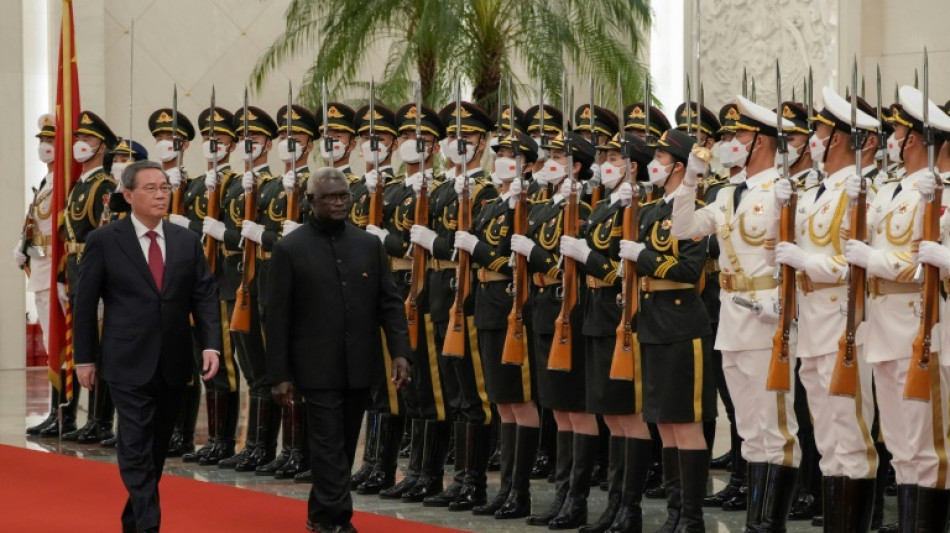
Solomon Islands readies for election in shadow of China's influence / Photo: Andy Wong - POOL/AFP

 Metal mining's carbon footprint far larger than thought: study
 TokenInsight Q2 2026 Report: TradFi Momentum Lifts MEXC to No. 2 in Commodity Perpetuals

 Leonardo chief sees potential for Germany to join GCAP fighter jet project
 Louvre heist gallery reopens to public, but with nothing to steal

 Ukraine's new army chief: who is Mykhailo Drapaty?

 India student protests keep up pressure on Modi government

 Italian FA chief says in touch with Guardiola over coaching vacancy

 Cooler inflation hands new UK PM Burnham an early boost
 Bezos holds talks with group interested in buying Liverpool stake: reports

 The student movement in India challenging Modi's government

 Danish fish fossil cliffs set to gain UNESCO status
 In Bulgarian mountains, local doctor still on call at 90

 Australia protests China's 'destabilising' missile test
 Sydney court dismisses defamation case against film star Rebel Wilson
 US tariffs on Brazil take effect as Trump readies fresh flurry
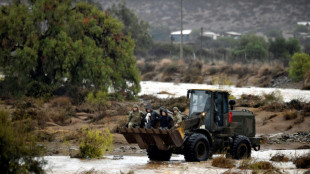 Death toll rises to 13 in Chile's severe storms
 24 hours in a Ukrainian hospital, buckling under the toll of war

 India's domestic workers go online as instant services boom
 From bath to fish market: DJs play to revive Japan neighbourhoods
 Nearly 3,000-year-old human remains unearthed in El Salvador

 New Zealand may miss climate targets due to government policies: report
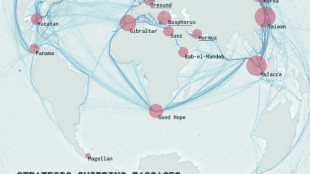 Hormuz, Malacca and other key straits spawn tensions throughout history

 Aston Bay Announces Board Changes
 Avino Announces Q2 2026 Production Results
 CANEX to Pay Out Bulk of Dissenting Gold Basin Shareholders in Canex Shares and Updates Helix Litigation
Solomon Islanders will head to the polls this week, voting in an election that promises to bolster or blunt China's regional ambitions, with security consequences that will ripple far beyond the Pacific nation's palm-fringed shores.
The archipelago, one of the world's least-developed countries, is the unlikely focal point of a diplomatic scramble pitting a rising China against Western rivals.
Solomon Islands has veered into China's orbit under Prime Minister Manasseh Sogavare, who inked a secret security pact with Beijing in 2022.
Sogavare has vowed to deepen these bonds if re-elected.
His challengers, meanwhile, are deeply sceptical of Beijing's influence in the archipelago, known as the Pacific's "Hapi Isles".
"Everyone knows this election is going to be very closely watched by the United States, by China, and by other Pacific island countries," said Solomon Islands expert Anouk Ride from Australian National University.
"It feels like the pressure is on."
- Lurch to China -
The former British colony gained independence in 1978, establishing diplomatic relations with Taiwan as one of its earliest foreign partners.
But those long-standing ties were abruptly junked in 2019, when a freshly installed Sogavare gave his full-throated backing to Beijing's "One China" stance.
A wave of Chinese aid and investment followed, including tens of millions of dollars for a state-of-the-art medical centre and a 10,000-seat athletics stadium.
In 2022, Solomon Islands signed a surprise security pact with Beijing, catching traditional partners Australia and the United States off guard.
Although the final details are murky, the Western allies fear the pact is the first step towards a permanent Chinese military base in the South Pacific -- something that could be a game-changer for security in the region.
China already maintains a small but conspicuous police presence in the nation, sending a revolving cadre of officers to train locals in shooting, riot tactics and martial arts.
Solomon Islands still bear the scars of the last time they were wedged between two chest-beating major powers.
Japan and the United States fought savagely over the Solomons at the height of World War II, littering it with unexploded bombs that still take lives today.
- Kidnappings and riots -
Elections are always boisterous, often tumultuous and sometimes violent in the nation of around 720,000 people.
In 2000, then-prime minister Bart Ulufa'alu was forced to resign after he was kidnapped by gunmen.
International peacekeepers were deployed to quell post-election violence in 2006, with premier Snyder Rini pushed out of office after just eight days.
In the lead-up to this year's vote, alcohol will be banned across the archipelago's 900 islands and coral atolls.
Sogavare's main rivals include Peter Kenilorea, a former United Nations lawyer who is akin to political royalty in Solomon Islands.
His father, Peter Kenilorea senior, was the nation's first prime minister after independence.
Matthew Wale, a chartered accountant and long-time human rights campaigner, is another prominent opposition figure.
Both Wale and Kenilorea have been sharply critical of the China security pact, signalling a possible change in direction if Sogavare loses.
- 'Master of mayhem' -
Sogavare has been Solomon Islands' dominant political figure of the past 20 years, holding the top office on four separate occasions since 2000.
A foreign academic once dubbed him the country's "master of mayhem", and critics fear his heavy-handed dealings look increasingly authoritarian.
In recent years, the 69-year-old karate black belt has tried to hose down dissent by threatening to ban meddlesome foreign journalists, Facebook and visiting diplomats.
Sogavare stared down widespread condemnation last year to delay the national elections by seven months.
"He has centralised power, and controls power, in a way that earlier prime ministers didn't," said historian Clive Moore, who has spent decades studying Solomon Islands.
But Sogavare's grip on power is far from absolute.
His embrace of Beijing in 2019 partly fuelled a wave of anti-government riots that tore through the Chinatown district in the capital Honiara.
Violence returned in 2021, when angry mobs tried to storm parliament, torched Chinatown and attempted to raze Sogavare's home.
While foreign diplomats sweat over the geopolitical consequences of the election, locals will be more consumed by creeping poverty and the paucity of jobs.
Solomon Islands ranks in the bottom quarter of the United Nations's human development index -- one spot above Haiti and several below war-torn Myanmar.
"There are other pressing issues right now," said Ride, who has lived and travelled throughout Solomon Islands.
"There is the health system, which has decayed to the point where you can't get basic medicines in your local clinic," she told AFP.
"Another one is the economy, and the impacts of the country going into further debt."
A.Anderson--AT