EU ministers mull climate policy, carbon border tax

 Malaysia's Firefly extends flight cancellations due to haze
 IMF upgrades 2026 growth forecast but warns of 'split' outlook
 Infantino could pull off 'Houdini' act as critics struggle for candidate

 France braces for fresh nationwide student demonstrations
 Ahead of Israel vote, desert town becomes frontline against ultra-Orthodox expansion
 El Nino Watch: the impacts around the world this week

 Man City, PSG clash at contrasting time for state-backed projects
 Melbourne imam denies links to suspected flydubai hijacker

 Coventry crush Newcastle to climb out of relegation zone
 'Devastating' waves leave California beach homes on brink of collapse
 Meta says its new AI models on par with OpenAI, Anthropic
 Talarico rejects mental health conspiracy theory after return from flu
 Brazil presidential candidate Flavio Bolsonaro to visit jailed father

 Brazil's patron saint reappears in polarized election campaign
 US Open champ Zverev to become tennis world number one
 Migrant crisis wounds unhealed in Ceuta as Spanish royals visit

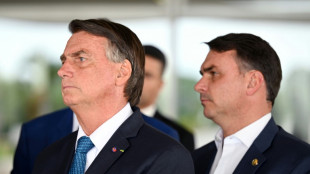 Brazilian judge allows Flavio Bolsonaro to visit jailed father
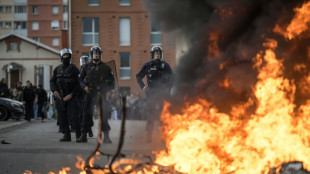 France braces for fresh student demonstrations as Macron calls for 'respect'
 Zelensky doubtful on Russian acceptance of Trump's 'energy ceasefire'
 Federal agents search home of Trump critic Ilhan Omar: government

 Pakistan detains hundreds from ex-PM Khan's party as protests falter
 Australia's Smith off field after being struck on helmet

 UK retains early access to test latest US AI models
 Top NATO commander warns Russia any attack would be 'futile'

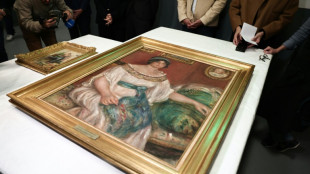
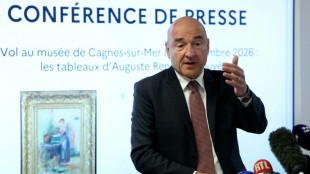 Stolen Renoir paintings found behind wall in France: prosecutor
European Union environment ministers gathered in France Thursday to mull climate policy and the merits of a carbon border tax, while airing differences on whether nuclear energy can be classified as "green".
The two-day informal talks in Amiens, hosted by France as it takes the rotating reins of the EU presidency, will look for a unified path toward achieving the 27-nation bloc's ambitious target of slashing carbon emissions 55 percent from 1990 levels.
Discussion on overhauling the EU's electricity market and carbon-trading system, already fraught, unfolds against a backdrop of sharp increases in energy prices, especially natural gas.
EU energy ministers will join the fray on Friday, and then continue on with separate talks.
Since last year, French President Emmanuel Macron has led the charge for the rapid implementation of a "carbon border adjustment mechanism", essentially a tax on imported products made in countries with less stringent rules on reducing carbon pollution.
The objective is to avoid shifting Europe's carbon emissions overseas as they are reduced at home -- known as "carbon leakage".
The sectors affected include steel, alumium, cement, fertiliser and electricity.
China and the United States are both opposed to such a tax, with Beijing saying last year when the plan was unveiled that it would "violate World Trade Organization (WTO) principles."
- Is nuclear 'green'? -
Even within Europe, Germany insists the mechanism can only be implemented gradually, and several countries are outright opposed, mainly because the tax would replace the allocation of free emissions permits.
"Spain, Portugal, Poland and Austria want to maintain free quotas," a European diplomat said.
Such a carbon tax "raises complicated questions," he added. "Who collects the money? Where does it go?"
But France's ecological transition minister Barbara Pompili said that there is already an "agreement in principle", and talks have shifted to questions of timing.
After EU ministers hammer out a consensus on "CBAM", as it is known, they will undertake negotiations with the EU Parliament to finalise an agreement.
Another divisive issue that has pitted Paris against Berlin is whether nuclear power's virtue as a source of carbon-free energy outweighs safety issues and the as-yet unsolved problem of nuclear waste.
A greater share of electricity in France -- about 70 percent -- is generated by nuclear power than any other country in the world.
The question on the table is whether nuclear power and natural gas should be officially classified in the "EU taxonomy" as environmentally sustainable, an important signal to companies, investors and policymakers.
Nuclear power is neither "sustainable" nor "economic", Germany environment minister Stefan Tidow said in Amiens. "It is not a green energy."
Pompili did not disagree, acknowledging that storage of spent nuclear fuel remains a major problem.
- 'Imported deforestation' -
But "nuclear is a decarbonised energy," she said. "We cannot deprive ourselves of it at the same time that we need to very rapidly reduce our carbon emissions."
A third initiative favoured by France is developing tools to fight so-called "imported deforestation," stemming from products indirectly responsible for the destruction of tropical forests.
Palm oil plantations in Southeast Asia and Africa, and commercial soy production in South America -- mostly to feed cattle -- are major drivers of deforestation.
A draft law submitted by the European Commission in November is currently under discussion in the bloc's Parliament.
Environmental NGOs said the text has too many loopholes, excluding commodities such as corn and rubber.
Yet another initiative running into stiff headwinds is a measure to expand the cap-and-trade system of carbon pollution quotas -- which currently covers heavy industry and the electricity sector -- to transport fuel for trucks and domestic heating fuel.
The controversial proposal, championed by the European Commission, has found scant support among ministers, concerned the measure would result in unpopular price hikes for consumers.
France has expressed "strong reservations," according to a French official.
"We saw the rise of the 'yellow vests'," he said, referring to popular protests in 2018 sparked by a modest increase in petrol prices.
A.Ruiz--AT