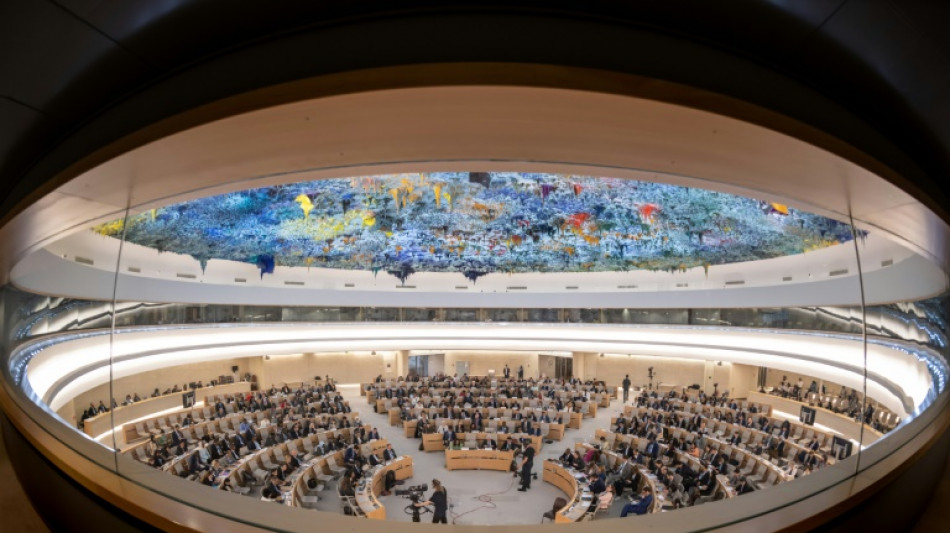
UN rights council takes a stand against intersex discrimination / Photo: Fabrice COFFRINI - AFP

 Danish fish fossil cliffs set to gain UNESCO status
 In Bulgarian mountains, local doctor still on call at 90

 Australia protests China's 'destabilising' missile test
 Sydney court dismisses defamation case against film star Rebel Wilson
 US tariffs on Brazil take effect as Trump readies fresh flurry
 Death toll rises to 13 in Chile's severe storms

 24 hours in a Ukrainian hospital, buckling under the toll of war

 India's domestic workers go online as instant services boom
 From bath to fish market: DJs play to revive Japan neighbourhoods

 Nearly 3,000-year-old human remains unearthed in El Salvador

 New Zealand may miss climate targets due to government policies: report
 Hormuz, Malacca and other key straits spawn tensions throughout history

 InterContinental Hotels Group PLC Announces Transaction in Own Shares - July 22
 Rainout keeps Red Sox MLB win streak at 14 with two games Wednesday
 Zelensky sacks army chief Syrsky after days of protests
 Messi lands in Argentine hometown after World Cup defeat
 Lipowitz breaks collarbone in Tour de France crash
 India opposition leader Gandhi detained after calling for PM resignation
 AI boom lifts Mexico tech exports, complicating Trump trade goals
 'Godzilla' actress Kaylee Hottle, 18, dies in US car crash

 South Africa's anti-migrant unrest led over 160,000 to flee
 Ipswich sign Ghana winger Fatawu from Leicester
 Evenepoel wins 'special' Tour de France individual time-trial
 Evenepoel wins Tour de France individual time-trial
 Tropical Storm Bertha strengthens, threatening Gulf coast of US
The UN Human Rights Council passed a resolution Thursday on tackling discrimination against intersex persons, despite opposition from several countries to the terminology used.
The resolution passed in the 47-member council with 24 votes in favour, none against and 23 abstentions.
Argentina, Brazil, France, Germany, India, and Japan and the United States were among the countries voting Yes.
Bangladesh, China, Indonesia, Malaysia, Qatar and the United Arab Emirates abstained.
The resolution, entitled "Combating discrimination, violence and harmful practices against intersex persons", was brought forward by Australia, Chile, Finland and South Africa.
"The resolution seeks to create awareness of the plight of intersex persons," South Africa's ambassador Mxolisi Nkosi said.
"Intersex persons face lifelong discrimination in various areas of their lives, including in sports, health and education.
"In extreme cases, this leads to violence and harmful practices such as forced castration, forced sterilisation and even infanticide."
France's ambassador Jerome Bonnafont welcomed the council discussing the situation of intersex people for the first time, saying they were "too often the victims of rejection, by their family or society".
US ambassador Michele Taylor called it a "landmark resolution" and a "historic juncture" for the UN's top rights body.
The resolution recognises that persons "with innate variations in sex characteristics, that is persons who are born with sex characteristics that do not fit typical definitions for male or female bodies, including sexual anatomy, reproductive organs and hormonal or chromosome patterns (also known as intersex persons) exist in all societies".
- Terminology debate -
Qatar's representative, speaking for the Arab Group members of the council, said they had presented constructive ideas "to make the text more balanced".
"The Human Rights Council is not the right platform for discussing this complex issue, especially given the medical aspects", he said.
"We wanted to change intersex persons to another description: persons with disorders in sex development. For us, this is the more scientific and medically appropriate description."
Bangladesh said the term intersex was "unknown in the national legal systems and social contexts of many member states", and the resolution "offers a vague and arbitrary definition of intersex persons".
Malaysia said the term intersex "is not universally recognised" and when translated into local languages could be derogatory and "do more harm than good".
Meanwhile China said the resolution should respect traditions in various countries.
The resolution recognises that intersex persons "may face multiple and intersecting forms of discrimination in all areas of life", and voices grave concern about the "violence and harmful practices" they face, "including medically unnecessary or deferrable interventions, which may be irreversible".
The resolution encourages states to enhance efforts to combat discrimination, violence and harmful practices, "such as stereotypes, the spread of misconceptions and inaccurate information, stigma and taboo".
J.Gomez--AT