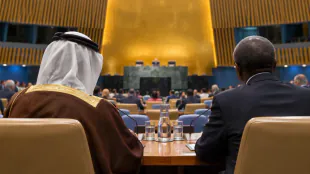
Hong Kong unveils new national security law with tough penalties / Photo: Isaac LAWRENCE - AFP

 Trump Signals Willingness to Work With Democrats After Midterm Defeat

 Qatar media bodies discuss support for humanitarian initiatives

 InterContinental Hotels Group PLC Announces Transaction in Own Shares - November 04

 No. 22 UCLA defeats No. 5 Arizona 84-75 despite Kharchenkov's 38 points

 Vessel operator seeks witnesses after Vancouver grounding

 US Air Force deploys F-16 fighters to remote Aleutian base for readiness drill

 Bezos grant helps Seattle nonprofit move thousands of families toward housing

 Shrini Srivastava joins crew of Varanasi-Delhi Vande Bharat Sleeper service

 Nearly Half of Australian Workers Overqualified, Survey Finds

 RBI eases export-declaration compliance for individual service exporters

 India proposes more import entry points for drugs and medical devices

 Derek Tierney Outlines Ten-Year Strategy for National Digital Health System

 NBC’s Steve Kornacki Reveals Tech Habits Ahead of Midterm Elections

 India and Israel oppose UN draft on regional conventional arms control

 BLS Polymers shares open 65.3% above IPO price

 Capital-markets shares rally as Motilal Oswal and Angel One lead gains

 Latino Voters Defy ICE Fears, Turn Out in Record Numbers for Midterms

 ITC shares rise as analysts anticipate gradual cigarette-business recovery

 Reliance rally puts historical one-year return pattern in focus

 Kuwait edges Oman 1-0 in veterans Gulf Cup in Doha

 Saudi Aramco quarterly profit climbs 34.6% amid elevated oil prices
Hong Kong on Friday introduced the draft bill of a new national security law that includes life sentences for major offences such as treason and insurrection.
The homegrown legislation is set to become the city's second national security law, following the one Beijing imposed in 2020 after quashing huge and sometimes violent democracy protests.
The "Safeguarding National Security Bill" was formally introduced at the city's rubber-stamp legislature on Friday morning for vetting.
Security chief Chris Tang told lawmakers there was a "genuine and urgent need" for the new law.
"Hong Kong has undergone serious threats to national security, especially the colour revolution and black-clad violence in 2019, which was an unbearably painful experience," he said, referring to the democracy protests.
Legislative Council president Andrew Leung vowed lawmakers would "spare no effort and work together to plug the national security loophole as soon as possible".
The bill lists five new categories of offences -- treason, insurrection, espionage and theft of state secrets, sabotaging national security, and external interference.
Authorities have proposed life imprisonment as the maximum penalty for treason, insurrection, sabotage endangering national security, and incitement of members of China's armed forces to mutiny.
The bill also reworks Hong Kong's colonial-era crime of "sedition" to cover inciting hatred against China's Communist leadership and socialist system while upping the maximum penalty from two years to 10 years.
Under the proposed bill, authorities could apply to the court to detain an arrested person for up to 16 days without charge and bar them from consulting with lawyers during their detention.
As with its predecessor, the proposed new security law states that offences committed outside Hong Kong fall under its jurisdiction.
In a section closely watched by Hong Kong's foreign business community, the draft proposes a multipronged definition of "state secrets" that covers not only technology but "major policy decisions" and the city's "economic and social development".
The draft bill also criminalises the unlawful acquisition, possession and disclosure of state secrets, though it offers a "public interest" defence under specific conditions.
- Fast-tracked process -
Hong Kong authorities have fast-tracked the bill, which was unveiled nine days after a one-month public consultation ended.
In response to the draft, the British consulate in Hong Kong on Friday urged the government "to allow time for proper legislative scrutiny" and urged that the law "align with international standards and uphold basic rights and freedoms".
City leader John Lee earlier said the city was fulfilling its "constitutional responsibility" by creating its own security law as required under Article 23 of the Basic Law, Hong Kong's mini-constitution since its handover from Britain to China in 1997.
Previous objections and concerns over potential rights infringements raised by local and overseas activists as well as some Western countries were rejected by Hong Kong officials as "deliberate smearing".
Critics say the existing security law has already eviscerated Hong Kong's political opposition and civil society, with pro-democracy politicians and activists jailed, forced into exile or silenced.
Nearly 300 people have been arrested and more than 170 charged since the Beijing-imposed security law came into force.
Y.Baker--AT