Gaza hostages risk lasting psychological trauma: experts / Photo: JACK GUEZ - AFP

 Cat rescued from ruins of Venezuela quake offers 'ray of hope'

 Sindhu wins Japan Open to end title drought

 Kyiv hit with deadly strikes after attack on Russian e-commerce giant

 Skipper Sheehan urges higher level from beaten Ireland

 Spain and Argentina brace for World Cup final

 Faith vs therapy: Inside the Philippine school for exorcists

 India probe into stolen donations tests trust in temple finances

 Kyiv struck after attack on Russian e-commerce giant

 Kiss has work cut out at Wallabies as Schmidt bids farewell

 Departing Deschamps looks back on 'wonderful' World Cup

 England finish third as Spain and Argentina brace for World Cup final

 England took first step towards elite nations with France win: Tuchel

 England edge France 6-4 in chaotic World Cup bronze match

 Erasmus calls Springbok victory over Wales a 'grind'

 Spain's Yamal aims to join elite club of teenage World Cup winners

 Zelensky mulls army changes as protests rock Ukraine for third day

 Wenger accepts World Cup hydration breaks split opinion

 England World Cup star Rogers set to join Chelsea: reports

 Debutant Williams scores as South Africa thump Wales

 Hamilton thanks Ferrari for 'mega' repairs after smashing car

 Fox joins 62 club to lead British Open, McIlroy unleashes on 'performative' DeChambeau

 Spain, Argentina tune up for World Cup final in smoggy New Jersey

 Wimbledon finalist Muchova out for 'a few weeks'

 Pogacar wins 'unforgettable' Tour de France 14th stage to extend overall lead

 Ukrainian strikes on Russian warehouses kill 8, shroud skies in smoke

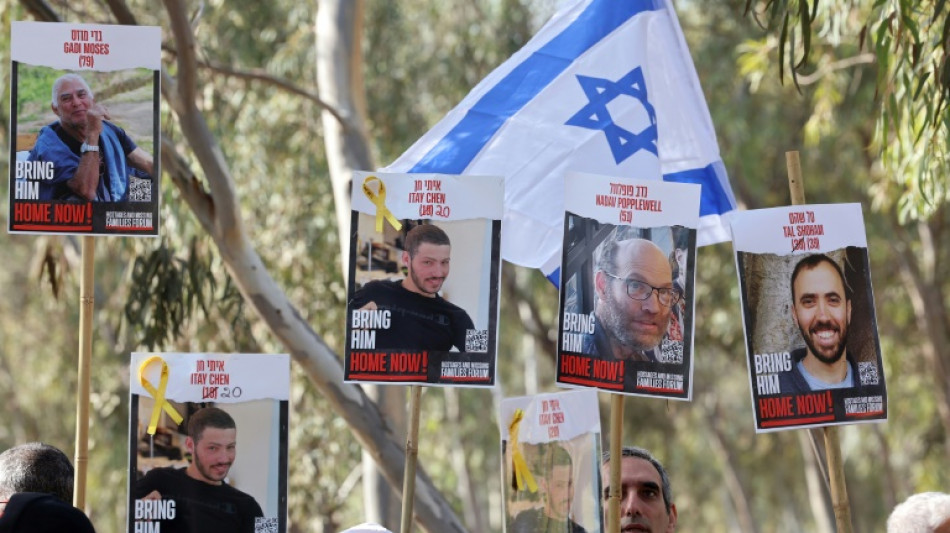
If and when the hostages held by Hamas in Gaza are released under any deal, they face the risk of lasting psychological trauma, experts warned, citing the suffering of people freed previously.
"There are some that are living dead. As if they were frozen in time and place in Gaza, and haven't returned," said Merav Roth, a clinical psychologist who treated some of those former hostages and their families.
Israel launched an assault to destroy Hamas after the group's unprecedented attack on southern Israel on October 7. The hostages' possible release is one of the points at stake in truce talks under way in Egypt.
Hamas's attack resulted in the deaths of about 1,160 people, mostly civilians, according to an AFP tally of official figures, and saw some 250 hostages taken, most of them Israelis.
Israel's retaliatory bombardment and ground offensive have killed more than 30,700 people, most of them women and children, according to the territory's Hamas-run health ministry.
- 'World of chaos' -
Some hostages were released under a week-long truce in November but around 130 others remained in the hands of Hamas in Gaza.
"We're going to have to immediately take care of these hostages... to help them overcome their fear and their stupor and bring them back to real life," Marilyne Baranes, a psychologist who specialises in post-traumatic stress disorder (PTSD), told AFP.
Of the approximately 100 Israeli hostages freed under the earlier truce, half are undergoing treatment or therapy, the country's government said.
Those who were kept in more dangerous or traumatic conditions, experience "more severe symptoms of anxiety, depression", Roth said.
"But among them all, there's great difficulty in returning to functionality."
Christine Roulliere-Le Lidec, a PTSD specialist, told AFP that survivors need both physical and psychological support in order to move on from a "world of chaos, of hell, to the world of life."
"I've seen cases of people who... supported of course by the health care teams and their families, can finally get through it... to be able to finally find meaning in your life when you've been living in nonsense and barbarism and chaos."
- Limited research -
Research indicates it is difficult to measure the risk of mental illness in different hostages after their release.
While some former hostages have suffered severely -- French journalist Brice Fleutiaux took his own life in 2001 after being held hostage in Chechnya -- others appeared to overcome their trauma.
Briton Terry Waite, who spent four years detained in Lebanon in the 1980s, has dedicated his life to helping hostages and their families.
A 2009 study in the Journal of the Royal Society of Medicine concluded: "As yet there is no clear delineation of all factors which conduce to an adverse outcome following being taken hostage."
- Post-release monitoring difficult -
The study found evidence that those facing worse after-effects included women, people with little education but also those held for long periods -- as is the case with the hostages in Gaza.
However, the findings are dated and research is difficult to carry out.
"For ethical and practical reasons, particularly if children are involved, the follow-up of hostages on release is difficult," the study said.
"Thus, the scientific and clinical database is relatively modest."
Many studies are based on autobiographies by former hostages which gives a limited point of view.
Experts agree that a lot depends on the first few hours after a hostage is released.
"You can get over this type of thing, but you won't go back to the way you were," psychologist Baranes said.
M.Robinson--AT