Tunisian civil society fears plan to limit foreign funding / Photo: FETHI BELAID - AFP

 Erasmus calls Springbok victory over Wales a 'grind'
 Spain's Yamal aims to join elite club of teenage World Cup winners

 Zelensky mulls army changes as protests rock Ukraine for third day

 Wenger accepts World Cup hydration breaks split opinion

 England World Cup star Rogers set to join Chelsea: reports

 Debutant Williams scores as South Africa thump Wales

 Hamilton thanks Ferrari for 'mega' repairs after smashing car
 Fox joins 62 club to lead British Open, McIlroy unleashes on 'performative' DeChambeau

 Spain, Argentina tune up for World Cup final in smoggy New Jersey

 Wimbledon finalist Muchova out for 'a few weeks'
 Pogacar wins 'unforgettable' Tour de France 14th stage to extend overall lead

 Ukrainian strikes on Russian warehouses kill 8, shroud skies in smoke

 India all-rounder Sundar out of England finale

 Antonelli takes pole at Belgian Grand Prix

 Record setter Kerr, Alfred light up London Diamond League
 Bethell hails 'incredible' Sobers for turning point in England career

 DeChambeau 'fired up' by two-shot penalty as Fox joins 62 club at British Open

 German lawmaker steps down for using US surrogacy to have a child

 Messi, Yamal come full circle in World Cup showdown

 Australia beat Italy 57-10 to end Schmidt era with win
 Antonelli continues to set blazing pace in Belgian practice

 France cruise past Japan 42-15 in Nations Championship

 France beat Japan 42-15 in Nations Championship

 The challenges facing UK's next PM Andy Burnham

 Vietnam floods and landslides kill at least 4
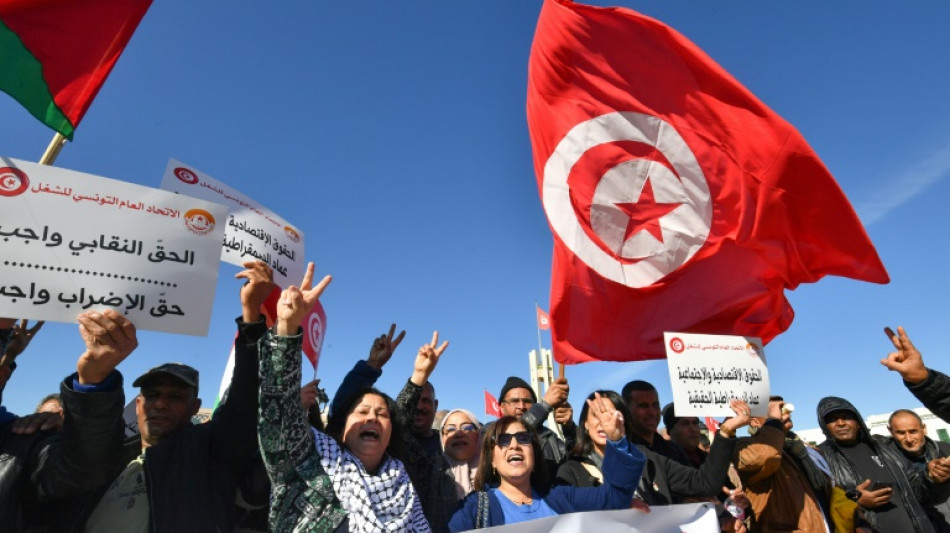
Tunisian civil society groups fear the government is planning to starve them of foreign funding under the pretext of fighting money laundering and terrorism.
President Kais Saied, who launched a sweeping power grab in 2021 and rules by decree, has accused many non-government organisations of serving "foreign agendas".
Under a draft law he supported, state authorities would have to approve all foreign funding for NGOs that operate in the North African country.
Human rights groups worry it is another repressive measure in the country that became known as the birthplace of the Arab Spring protests more than a decade ago.
"The aim of the bill is to restrict civil society -- its financing, its activity and to limit its work to certain topics suggested by the political authority," said Bassem Trifi, president of the Tunisian League for the Defence of Human Rights.
If the draft law is enacted, Trifi warned, "Tunisia will lose its civil society and all the work it has done".
Amnesty International warned that the "absolute discretion given to the government to authorise or deny funding requests of civil society groups may constitute a disproportionate restriction of the right to freedom of association".
The Tunisian groups also worry that tens of thousands of jobs will be lost if funding from abroad dries up, given that most organisations receive little to no public money in the recession-hit and highly indebted country.
Saied, elected democratically in October 2019, sacked parliament in July 2021 and assumed most executive powers.
A number of Saied's opponents are behind bars as Tunisia prepares for presidential elections set to take place in October.
- 'Preserve the freedoms' -
The draft law would replace a 2011 decree that saw the creation of over 25,000 organisations after the uprising that ousted dictator Zine El Abidine Ben Ali and set in motion what later came to be known as the Arab Spring.
"According to a study we did, by limiting civil society's financial resources, we risk losing around 30,000 direct jobs" and about 100,000 indirect jobs, Trifi said.
Critics worry that this would exacerbate unemployment rates, which already stand at 16 percent overall and 40 percent among the youth.
Shanti, an association that employs 22 full-time workers and manages over 100 projects involving crafts, farming and eco-tourism nationwide, may be among those affected.
The group receives over 90 percent of its funding from abroad.
Their projects like L'Artisanerie, a workshop in Tunis that supports about 60 craftspeople selling items including handmade carpets, pottery and furniture, could also be impacted.
"We're on alert about what's going to happen," said Shanti's head Mehdi Baccouche.
He said that he is not opposed to new regulation, but that any change should result from "a permanent dialogue" between organisations and authorities.
"It's important to preserve the freedoms acquired by associations and to continue to develop access to national and foreign funds," Baccouche said.
"The development of the associative sector brings thousands of jobs and, beyond that, thousands of people are directly impacted."
- 'Achievement of the revolution' -
Clement Nyaletsossi Voule, the UN special rapporteur on freedom of assembly and association, said the proposed legislation also "gives excessive powers to the authority which can, according to its agenda, refuse an association".
"The 2011 decree is an achievement of the revolution that must be preserved," Voule told AFP.
The current law allows the creation of an organisation simply by notifying the government, without requiring approval.
This has allowed for the flourishing of NGOs working on political and social issues, such as women's and LGBTQ rights.
Their championing of freedoms, including of the press, saw the emergence of independent media outlets.
This "does not mean that the authorities turn a blind eye", Voule added, arguing that the government can still examine "the organisation's agenda and whether there is an imminent security risk".
Before making any sweeping changes to the system, the UN rapporteur argued, "authorities must open discussions with civil society".
A.Moore--AT