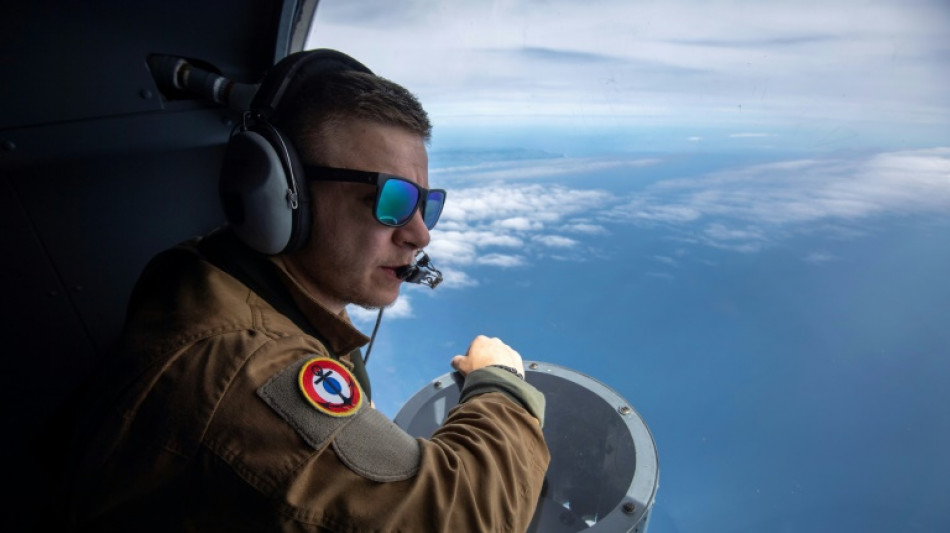
Does Sweden joining make the Baltic Sea a 'NATO lake'? / Photo: FRED TANNEAU - AFP

 Galloway accuser could not foresee publishing-sector fallout, lawyer argues

 New York City Center revives In the Heights as a timely community story

 Godzilla Minus Zero shifts focus toward postwar human drama

 Mehbooba Mufti urges dialogue and renewed Central Asia links for Kashmir

 Seacliff Healthcare Seeks Specialist GP in Thirroul

 US stocks fall before midterm Election Day as technology shares weaken

 BLS Polymers makes strong market debut at ₹248 per share

 Petrol and diesel prices remain broadly steady across major Indian cities

 Reliance shares remain in focus after near-12% surge

 2026 Arizona Midterms: Key Races, Ballot Measures, and Voter Deadlines

 Coal India prepares possible $1 billion Mahanadi Coalfields listing

 Julia Stiles and Ezra Sosa Share Emotional Farewell After 'DWTS' Elimination

 US Buildings Threatened by Wildfires Could Triple by 2060

 Why Pregnancy Cost Estimates Fail: A Family’s $9,000 Surprise

 US Strikes Iranian Targets in Strait of Hormuz Ahead of Midterms

 Brodeur’s Overtime Goal Secures Bethlehem’s Second Consecutive Sectional Title

 Rare 1970 Plymouth ‘Cuda 426 Hemi Listed for $400,000

 The Digital Burden: Why Instant Messaging Feels Like a Full-Time Job

 Alberta Tabled Controversial Riding Boundary Maps Amid Gerrymandering Accusations

 Hong Kong court set to sentence activist Joshua Wong in security case

 Australia raises benchmark rate to highest level in 18 years

 'The Remarried Empress' Cast Discusses Bringing Fantasy Royal Drama to Life

 Asian stocks retreat as AI worries outweigh steep oil-price drop

 Hamad International Airport stages emergency drills during WATAN 2026

 Global failure to punish attacks leaves journalists at continuing risk

Sweden's accession to NATO adds a final puzzle piece to the alliance around the shores of the strategically important Baltic Sea -- but Russia still poses a threat above and below water.
After Finland joined last year, Sweden's membership -- which cleared the final hurdle Monday with Hungary's vote on ratification -- means all the countries surrounding the Baltic Sea, except Russia, will be part of the US-led military alliance.
That has led some to label the sea a "NATO lake", with the Western allies now appearing well-placed to strangle Russia's room for manoeuvre in the crucial shipping route if a war with Moscow ever breaks out.
But analysts warn that while Sweden's entry makes it easier for NATO to exert control and reinforce its vulnerable Baltic states, Russia can still menace the region from heavily-armed exclave Kaliningrad and threaten undersea infrastructure.
"If you look at a map then geographically the Baltic Sea is becoming a NATO lake, yes," said Minna Alander a research fellow at the Finnish Institute of International Affairs.
"But there is still work to do for NATO."
Since Russia's invasion of Ukraine, a series of high-profile incidents involving pipelines and cables under the Baltic Sea have given NATO a wake-up call over its vulnerabilities.
In September 2022 a sabotage attack hit the Nord Stream gas pipelines between Russia and Europe. Over a year on, investigators have still not publicly named those responsible.
Then last October a gas pipeline and a cable from Finland and Sweden to Estonia were damaged. Finnish police say they believe a Chinese cargo ship was likely involved.
NATO has bolstered its naval deployments in response and is looking to step up its monitoring capabilities, but keeping an eye on what's happening beneath the water is a major task.
"It's very difficult to have overall control of a sea as you would control territories on land," said Julian Pawlak, a researcher at Germany's Bundeswehr University in Hamburg.
"What the Nord Stream sabotages have shown, among others, is that it remains hard to be aware exactly what is happening below the surface and on the seabed."
- Kaliningrad threat -
Sweden has long had a close partnership with NATO but its formal membership will allow it to be fully integrated into the alliance's defence plans.
Beyond its long Baltic coastline, Sweden brings with it the island of Gotland which would play a central role in helping NATO impose its will.
But just across the water Russia has its own vital outpost -- the exclave of Kaliningrad.
Wedged between Poland and Lithuania, Moscow has in recent years turned the region into one of the most militarised in Europe, with nuclear-capable missiles stationed there.
Russia's Baltic fleet based in Kaliningrad is a shadow of what it was during the Cold War and the invasion of Ukraine has sapped some of its forces from the region.
But John Deni, a research professor at the US Army War College, said the Kremlin has kept up investments in undersea capabilities and still has the firepower to stage small-scale landings or threaten NATO supply routes.
"In terms of artillery, indirect fires and nuclear-capable weapons they out-gun and out-range NATO allies in the region," Deni told AFP.
"Allies have to meet that threat and counter it."
On the other side, while Stockholm brings with it a rich heritage of naval history, like other NATO states in the area its sea power in the Baltic remains understrength.
"Even if you count Sweden, NATO naval assets are relatively limited," Deni said, adding that the allies need to develop their ability to carry out demining under fire.
- Reinforcing the Baltic states -
Three countries breathing a particular sigh of relief over the entry of Sweden -- and Finland -- are NATO's Baltic states, Estonia, Latvia and Lithuania, long seen as an Achilles heel for the alliance.
War planners have struggled to work out how to stop them being cut off if Russian land troops seized the 65-kilometre (40-mile) Suwalki Gap between Belarus and Kaliningrad.
Sweden's position straddling both the North and Baltic Seas opens up a key route for transiting more NATO forces to protect them in case of attack.
"It allows US forces to reinforce the Baltic Sea nations in a timely manner, but especially the frontline states," said Tuuli Duneton, Estonian undersecretary for defence policy.
Despite the joy at NATO over welcoming Sweden to the fold, however, US academic Deni insisted the alliance should lay off considering the Baltic its own property.
"Calling it a 'NATO lake' leads to complacency," Deni said.
"The challenge and the threat posed by Russia in the region is significant in some ways and the allies for now lack the capacity to counter that in a crisis."
E.Flores--AT