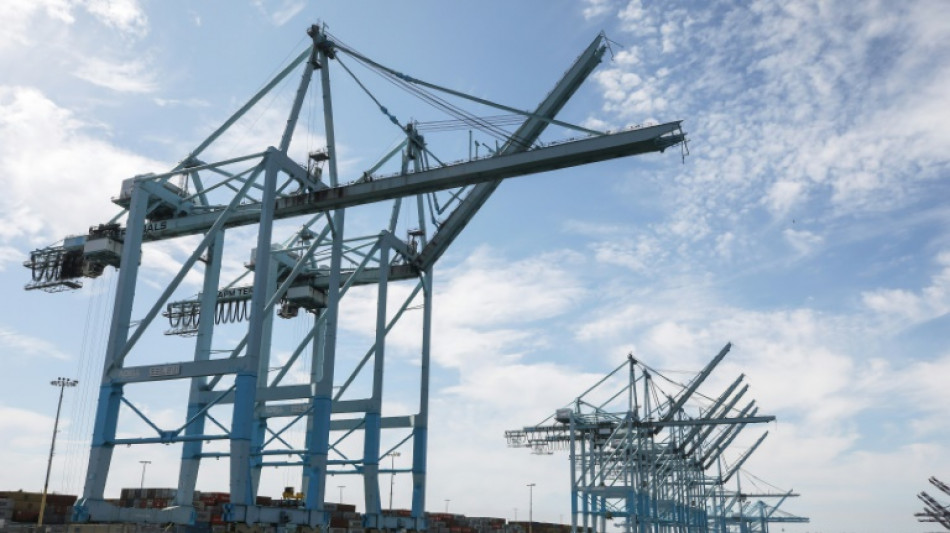
US-China economic flashpoints at a glance / Photo: MARIO TAMA - GETTY IMAGES NORTH AMERICA/AFP/File

 Vietnam floods and landslides kill at least 4

 Founding father: statues of Myanmar's Aung San disappear

 Infantino's enlarged World Cup gamble pays off with punters

 No fuel, no patience: Russians endure fuel shortages
 'Chainsaw massacre': Europe mulls culls for fish-guzzling cormorant

 England carry 'scars' of World Cup exit, says Tuchel

 Argentina coach Scaloni hails 'legend' Messi before World Cup final

 Argentina World Cup success moves me to tears, says goalkeeper Martinez
 Gold IRA Fees Explained: New 2026 Breakdown of Setup, Storage, and Annual Costs

 Spain captain Rodri preparing for 'physical' Argentina battle

 Leather jacket worn by Nvidia CEO Jensen Huang auctions for nearly $1 mn

 Leader Herbert, Burns equal record 62 at British Open, DeChambeau docked two shots

 Yankees' Judge improving, but not ready for baseball activities

 None shall pass: Spain's defence ready to thwart Messi in World Cup final

 China's Kimi K3 rattles US AI industry

 Herbert takes Open lead, equals Burns' round of 62

 'Great innings ends': Cricket mourns West Indies great Sobers

 Fickle winds whip up huge Spanish wildfire

 US links Taco Bell lettuce to diarrhea-causing parasite outbreak

 Strong quake hits southern Mexico, tsunami alert lifted

 Deschamps set for bittersweet ending to France reign as Zidane waits

 German lawmaker faces criticism for US surrogacy to have a child

 Southern Mexico hit by 7.3 quake, triggering tsunami alert

 Germany defender Gosens signs with Schalke

 Nigerian court dismisses suit challenging Shell's divestment

From a trade imbalance to technological competition, a host of economic flashpoints are boosting tensions between Washington and Beijing -- and these are among areas in which both Republicans and Democrats can agree.
What's behind these concerns?
- American debt -
Republicans in particular are worried about this issue, concerned that China holds too much American debt.
The fear is that Beijing could use this to pressure Washington by threatening to resell its bonds, bringing down the value of holdings.
While the American debt exceeds $34 trillion, only around $8 trillion is held abroad.
China is a key holder of US debt, accounting for $816 billion and just over $1 trillion when Hong Kong is included, according to Treasury Department figures.
But it is the second biggest foreign holder behind Japan -- which holds $1.1 trillion -- and ahead of Britain.
- Tech race -
US President Joe Biden has focused on tech, noting its importance to ensuring national security.
Be it in semiconductors, artificial intelligence or electric vehicles, Washington is seeking to stay ahead or catch up with Beijing in various areas -- including to prevent advanced tools from falling into the hands of the Chinese military.
A major target during former president Donald Trump's term was telecoms giant Huawei, which the United States sought to keep out of its 5G networks and those of allies.
Restrictions grew under the Joe Biden administration, especially involving cutting-edge semiconductors necessary in AI development.
The goal, said Commerce Secretary Gina Raimondo in October, is to limit Chinese access to advanced chips that could fuel breakthroughs in AI and sophisticated computers that are critical to military applications.
In the field of critical minerals, of which Beijing has ample supplies, Washington has also been seeking to circumvent China.
- Trade -
While China is no longer the top source from which the United States imports goods, the perceived trade imbalance between the world's two biggest economies remains a concern.
Trump's tariffs on Chinese goods and attempts to secure a deal to rebalance trade has failed to turn the tide, and the Biden administration has largely maintained levies while pursuing efforts in "friendshoring" -- or diversifying supply chains across allies and partners.
There appears to be some impact with US-China trade growing less quickly, although a deeper look shows that some Chinese products are simply routed through other countries.
- Currency war? -
The question of exchange rates and the use of currency for political and commercial purposes has been a recurring issue, too.
For years, Washington has accused Beijing of maintaining the yuan at a deliberately lower rate against the dollar in order to promote exports.
In November, the US Treasury flagged China's "lack of transparency" in its exchange rate mechanism, saying this warranted monitoring.
The concern now centers on the internationalization of the yuan, with the Chinese currency still little present in commercial exchanges.
As of end-2023, fewer than 3.5 percent of payments via the SWIFT international electronic transfer system were made in yuan -- compared with nearly 19 percent in euros and more than 50 percent in dollars.
China wants the yuan to establish itself, especially in trade, as a safeguard against potential US sanctions. Beijing in turn believes that Washington is weaponizing the dollar.
Ch.Campbell--AT