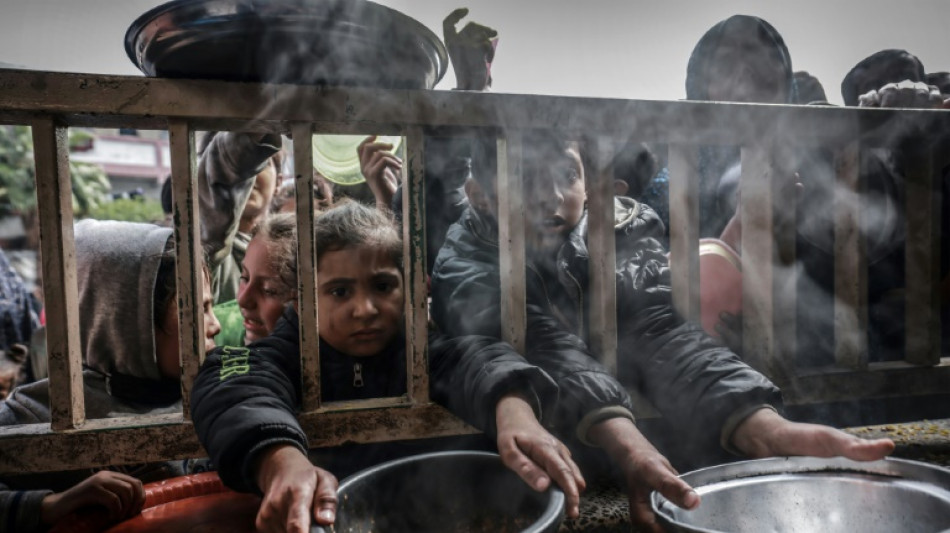
Dead horses, scraps, leaves: Gaza's hungry get desperate / Photo: MOHAMMED ABED - AFP/File

 Founding father: statues of Myanmar's Aung San disappear
 Infantino's enlarged World Cup gamble pays off with punters
 No fuel, no patience: Russians endure fuel shortages

 'Chainsaw massacre': Europe mulls culls for fish-guzzling cormorant
 England carry 'scars' of World Cup exit, says Tuchel

 Argentina coach Scaloni hails 'legend' Messi before World Cup final

 Argentina World Cup success moves me to tears, says goalkeeper Martinez

 Gold IRA Fees Explained: New 2026 Breakdown of Setup, Storage, and Annual Costs

 Spain captain Rodri preparing for 'physical' Argentina battle

 Leather jacket worn by Nvidia CEO Jensen Huang auctions for nearly $1 mn
 Leader Herbert, Burns equal record 62 at British Open, DeChambeau docked two shots

 Yankees' Judge improving, but not ready for baseball activities

 None shall pass: Spain's defence ready to thwart Messi in World Cup final

 China's Kimi K3 rattles US AI industry

 Herbert takes Open lead, equals Burns' round of 62
 'Great innings ends': Cricket mourns West Indies great Sobers

 Fickle winds whip up huge Spanish wildfire

 US links Taco Bell lettuce to diarrhea-causing parasite outbreak

 Strong quake hits southern Mexico, tsunami alert lifted
 Deschamps set for bittersweet ending to France reign as Zidane waits

 German lawmaker faces criticism for US surrogacy to have a child

 Southern Mexico hit by 7.3 quake, triggering tsunami alert

 Germany defender Gosens signs with Schalke

 Nigerian court dismisses suit challenging Shell's divestment
 Ex-president Sall arrives back in Senegal for meeting with successor

At the Jabalia refugee camp in northern Gaza, Abu Gibril was so desperate for food to feed his family that he slaughtered two of his horses.
"We had no other choice but to slaughter the horses to feed the children. Hunger is killing us," he told AFP.
Jabalia was the biggest camp in the Palestinian territories before the war, which began after Hamas fighters attacked southern Israel on October 7, leaving some 1,160 dead, based on Israeli figures.
Gibril, 60, fled there from nearby Beit Hanun when the conflict erupted. Home for him and his family is now a tent near what was a UN-run school.
Contaminated water, power cuts and overcrowding were already a problem in the densely populated camp, which was set up in 1948 and covers just 1.4 square kilometres (half a square mile).
Poverty, from high unemployment, was also an issue among its more than 100,000 people.
Now food is running out, with aid agencies unable to get in to the area because of the bombing -- and the frenzied looting of the few trucks that try to get through.
The World Food Programme this week said its teams reported "unprecedented levels of desperation" while the United Nations warned that 2.2 million people were on the brink of famine.
On Friday, the health ministry in Hamas-run Gaza said a two-month-old baby died of malnutrition in hospital in Gaza City, seven kilometres (just over four miles) away from Jabalia.
Overall, at least 29,606 people have been killed in Gaza in the war, the ministry said Saturday.
- Scavenging and begging -
In the camp, bedraggled children wait expectantly, holding plastic containers and battered cooking pots for what little food is available.
With supplies dwindling, costs are rising. A kilo of rice, for example, has shot up from seven shekels ($1.90) to 55 shekels, complains one man.
The UN children's agency UNICEF has warned that the alarming lack of food, surging malnutrition and disease could lead to an "explosion" in child deaths in Gaza.
One in six children aged under two in Gaza was acutely malnourished, it estimated on February 19.
Residents have taken to eating scavenged scraps of rotten corn, animal fodder unfit for human consumption and even leaves to try to stave off the growing hunger pangs.
"There is no food, no wheat, no drinking water," said one woman.
"We have started begging neighbours for money. We don't have one shekel at home. We knock on doors and no one is giving us money".
- 'Dying from hunger' -
Tempers are rising in Jabalia about the lack of food and the consequences. On Friday, an impromptu protest was held involving dozens of people.
One child held up a sign reading: "We didn't die from air strikes but we are dying from hunger."
Another held aloft a placard warning "Famine eats away at our flesh", while protesters chanted "No to starvation. No to genocide. No to blockade."
In Beit Hanun, Gibril used two horses to harvest a parcel of land. But the conflict destroyed that, along with his house, leaving him with nothing.
Over the weeks and months, Israel's relentless bombardment has left Gaza largely a place of shattered concrete and lives.
Gibril kept the radical decision to slaughter his horses to himself, boiling the meat with rice, and giving it to his unwitting family and neighbours.
Despite the necessity, he said he was still wary of their reaction. "No one knows they were in fact eating a horse."
B.Torres--AT