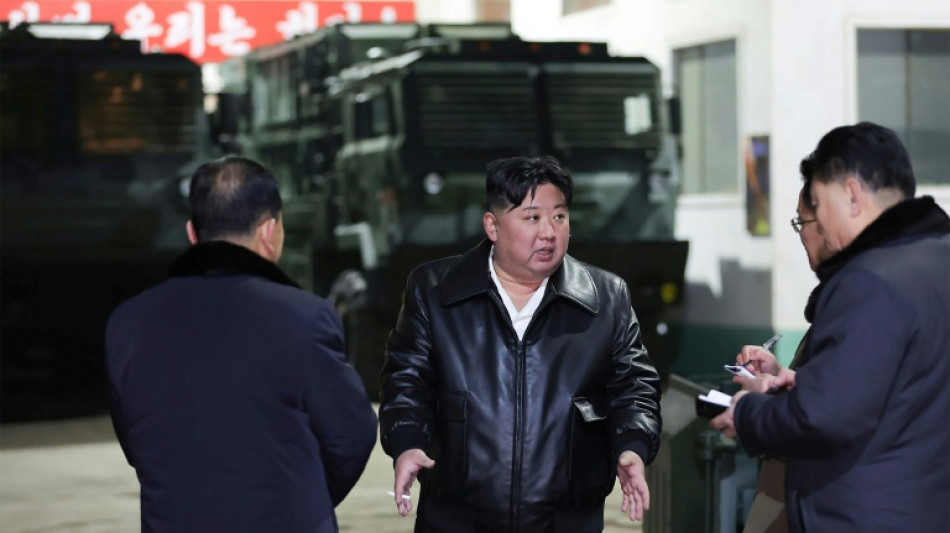
Is North Korea's Kim preparing for war? / Photo: STR - KCNA VIA KNS/AFP

 Myanmar leader to visit Thailand next month: Thai FM to AFP
 Belgian great Meunier signs for Premier League side Sunderland

 Kenya denies Rastafarians the right to smoke weed

 Generative AI's power sparks fears of dumbing humans down
 'Like my lover': Chinese users bid farewell to AI companions

 Empty skyscrapers: China's property slump still throttling growth

 Cuba slowly gets power back after latest blackout
 AI demand powers forecast hike, profit gains at tech giant ASML

 Aussie Rules removes Indigenous figure from Hall of Fame
 France set to adopt assisted dying law in final vote
 Australian swimmer O'Callaghan reveals she has spinal fractures
 Argentina and England collide with World Cup final spot at stake
 AI ignites 'ignored sector' for Japan chipmaker Kioxia

 Writers union sues to block US Paramount deal

 UK announces social media curfew for older teens
 Italy court to rule in deadly bridge collapse case

 Tuchel unfazed by history ahead of England v Argentina World Cup semi
 Scaloni says fatigue not a concern for Argentina in World Cup semi-final

 Tocvan Outlines Phased Development Plan for Pilot Mine Operations at Gran Pilar Gold-Silver Project

 Caledonia Mining Corporation Plc: Notification of Relevant Change to Significant Shareholder
 InterContinental Hotels Group PLC Announces Transaction in Own Shares - July 15

 Elevex Capital Launches Multi-Vertical Floor Plan Finance Platform, Powered by Vero Technologies

 Two Free Travel Itinerary Builders Launch With One-Tap Auto-Planning - No Account, No Upload, Your Trip Stays on Your Device

 MPS Law Welcomes Howard Teplinsky as a Partner
 Mac Allister calls on Argentina to channel Maradona spirit in England World Cup clash

North Korean leader Kim Jong Un has declared the South his country's "principal enemy", jettisoned agencies dedicated to reunification and outreach, and threatened war over "even 0.001 mm" of territorial infringement.
But is the fiery rhetoric a sign of a real shift? AFP takes a look at what we know:
What's happened?
After years of worsening ties, Pyongyang made it official this week: declaring Seoul its main enemy, abolishing agencies dedicated to reunification and threatening to occupy the South during war.
It's a big shift, as "in the past when there was risk of an armed conflict, there was a back channel to keep it in control, but now there is none of that," said Hong Min, a senior analyst at the Korea Institute for National Unification in Seoul.
North Korea has gotten rid "of any inter-Korean mechanisms to prevent conflicts from spiralling out of control," he added.
"The North's labeling of the South as its 'principal enemy' isn't just rhetorical -- the words could carry into action."
Will he invade?
Kim said he had no intention of starting a war -- but also none of avoiding one.
He's declared he will no longer recognise the de facto maritime border between the two Koreas, known as the Northern Limit Line, and his military recently staged days of live-fire artillery drills in the area.
This has created "a growing possibility of the two sides getting into a military skirmish, which could lead to a wider conflict," Hong said.
In addition, Pyongyang has been drawing closer to Moscow, including -- Washington and Seoul claim -- sending missiles for Russia's war in Ukraine in exchange for help with their satellite program.
Seoul, for its part, has threatened a "multiple times stronger" response to any provocation, a hawkish approach that carries risks as an editorial in the Hankyoreh newspaper pointed out this week.
"It is never wise for both South and North Korea to take a no-prisoners approach in inter-Korea dealings," it said.
"As North Korea becomes more reckless, we hope that the government will focus its efforts... to manage the situation," it added.
What's next?
The two Koreas are now "at the highest probability of being dragged into armed conflict", said Choi Gi-il, professor of military studies at Sangji University.
"Let's say civilian and military casualties incur from a future Northern provocation. We target the point of origin with shells. But will we also strike them with air power?" he said.
In 2010, when the North shelled the remote South Korean border island of Yeonpyeong, killing four, Seoul's F-16 jets were "in the air ready to strike but then-president Lee Myung-bak called it off" to avoid escalating the situation.
"But if we have a similar incident, there's no guarantee that air power will not be used given hawkish calls" from Seoul's administration, Choi said.
And Pyongyang's response could see the peninsula "reach a full-fledged war in the worst case scenario," he said.
No chance of rapprochement?
The prospects for inter-Korean reconciliation have long been dim, but now Kim has told Seoul to its face that he views them as his number one enemy, Soo Kim, policy practice area lead at LMI Consulting and former CIA analyst, told AFP.
"He's not only closed the door to rapprochement -- he's put a padlock on it to make it clear to the South Koreans where he stands on their relationship," she added.
But the new rhetoric from Pyongyang doesn't necessarily "change the calculus for North Korea," she said.
Pyongyang has long been developing nukes and missiles, and Kim has been waiting for an opportune moment to conduct his much-anticipated seventh nuclear test.
"These weapons weren't developed overnight, and the Kim regime's plans to use them as tools of coercion, threats, and bargaining have been their modus operandi for decades," she added.
Why is Kim doing this?
Kim's new messaging on South Korea "appears to be an ideological adjustment for regime survival, justifying Kim's focus on nuclear missiles," said Leif-Eric Easley, a professor at Ewha University in Seoul.
Despite years of Covid-linked border closures, and strict controls on the flow of information domestically, North Koreans "are increasingly aware of their country's economic failings compared to South Korean successes," he said.
"So Kim is doubling down on military prowess against external threats for his domestic legitimacy," he said.
South Korea is also set for a general election in April, where President Yoon Suk Yeol's party is trying to win back control of the country's parliament.
"Kim may also be trying to politically punish the Yoon administration for its policies toward Pyongyang ahead of South Korea's legislative elections in April," Easley said.
A.Taylor--AT