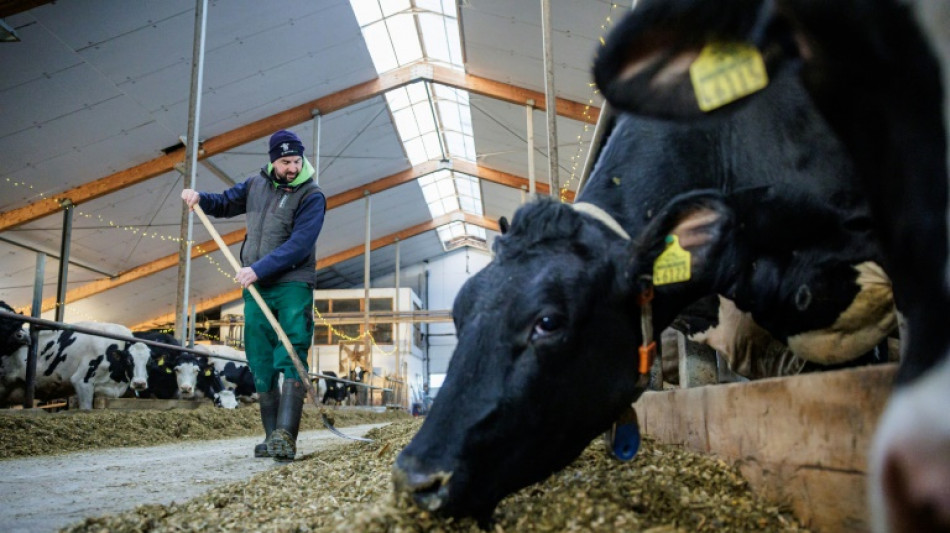
Struggles of family farms fuel German discontent / Photo: JENS SCHLUETER - AFP

 Trump Signals Willingness to Work With Democrats After Midterm Defeat

 Qatar media bodies discuss support for humanitarian initiatives

 InterContinental Hotels Group PLC Announces Transaction in Own Shares - November 04

 No. 22 UCLA defeats No. 5 Arizona 84-75 despite Kharchenkov's 38 points

 Vessel operator seeks witnesses after Vancouver grounding

 US Air Force deploys F-16 fighters to remote Aleutian base for readiness drill

 Bezos grant helps Seattle nonprofit move thousands of families toward housing

 Shrini Srivastava joins crew of Varanasi-Delhi Vande Bharat Sleeper service

 Nearly Half of Australian Workers Overqualified, Survey Finds

 RBI eases export-declaration compliance for individual service exporters

 India proposes more import entry points for drugs and medical devices

 Derek Tierney Outlines Ten-Year Strategy for National Digital Health System

 NBC’s Steve Kornacki Reveals Tech Habits Ahead of Midterm Elections

 India and Israel oppose UN draft on regional conventional arms control

 BLS Polymers shares open 65.3% above IPO price

 Capital-markets shares rally as Motilal Oswal and Angel One lead gains

 Latino Voters Defy ICE Fears, Turn Out in Record Numbers for Midterms

 ITC shares rise as analysts anticipate gradual cigarette-business recovery

 Reliance rally puts historical one-year return pattern in focus

 Kuwait edges Oman 1-0 in veterans Gulf Cup in Doha

 Saudi Aramco quarterly profit climbs 34.6% amid elevated oil prices
For more than a century, Marc Bernhardt's family has been running a dairy farm in eastern Germany's Saxony region. But passing the torch to the next generation will prove a challenge, he warns.
His production costs have increased by 40 percent since the stat of the war in Ukraine, he told AFP, and his electricity costs are up by 50 percent.
"If it continues like this, we'll have to do something else," said the 37-year-old farmer, based in Freital, south of Dresden.
Although the average income of German farmers increased last year as food prices rose, family farms -- which make up around half of the sector's businesses -- are struggling to cope with increased operating costs.
Anger boiled over after the government unexpectedly announced cuts to subsidies for the agricultural sector, resulting in tractor blockades across the country last week.
The protests culminated in a major demonstration by thousands of farmers in Berlin on Monday.
- 'Unfair' -
At his dairy farm, where he also grows cereal crops and maize, Bernhardt works side by side with his father, the head of the business.
Production is entirely automated. The farm's 100 or so cows, guided by a scent, make their own way to the milking machine, which operates without human intervention. A robot vacuum regularly cleans out the stable.
For Bernhardt, the planned cuts by the government will result in a loss of "10 to 15 percent" in subsidies.
In Germany, more than half of agricultural incomes are supplemented by public aid.
"It's unfair to have to provide the same amount of work for less money," the bearded farmer said.
As a member of an independent farmers' collective, Bernhardt has been active in the protests that erupted at the start of the year.
Berlin announced plans to cut subsidies and tax breaks on diesel and agricultural vehicles after a court ruling tore a multi-billion-euro hole in the government's budget, forcing Chancellor Olaf Scholz's coalition to find savings.
The government, which has already partially walked back on the plans, defended the reductions by pointing to increases in farmers' income in recent years.
In the financial year 2022/2023, farms made a record profit of 115,400 euros ($126,000) on average, a 45-percent increase on the year before, according to industry figures.
- Diversifying -
The strong performance was down to "short-term price increases" amid high inflation in developed countries, explained Martin Odening, professor of agricultural economics at Humboldt University in Berlin.
But, he added, "we must not forget the losses of previous years, especially since prices remain volatile". Some food prices have already started to come down, such as those for milk.
The increased income level was also "just an average", he said.
"Some farms, especially the smaller ones, have not necessarily managed to offset the rising costs with this increase in turnover."
As well as costly investments to meet environmental regulations, smaller farms face difficulties finding skilled workers and a successor when the head of the business retires, according to a study by DZ Bank.
Growing international competition has further added to the plight of family farms and small and medium-sized agricultural outfits.
"We really wonder if it's still worth having a small farm like ours," said 26-year-old Nathalie Diebow, currently in training, who joined a farmers' protest in the eastern city of Cottbus last week.
The number of farms in Germany decreased by 12 percent between 2010 and 2020 and is expected to drop from around 256,000 currently to 100,000 by 2040, according to DZ Bank.
Consolidation in the agricultural sector will see the average farm size increase from 64.8 hectares to 160 hectares.
To diversify his income, Bernhardt has decided to open a guest house, host educational events and install solar panels at the farm.
But for Bernhardt, nothing could ever replace dairy farming. "It's in my blood," he said.
J.Gomez--AT