Will Yemen air strikes stop the Red Sea attacks? / Photo: MOHAMMED HUWAIS - AFP

 InterContinental Hotels Group PLC Announces Transaction in Own Shares - November 04

 No. 22 UCLA defeats No. 5 Arizona 84-75 despite Kharchenkov's 38 points

 Vessel operator seeks witnesses after Vancouver grounding

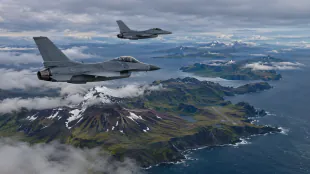 US Air Force deploys F-16 fighters to remote Aleutian base for readiness drill

 Bezos grant helps Seattle nonprofit move thousands of families toward housing

 Shrini Srivastava joins crew of Varanasi-Delhi Vande Bharat Sleeper service

 Nearly Half of Australian Workers Overqualified, Survey Finds

 RBI eases export-declaration compliance for individual service exporters

 India proposes more import entry points for drugs and medical devices

 Derek Tierney Outlines Ten-Year Strategy for National Digital Health System

 NBC’s Steve Kornacki Reveals Tech Habits Ahead of Midterm Elections

 India and Israel oppose UN draft on regional conventional arms control

 BLS Polymers shares open 65.3% above IPO price

 Capital-markets shares rally as Motilal Oswal and Angel One lead gains

 Latino Voters Defy ICE Fears, Turn Out in Record Numbers for Midterms

 ITC shares rise as analysts anticipate gradual cigarette-business recovery

 Reliance rally puts historical one-year return pattern in focus

 Kuwait edges Oman 1-0 in veterans Gulf Cup in Doha

 Saudi Aramco quarterly profit climbs 34.6% amid elevated oil prices

 Washington reports movement in Iran negotiations aimed at preventing escalation

 Korea’s Labor Share of GDP Hits Record Low Amid Semiconductor Boom

 littlefish and Halo Dot Partner to Replace Payment Terminals with SoftPOS

 Kuwait inspectors destroy 115 kilograms of unverified meat in Farwaniya

 Egypt Accelerates Construction of 341km Sinai Railway Linking Arish and Taba

 John Schneider Admits Owes Millions in 'Dukes of Hazzard' Divorce Battle
US and British strikes on rebel-held Yemen on Friday marked a sharp escalation after weeks of attacks on Red Sea shipping by the Iran-backed Huthi insurgents.
AFP examines the impact and possible repercussions of the aerial assault on the Huthis, who say they are targeting Israel-linked vessels in retaliation for the war in Gaza.
- What happened in the strikes? -
More than 100 precision-guided munitions struck 60 targets at 16 locations in an attack involving fighter jets and Tomahawk missiles, US Central Command said in a statement.
Britain's air force said its Typhoon fighter jets dropped guided bombs on a drone launch site in Bani and an airfield in Abs, both located in northwest Yemen.
The Huthis said there were 73 strikes, targeting sites in the capital Sanaa and Hodeida, Taez, Hajjah, and Saada provinces and that five people were killed and six injured.
- How effective were they? -
Even with precision bombing, it is no easy task to cripple a battle-hardened operation that has survived years of air strikes by a Saudi-led military coalition.
Analysts were split on how effective the US-UK bombings would prove.
"The Huthis are immune to air strikes," Maged Al-Madhaji, co-founder of the Sanaa Center for Strategic Studies think-tank, told AFP.
"For years they have learnt to avoid strikes and hide their arsenal by taking advantage of the difficult geography of the territory.
"These strikes could therefore destroy part of their military capabilities, but they will not eliminate them, and the threat will remain high."
However, the Middle East Institute's Fatima Abo Alasrar said the strikes "will significantly disrupt their military capabilities particularly in threatening international shipping lanes".
Fabian Hinz, a research fellow at the International Institute for Strategic Studies, said the strikes' effectiveness would depend on US intelligence about the Huthi sites.
"Many of the systems used by the Huthis are quite small and quite mobile, so it's easy to disperse them around the country," he said.
"The Huthis adapted during the war in Yemen. They are quite good in hiding their assets. So to know where the storage areas are... the launching sites or who are high-ranking people, intelligence is very important."
- What happens next? -
One fear is that the Huthis will target US interests including the country's military bases scattered around the Gulf, widening the Middle East conflict further still.
However, Cinzia Bianco, a visiting fellow at the European Council on Foreign Relations, said that would be a step too far for the Huthis.
"It would be just too much of a provocation and they know very well, and Iran knows very well, that would (trigger) inevitably the beginning of a much broader US-led international mission in Yemen," she told AFP.
Hinz said: "The risk of regional escalation seems low as big players like Iran are keen on avoiding a regional war."
Instead, said Mohammed Albasha of the Navanti Group consultancy, the Huthis could choose to take more drastic action in the Red Sea.
With the US Navy proving effective at repelling Huthi efforts so far, the rebels could be "contemplating a more coordinated swarm offensive", he said, in either the Red or Arabian seas, with multiple drones, missiles, mines and improvised explosive devices.
Regardless of any retaliation, the Huthis have vowed to continue targeting what they consider Israeli-linked shipping in the Red Sea, one of the world's busiest trade routes.
"It seems very likely that the Huthis will continue attacking ships with whatever capabilities they have left. I would expect them to strike back," said Hinz.
N.Mitchell--AT